




ABCD is a parallelogram. Points P and Q are taken on the sides AB and AD respectively and the perpendicular PRQA is formed. If $\angle C={{40}^{\circ }}$ find $\angle R\text{ and }\angle P$
Answer
 Verified
583.8k+ views
Hint: For solving and better understanding of the question, we will first draw a diagram. As per question, a parallelogram PRQA is formed using two points P and Q on sides AB and AD respectively. We will prove that corresponding sides of both parallelograms are parallel which will imply that corresponding angles are also equal which will give us one of the required angles. After that, we will use the property of parallelogram that, sum of adjacent angles is equal to ${{180}^{\circ }}$ to find the other required angle.
Complete step-by-step answer:
Let us first draw diagram for better understanding of question:
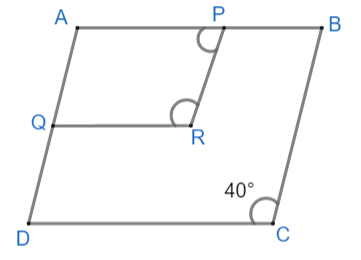
Here, we are given parallelogram ABCD. P and Q are two points on AB and AD respectively. PRQA forms a parallelogram. We are given that $\angle BCD={{40}^{\circ }}$ and we have to find $\angle PRQ\left( \angle R \right)\text{ and }\angle \text{APR}\left( \angle P \right)$
As we know, opposite sides of parallelograms are parallel. Therefore, for parallelogram ABCD,
\[AD\parallel BC\cdots \cdots \cdots \cdots \left( 1 \right)\]
And for parallelogram AQRP,
\[AQ\parallel PR\]
Since AD is just an extended line of AQ therefore both lines are parallel to the same line.
Hence, we can say that $AD\parallel PR$
Now from (1) we can say that $BC\parallel PR$
Also for parallelogram ABCD,
\[AD\parallel DC\cdots \cdots \cdots \cdots \left( 2 \right)\]
And for parallelogram APRQ,
\[AP\parallel QR\]
Since AB is just an extended line of AP, therefore both lines are parallel to the same line.
Hence, we can say that $AB\parallel QR$
Now from (1) we can say that $DC\parallel QR$
As we concluded that $BC\parallel PR$ and $DC\parallel QR$ therefore, they will form same angle that is $\angle BCD=\angle PRQ$
We are given value of $\angle BCD$ which is ${{40}^{\circ }}$ therefore, $\angle R={{40}^{\circ }}$
As PRQA is a parallelogram, therefore, sum of any two adjacent angles will be equal to ${{180}^{\circ }}$
Let us take $\angle R\text{ and }\angle P$ both these angles are adjacent. Therefore,
\[\angle R+\angle P={{180}^{\circ }}\]
As we know $\angle R={{40}^{\circ }}$ therefore,
\[\begin{align}
& {{40}^{\circ }}+\angle P={{180}^{\circ }} \\
& \Rightarrow \angle P={{140}^{\circ }} \\
\end{align}\]
Hence, we have found that $\angle R={{40}^{\circ }}\text{ and }\angle P={{140}^{\circ }}$
Note: Students should note that, both pairs of corresponding sides should be parallel for the angle to be equal. Also, if students cannot remember property of parallelogram that sum of adjacent angles is equal to ${{180}^{\circ }}$ then they can consider it as parallel lines with transversal and hence, sum of interior angles is equal to ${{180}^{\circ }}$
Complete step-by-step answer:
Let us first draw diagram for better understanding of question:
Here, we are given parallelogram ABCD. P and Q are two points on AB and AD respectively. PRQA forms a parallelogram. We are given that $\angle BCD={{40}^{\circ }}$ and we have to find $\angle PRQ\left( \angle R \right)\text{ and }\angle \text{APR}\left( \angle P \right)$
As we know, opposite sides of parallelograms are parallel. Therefore, for parallelogram ABCD,
\[AD\parallel BC\cdots \cdots \cdots \cdots \left( 1 \right)\]
And for parallelogram AQRP,
\[AQ\parallel PR\]
Since AD is just an extended line of AQ therefore both lines are parallel to the same line.
Hence, we can say that $AD\parallel PR$
Now from (1) we can say that $BC\parallel PR$
Also for parallelogram ABCD,
\[AD\parallel DC\cdots \cdots \cdots \cdots \left( 2 \right)\]
And for parallelogram APRQ,
\[AP\parallel QR\]
Since AB is just an extended line of AP, therefore both lines are parallel to the same line.
Hence, we can say that $AB\parallel QR$
Now from (1) we can say that $DC\parallel QR$
As we concluded that $BC\parallel PR$ and $DC\parallel QR$ therefore, they will form same angle that is $\angle BCD=\angle PRQ$
We are given value of $\angle BCD$ which is ${{40}^{\circ }}$ therefore, $\angle R={{40}^{\circ }}$
As PRQA is a parallelogram, therefore, sum of any two adjacent angles will be equal to ${{180}^{\circ }}$
Let us take $\angle R\text{ and }\angle P$ both these angles are adjacent. Therefore,
\[\angle R+\angle P={{180}^{\circ }}\]
As we know $\angle R={{40}^{\circ }}$ therefore,
\[\begin{align}
& {{40}^{\circ }}+\angle P={{180}^{\circ }} \\
& \Rightarrow \angle P={{140}^{\circ }} \\
\end{align}\]
Hence, we have found that $\angle R={{40}^{\circ }}\text{ and }\angle P={{140}^{\circ }}$
Note: Students should note that, both pairs of corresponding sides should be parallel for the angle to be equal. Also, if students cannot remember property of parallelogram that sum of adjacent angles is equal to ${{180}^{\circ }}$ then they can consider it as parallel lines with transversal and hence, sum of interior angles is equal to ${{180}^{\circ }}$
Recently Updated Pages
Master Class 10 Computer Science: Engaging Questions & Answers for Success

Master Class 10 General Knowledge: Engaging Questions & Answers for Success
Master Class 10 English: Engaging Questions & Answers for Success
Master Class 10 Social Science: Engaging Questions & Answers for Success
Master Class 10 Maths: Engaging Questions & Answers for Success
Master Class 10 Science: Engaging Questions & Answers for Success
Trending doubts
What is the median of the first 10 natural numbers class 10 maths CBSE
Which women's tennis player has 24 Grand Slam singles titles?
Who is the Brand Ambassador of Incredible India?
Why is there a time difference of about 5 hours between class 10 social science CBSE
Write a letter to the principal requesting him to grant class 10 english CBSE
State and prove converse of BPT Basic Proportionality class 10 maths CBSE