




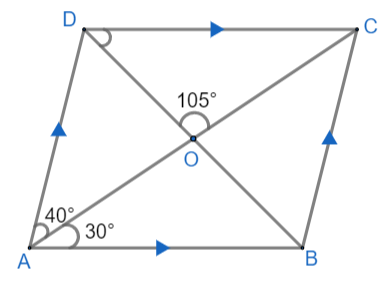
ABCD is a parallelogram in which \[\angle DAC={{40}^{\circ }},\angle BAC={{30}^{\circ }},\angle DOC={{105}^{\circ }}\] then $\angle CDO$ equals
\[\begin{align}
& A{{.75}^{\circ }} \\
& B{{.70}^{\circ }} \\
& C{{.40}^{\circ }} \\
& D{{.45}^{\circ }} \\
\end{align}\]
Answer
 Verified
583.8k+ views
Hint: Here, we are given three angles and we have to find the value of $\angle CDO$. For this, we will use various properties of lines and angles and also the sum of angles of a triangle property. Properties which we will use are
(i) When two lines intersect each other, vertically opposite angles are equal.
(ii) When two lines are parallel and a transversal intersects them, then alternate interior angles formed are equal.
(iii) Sum of angles of a triangle is equal to ${{180}^{\circ }}$
Complete step by step answer:
In the given triangle, we are given \[\angle DAC={{40}^{\circ }},\angle BAC={{30}^{\circ }},\angle DOC={{105}^{\circ }}\] and we have to find $\angle CDO$.
As we know, AC and BD are diagonals of parallelograms. Hence, intersect each other.
Hence, $\angle AOB\text{ and }\angle COD$ are vertically opposite angles and thus they are equal.
We find that $\angle AOB=\angle COD={{105}^{\circ }}$. Therefore, $\angle AOB={{105}^{\circ }}$
As we can see OAB forms a triangle, we can use sum of angles property which states that sum of angles of a triangle is ${{180}^{\circ }}$.
As calculated earlier $\angle AOB={{105}^{\circ }}$
We are given $\angle OAB={{30}^{\circ }}$. Putting them in above equation, we get:
\[\begin{align}
& {{105}^{\circ }}+{{30}^{\circ }}+\angle OBA={{180}^{\circ }} \\
& \Rightarrow \angle OBA={{180}^{\circ }}-{{135}^{\circ }} \\
& \Rightarrow \angle OBA={{45}^{\circ }}=\angle ABD \\
\end{align}\]
Now, as we know opposite sides of a parallelogram are always parallel, therefore, AB and CD are parallel and BD being diagonal acts as transversal. Therefore, alternate interior angles are equal. Hence, \[\angle ABD=\angle BDC={{45}^{\circ }}\]
Therefore, option D is the correct answer.
Note: Students should remember all the properties of lines and angles. These types of questions can be solved by many methods. We can also solve it first by finding angle OCD which is equal to angle CAB being alternate interior angle and then using the sum of angles of a triangle property in triangle OCD to find the required angle CDO.
(i) When two lines intersect each other, vertically opposite angles are equal.
(ii) When two lines are parallel and a transversal intersects them, then alternate interior angles formed are equal.
(iii) Sum of angles of a triangle is equal to ${{180}^{\circ }}$
Complete step by step answer:
In the given triangle, we are given \[\angle DAC={{40}^{\circ }},\angle BAC={{30}^{\circ }},\angle DOC={{105}^{\circ }}\] and we have to find $\angle CDO$.
As we know, AC and BD are diagonals of parallelograms. Hence, intersect each other.
Hence, $\angle AOB\text{ and }\angle COD$ are vertically opposite angles and thus they are equal.
We find that $\angle AOB=\angle COD={{105}^{\circ }}$. Therefore, $\angle AOB={{105}^{\circ }}$
As we can see OAB forms a triangle, we can use sum of angles property which states that sum of angles of a triangle is ${{180}^{\circ }}$.
As calculated earlier $\angle AOB={{105}^{\circ }}$
We are given $\angle OAB={{30}^{\circ }}$. Putting them in above equation, we get:
\[\begin{align}
& {{105}^{\circ }}+{{30}^{\circ }}+\angle OBA={{180}^{\circ }} \\
& \Rightarrow \angle OBA={{180}^{\circ }}-{{135}^{\circ }} \\
& \Rightarrow \angle OBA={{45}^{\circ }}=\angle ABD \\
\end{align}\]
Now, as we know opposite sides of a parallelogram are always parallel, therefore, AB and CD are parallel and BD being diagonal acts as transversal. Therefore, alternate interior angles are equal. Hence, \[\angle ABD=\angle BDC={{45}^{\circ }}\]
Therefore, option D is the correct answer.
Note: Students should remember all the properties of lines and angles. These types of questions can be solved by many methods. We can also solve it first by finding angle OCD which is equal to angle CAB being alternate interior angle and then using the sum of angles of a triangle property in triangle OCD to find the required angle CDO.
Recently Updated Pages
Master Class 10 Computer Science: Engaging Questions & Answers for Success

Master Class 10 General Knowledge: Engaging Questions & Answers for Success
Master Class 10 English: Engaging Questions & Answers for Success
Master Class 10 Social Science: Engaging Questions & Answers for Success
Master Class 10 Maths: Engaging Questions & Answers for Success
Master Class 10 Science: Engaging Questions & Answers for Success
Trending doubts
What is the median of the first 10 natural numbers class 10 maths CBSE
Which women's tennis player has 24 Grand Slam singles titles?
Who is the Brand Ambassador of Incredible India?
Why is there a time difference of about 5 hours between class 10 social science CBSE
Write a letter to the principal requesting him to grant class 10 english CBSE
State and prove converse of BPT Basic Proportionality class 10 maths CBSE