




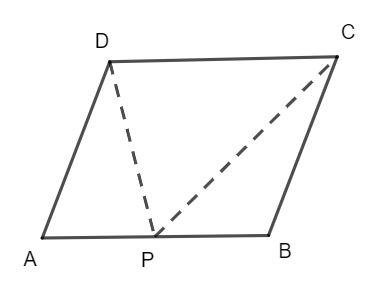
ABCD is a parallelogram as shown in the figure. If AB = 2AD and P is midpoint of AB, then what is the value of \[\angle CPD\] ?
(a). 90°
(b). 60°
(c). 45°
(d). 135°
Answer
 Verified
655.8k+ views
Hint: Use the property of the parallelogram that the adjacent angles are supplementary. Then find the angle CPD in terms of the adjacent angles and find its value.
Complete step-by-step answer:
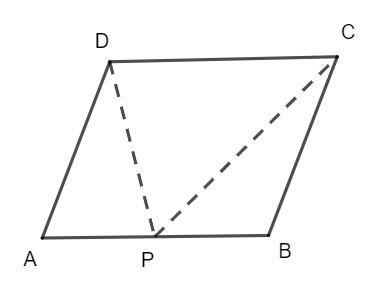
ABCD is a parallelogram, hence, the adjacent angles of the parallelogram are supplementary, that is, the sum of angles is 180°.
\[\angle A + \angle B = 180^\circ ............(1)\]
It is given that AB = 2 AD, then we have:
\[AD = \dfrac{{AB}}{2}..............(2)\]
It is given that P is the midpoint of AB. Then, we have the following:
\[AP = \dfrac{{AB}}{2}..........(3)\]
From equation (2) and equation (3), we have:
\[AD = AP\]
Hence, the triangle APD is an isosceles triangle.
The sum of the angles of the triangle APD is 180°.
\[\angle APD + \angle ADP + \angle A = 180^\circ \]
\[2\angle APD + \angle A = 180^\circ \]
Solve for the angle APD to get as follows:
\[\angle APD = 90^\circ - \dfrac{{\angle A}}{2}............(4)\]
The opposite sides of the parallelogram are equal. Hence, AD = BC, then we have:
\[BP = BC\]
Then, the triangle BPC is also an isosceles triangle.
The sum of the angles of the triangle BPC is 180°.
\[\angle BPC + \angle BCP + \angle B = 180^\circ \]
\[2\angle BPC + \angle B = 180^\circ \]
Solve for the angle BPC to get as follows:
\[\angle BPC = 90^\circ - \dfrac{{\angle B}}{2}............(5)\]
The angle on a straight line add up to 180°, then we have on line APB as follows:
\[\angle BPC + \angle CPD + \angle APD = 180^\circ \]
Using equations (4) and (5), we get:
\[90^\circ - \dfrac{{\angle B}}{2} + \angle CPD + 90^\circ - \dfrac{{\angle A}}{2} = 180^\circ \]
Simplifying, we have:
\[180^\circ - \dfrac{{\angle B + \angle A}}{2} + \angle CPD = 180^\circ \]
Canceling 180° on both sides, we have:
\[\angle CPD = \dfrac{{\angle B + \angle A}}{2}\]
From equation (1), we have:
\[\angle CPD = \dfrac{{180^\circ }}{2}\]
\[\angle CPD = 90^\circ \]
Hence, the correct answer is option (a).
Note: You can also find the angles CDP and DCP in terms of the angle D and angle C respectively and then find the angle CPD using the properties of the triangle.
Complete step-by-step answer:
ABCD is a parallelogram, hence, the adjacent angles of the parallelogram are supplementary, that is, the sum of angles is 180°.
\[\angle A + \angle B = 180^\circ ............(1)\]
It is given that AB = 2 AD, then we have:
\[AD = \dfrac{{AB}}{2}..............(2)\]
It is given that P is the midpoint of AB. Then, we have the following:
\[AP = \dfrac{{AB}}{2}..........(3)\]
From equation (2) and equation (3), we have:
\[AD = AP\]
Hence, the triangle APD is an isosceles triangle.
The sum of the angles of the triangle APD is 180°.
\[\angle APD + \angle ADP + \angle A = 180^\circ \]
\[2\angle APD + \angle A = 180^\circ \]
Solve for the angle APD to get as follows:
\[\angle APD = 90^\circ - \dfrac{{\angle A}}{2}............(4)\]
The opposite sides of the parallelogram are equal. Hence, AD = BC, then we have:
\[BP = BC\]
Then, the triangle BPC is also an isosceles triangle.
The sum of the angles of the triangle BPC is 180°.
\[\angle BPC + \angle BCP + \angle B = 180^\circ \]
\[2\angle BPC + \angle B = 180^\circ \]
Solve for the angle BPC to get as follows:
\[\angle BPC = 90^\circ - \dfrac{{\angle B}}{2}............(5)\]
The angle on a straight line add up to 180°, then we have on line APB as follows:
\[\angle BPC + \angle CPD + \angle APD = 180^\circ \]
Using equations (4) and (5), we get:
\[90^\circ - \dfrac{{\angle B}}{2} + \angle CPD + 90^\circ - \dfrac{{\angle A}}{2} = 180^\circ \]
Simplifying, we have:
\[180^\circ - \dfrac{{\angle B + \angle A}}{2} + \angle CPD = 180^\circ \]
Canceling 180° on both sides, we have:
\[\angle CPD = \dfrac{{\angle B + \angle A}}{2}\]
From equation (1), we have:
\[\angle CPD = \dfrac{{180^\circ }}{2}\]
\[\angle CPD = 90^\circ \]
Hence, the correct answer is option (a).
Note: You can also find the angles CDP and DCP in terms of the angle D and angle C respectively and then find the angle CPD using the properties of the triangle.
Recently Updated Pages
Master Class 11 English: Engaging Questions & Answers for Success

Master Class 11 Social Science: Engaging Questions & Answers for Success
Master Class 11 Maths: Engaging Questions & Answers for Success
Master Class 11 Biology: Engaging Questions & Answers for Success
Master Class 11 Physics: Engaging Questions & Answers for Success
Master Class 11 Chemistry: Engaging Questions & Answers for Success
Trending doubts
Explain the Treaty of Vienna of 1815 class 10 social science CBSE
First Cotton Mill of India
In which year voting age was reduced from 21 to 18?
What planets have no moons Which one has only one moon class 10 physics CBSE
What is the full form of POSCO class 10 social science CBSE
10 examples of evaporation in daily life with explanations