




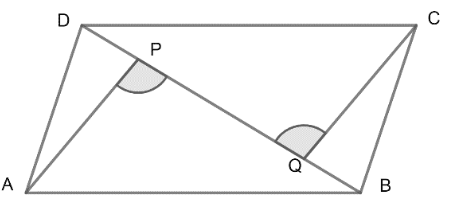
ABCD is a parallelogram AP and CQ are perpendicular drawn from vertices A and C on diagonal BD (see figure) show that AP = CQ.
Answer
 Verified
679.5k+ views
Hint: We will first start by using the fact that if two triangles are congruent then their corresponding parts are equal for proving two triangles congruent. We will use AAS congruency wherein we have to prove two angles and one side are equal.
Complete step-by-step solution -
Now, we have been given a parallelogram and AP and CQ are perpendicular drawn from vertices A and C and diagonal BD and we have to show that AP = CQ.
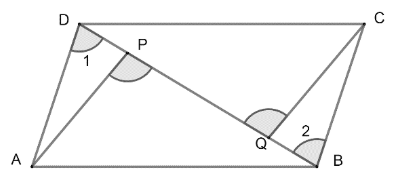
Now, we know that opposite sides of a parallelogram are parallel and equal. Therefore, we have,
$AD=BC ......................\left( 1 \right)$
Also, we have $AD\parallel BC$ and we know that alternate interior angles formed by a transversal cutting a pair of parallel lines are equal. Therefore we have,
$\angle 1=\angle 2 ...............\left( 2 \right)$
Now, we know that the angle formed by a straight line is $180{}^\circ $. Therefore, we have,
$\begin{align}
& \angle DPA+90{}^\circ =180{}^\circ \\
& \Rightarrow \angle DPA=90{}^\circ \\
& \angle CQB+90{}^\circ =180{}^\circ \\
& \Rightarrow \angle CQB=90{}^\circ \\
& \Rightarrow \angle DPA=\angle CQB .................\left( 3 \right) \\
\end{align}$
Now, we have in $\Delta DPA$ and $\Delta BQC$,
$\begin{align}
& \angle DPA=\angle BQC \\
& AD=CB \\
& \angle 1=\angle 2 \\
\end{align}$
Hence, $\Delta DPA\cong \Delta BQC$ by AAS congruency.
Now, we know that by the corresponding part of the congruent triangle we have,
AP = CQ
Hence proved.
Note: It is important to note that we have used a fact that the sum of the linear pair of angles is $180{}^\circ $. Therefore, we have $\angle APD=\angle CQB=90{}^\circ $. Also, we have used a fact that the opposite sides of a parallelogram are equal and parallel. It is also worthwhile to remember that the alternate interior angle formed by a transversal on a pair of parallel lines are equal.
Complete step-by-step solution -
Now, we have been given a parallelogram and AP and CQ are perpendicular drawn from vertices A and C and diagonal BD and we have to show that AP = CQ.
Now, we know that opposite sides of a parallelogram are parallel and equal. Therefore, we have,
$AD=BC ......................\left( 1 \right)$
Also, we have $AD\parallel BC$ and we know that alternate interior angles formed by a transversal cutting a pair of parallel lines are equal. Therefore we have,
$\angle 1=\angle 2 ...............\left( 2 \right)$
Now, we know that the angle formed by a straight line is $180{}^\circ $. Therefore, we have,
$\begin{align}
& \angle DPA+90{}^\circ =180{}^\circ \\
& \Rightarrow \angle DPA=90{}^\circ \\
& \angle CQB+90{}^\circ =180{}^\circ \\
& \Rightarrow \angle CQB=90{}^\circ \\
& \Rightarrow \angle DPA=\angle CQB .................\left( 3 \right) \\
\end{align}$
Now, we have in $\Delta DPA$ and $\Delta BQC$,
$\begin{align}
& \angle DPA=\angle BQC \\
& AD=CB \\
& \angle 1=\angle 2 \\
\end{align}$
Hence, $\Delta DPA\cong \Delta BQC$ by AAS congruency.
Now, we know that by the corresponding part of the congruent triangle we have,
AP = CQ
Hence proved.
Note: It is important to note that we have used a fact that the sum of the linear pair of angles is $180{}^\circ $. Therefore, we have $\angle APD=\angle CQB=90{}^\circ $. Also, we have used a fact that the opposite sides of a parallelogram are equal and parallel. It is also worthwhile to remember that the alternate interior angle formed by a transversal on a pair of parallel lines are equal.
Recently Updated Pages
Master Class 10 Computer Science: Engaging Questions & Answers for Success

Differentiate between voluntary action and reflex class 10 biology CBSE
The uses of bleaching powder are A It is used bleaching class 10 chemistry CBSE
Fill in the blanks with abstract nouns of the words class 10 english CBSE
How many threedigit numbers are there class 10 maths CBSE
What is a reflex arc class 10 biology CBSE
Trending doubts
Explain the Treaty of Vienna of 1815 class 10 social science CBSE
10 examples of evaporation in daily life with explanations
What is the full form of POSCO class 10 social science CBSE
Make a sketch of the human nerve cell What function class 10 biology CBSE
GST is a direct or indirect tax?
The sum of all even numbers between 21 and 51 is a class 10 maths CBSE