




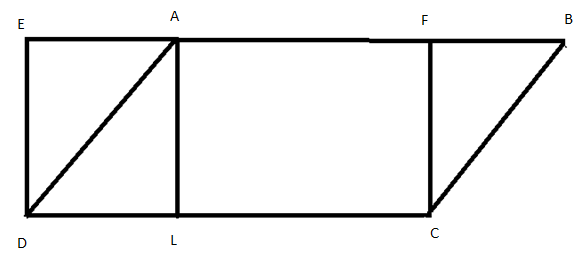
\[ABCD\] is a parallelogram and \[EFCD\] is a rectangle. Also, \[AL \bot CD\]. Prove that,
A. \[ar(ABCD) = ar(EFCD)\]
B. \[ar(ABCD) = DC \times AL\]
Answer
 Verified
653.1k+ views
Hint: We know that parallelograms with the same base and between the same parallels are equal in area.
The area of a parallelogram is equal to the product of the base and the altitude. By using the above two hints we solve the question to find the solution.
Complete step-by-step answer:
It is given that, \[ABCD\] is a parallelogram and \[EFCD\] is a rectangle and \[AL \bot CD\]. It means \[AL\] is perpendicular to \[CD\].
Since, \[ABCD\] is a parallelogram, opposite sides are parallel and equal.
Hence \[AB\parallel CD\].
Again, \[EFCD\] is a rectangle, so opposite sides are parallel and equal.
Hence\[EF\parallel CD\].
Since, \[AB\] is a parallel to \[CD\] and \[EF\] is a parallel to \[CD\].
\[AB\parallel EF\]
We can say that \[EB\] is a parallel to \[CD\].
We know that the theorem of equal area states that “parallelograms with the same base and between the same parallels are equal in area”.
Here, \[ABCD\] and \[EFCD\] are two parallelograms with the same parallels \[EB\] and \[CD\].
So, by the theorem of equal area we get,
\[ar(ABCD) = ar(EFCD)\]
Again, from given \[ABCD\] is a parallelogram with base \[CD\] and altitude \[AL.\]
We know that the area of a parallelogram is equal to the product of the base and the altitude.
Hence, by applying the above statement we have,
\[ar(ABCD) = DC \times AL\]
Hence, we have shown that,
\[ar(ABCD) = ar(EFCD)\]
\[ar(ABCD) = DC \times AL\]
Note: Since, a rectangle is also a parallelogram so, we can apply all the properties of a parallelogram on the rectangles. So, the equal area theorem of parallelogram holds for the rectangles also.
The area of a parallelogram is equal to the product of the base and the altitude. By using the above two hints we solve the question to find the solution.
Complete step-by-step answer:
It is given that, \[ABCD\] is a parallelogram and \[EFCD\] is a rectangle and \[AL \bot CD\]. It means \[AL\] is perpendicular to \[CD\].
Since, \[ABCD\] is a parallelogram, opposite sides are parallel and equal.
Hence \[AB\parallel CD\].
Again, \[EFCD\] is a rectangle, so opposite sides are parallel and equal.
Hence\[EF\parallel CD\].
Since, \[AB\] is a parallel to \[CD\] and \[EF\] is a parallel to \[CD\].
\[AB\parallel EF\]
We can say that \[EB\] is a parallel to \[CD\].
We know that the theorem of equal area states that “parallelograms with the same base and between the same parallels are equal in area”.
Here, \[ABCD\] and \[EFCD\] are two parallelograms with the same parallels \[EB\] and \[CD\].
So, by the theorem of equal area we get,
\[ar(ABCD) = ar(EFCD)\]
Again, from given \[ABCD\] is a parallelogram with base \[CD\] and altitude \[AL.\]
We know that the area of a parallelogram is equal to the product of the base and the altitude.
Hence, by applying the above statement we have,
\[ar(ABCD) = DC \times AL\]
Hence, we have shown that,
\[ar(ABCD) = ar(EFCD)\]
\[ar(ABCD) = DC \times AL\]
Note: Since, a rectangle is also a parallelogram so, we can apply all the properties of a parallelogram on the rectangles. So, the equal area theorem of parallelogram holds for the rectangles also.
Recently Updated Pages
Class 10 Question and Answer - Your Ultimate Solutions Guide

Master Class 10 Computer Science: Engaging Questions & Answers for Success
Master Class 10 General Knowledge: Engaging Questions & Answers for Success
Master Class 12 Economics: Engaging Questions & Answers for Success
Master Class 12 Social Science: Engaging Questions & Answers for Success
Master Class 12 English: Engaging Questions & Answers for Success
Trending doubts
Explain the Treaty of Vienna of 1815 class 10 social science CBSE
The slogan Jai Hind was given by A Lal Bahadur Shastri class 10 social science CBSE
10 examples of evaporation in daily life with explanations
What is the full form of POSCO class 10 social science CBSE
Five things I will do to build a great India class 10 english CBSE
Identify the feminine form of noun nephew a shenephew class 10 english CBSE