




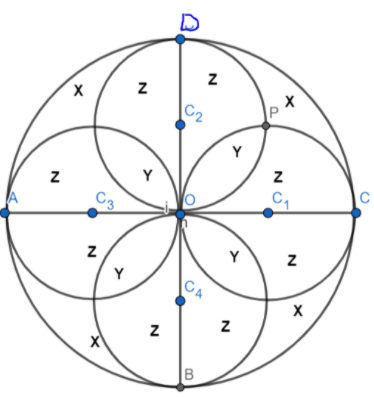
ABCD is a circle and circles are drawn with AO, CO, DO, and OB as diameters. Areas “X” and “Y” are labeled, what is the value of $\dfrac{X}{Y}$?
A). 1
B). $\dfrac{1}{2}$
C). $\dfrac{1}{4}$
D). $\dfrac{\pi }{4}$
Answer
 Verified
650.1k+ views
Hint: As you see from the figure all areas had been marked. The first thing that you have to consider the areal symmetry of the circle. But the only problem is the portion in the $\overset\frown{OCD}$ part as if you subtract the area of a small circle [whose diameter is OC and OD], then you basically subtract the \[\overset\frown{OP}\] twice.
Complete step-by-step solution:
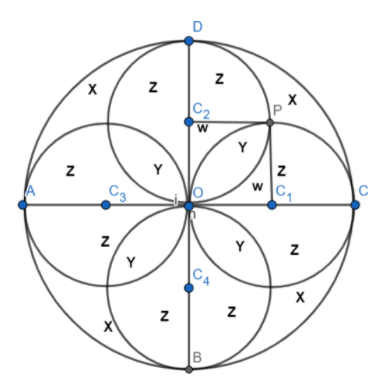
Here we introduce a new areal portion “w”
\[\overleftrightarrow{O{{C}_{1}}}=\overleftrightarrow{O{{C}_{2}}}=a\] and \[\square O{{C}_{1}}P{{C}_{2}}\] is square.
First , see the point P , and join \[\overleftrightarrow{{{C}_{_{2}}}P}\] and \[\overleftrightarrow{{{C}_{1}}P}\]
After joining “\[\square O{{C}_{1}}P{{C}_{2}}\]” become a square.
Now suppose that the radius of the big circle is “2a” unit.
so the radius of the small circle is “a” unit. {as mentioned in the question}.
As you may know, a circle whose radius is “r “ unit has an area
\[A=\pi {{r}^{2}}\] sq. unit .
In this way , we can calculate the area of big and small circle ,
Area of big circle : \[\pi {{(2a)}^{2}}=4\pi {{a}^{2}}\]
Similarly area of small circle is : \[\pi {{a}^{2}}\]
As see from the figure we have to consider only \[\dfrac{1}{4}\]th area of big circle i.e.
\[area\text{ }(\overset\frown{OCD})\] : \[\dfrac{1}{4}(4\pi {{a}^{2}})=\pi {{a}^{2}}\]
Now we calculate the area of the square \[\square O{{C}_{1}}{{C}_{2}}P\], as \[\overleftrightarrow{O{{C}_{1}}}=\overleftrightarrow{O{{C}_{2}}}=a\],
so the length of each side of the square is “a” unit . So the area will be \[{{a}^{2}}\] sq.unit .
Now join \[\overleftrightarrow{{{C}_{1}}P}\], clearly after joining the circle is partitioned into two equal half-circle of equal area.
The area of each half circle will be \[\dfrac{1}{2}.\dfrac{\pi {{a}^{2}}}{2}=\dfrac{\pi {{a}^{2}}}{4}\] sq.unit .
Here we “w” is the area of the portion of half-circle and “y” is the area of closed-loop of OP.
Next , we will try to formulate the linear equation ,
\[\begin{align}
& 2w+y={{a}^{2}}\text{....................................(1)} \\
& w+y=\dfrac{\pi {{a}^{2}}}{4}\text{.............................(2)} \\
\end{align}\]
after substituting the value from (2) and put it on (1) ,we get \[y={{a}^{2}}\left( \dfrac{\pi }{2}-1 \right)\]
To get the value x we need to solve following equation ,
\[x+{{a}^{2}}+\dfrac{\pi {{a}^{2}}}{2}=\pi {{(2a)}^{2}}\dfrac{1}{4}\]
\[\Rightarrow x={{a}^{2}}\left( \dfrac{\pi }{2}-1 \right)\]
This implies \[\dfrac{X}{Y}=1\]
Hence option (a) is correct.
Note: Please do not try to use the method of definite integral, by assuming the equation of the circle. In order to apply, we have to assume the coordinate and equation of the circle, solving, and manipulating this type of equation is a very tedious process.
Complete step-by-step solution:
Here we introduce a new areal portion “w”
\[\overleftrightarrow{O{{C}_{1}}}=\overleftrightarrow{O{{C}_{2}}}=a\] and \[\square O{{C}_{1}}P{{C}_{2}}\] is square.
First , see the point P , and join \[\overleftrightarrow{{{C}_{_{2}}}P}\] and \[\overleftrightarrow{{{C}_{1}}P}\]
After joining “\[\square O{{C}_{1}}P{{C}_{2}}\]” become a square.
Now suppose that the radius of the big circle is “2a” unit.
so the radius of the small circle is “a” unit. {as mentioned in the question}.
As you may know, a circle whose radius is “r “ unit has an area
\[A=\pi {{r}^{2}}\] sq. unit .
In this way , we can calculate the area of big and small circle ,
Area of big circle : \[\pi {{(2a)}^{2}}=4\pi {{a}^{2}}\]
Similarly area of small circle is : \[\pi {{a}^{2}}\]
As see from the figure we have to consider only \[\dfrac{1}{4}\]th area of big circle i.e.
\[area\text{ }(\overset\frown{OCD})\] : \[\dfrac{1}{4}(4\pi {{a}^{2}})=\pi {{a}^{2}}\]
Now we calculate the area of the square \[\square O{{C}_{1}}{{C}_{2}}P\], as \[\overleftrightarrow{O{{C}_{1}}}=\overleftrightarrow{O{{C}_{2}}}=a\],
so the length of each side of the square is “a” unit . So the area will be \[{{a}^{2}}\] sq.unit .
Now join \[\overleftrightarrow{{{C}_{1}}P}\], clearly after joining the circle is partitioned into two equal half-circle of equal area.
The area of each half circle will be \[\dfrac{1}{2}.\dfrac{\pi {{a}^{2}}}{2}=\dfrac{\pi {{a}^{2}}}{4}\] sq.unit .
Here we “w” is the area of the portion of half-circle and “y” is the area of closed-loop of OP.
Next , we will try to formulate the linear equation ,
\[\begin{align}
& 2w+y={{a}^{2}}\text{....................................(1)} \\
& w+y=\dfrac{\pi {{a}^{2}}}{4}\text{.............................(2)} \\
\end{align}\]
after substituting the value from (2) and put it on (1) ,we get \[y={{a}^{2}}\left( \dfrac{\pi }{2}-1 \right)\]
To get the value x we need to solve following equation ,
\[x+{{a}^{2}}+\dfrac{\pi {{a}^{2}}}{2}=\pi {{(2a)}^{2}}\dfrac{1}{4}\]
\[\Rightarrow x={{a}^{2}}\left( \dfrac{\pi }{2}-1 \right)\]
This implies \[\dfrac{X}{Y}=1\]
Hence option (a) is correct.
Note: Please do not try to use the method of definite integral, by assuming the equation of the circle. In order to apply, we have to assume the coordinate and equation of the circle, solving, and manipulating this type of equation is a very tedious process.
Recently Updated Pages
Differentiate between voluntary action and reflex class 10 biology CBSE

The uses of bleaching powder are A It is used bleaching class 10 chemistry CBSE
Fill in the blanks with abstract nouns of the words class 10 english CBSE
How many threedigit numbers are there class 10 maths CBSE
What is a reflex arc class 10 biology CBSE
Construct a square whose diagonal is 6cm Measure the class 10 maths CBSE
Trending doubts
Explain the Treaty of Vienna of 1815 class 10 social science CBSE
The slogan Jai Hind was given by A Lal Bahadur Shastri class 10 social science CBSE
10 examples of evaporation in daily life with explanations
What is the full form of POSCO class 10 social science CBSE
Identify the feminine form of noun nephew a shenephew class 10 english CBSE
CSIR full form?