




ABC is any triangle inscribed in the circle $ {{x}^{2}}+{{y}^{2}}={{r}^{2}} $ such that A is a fixed point. If the external and internal bisectors of $ \angle A $ intersect the circle at D and E, respectively, then which of the following statements is true about $ \Delta ADE $?
A. Its centroid is a fixed point.
B. Its circumcentre is a fixed point.
C. Its orthocentre is a fixed point.
D. none of these
Answer
 Verified
590.1k+ views
Hint:
We know that angle between the external and internal bisectors of any angle is always $ \dfrac{\pi }{2} $. We use that theorem to find the inscribed right-angle triangle inside the circle. We form it as a circumcircle for the $ \Delta DAE $. We find the fixed point of centre as the circumcentre.
Complete step by step answer:
ABC is any triangle inscribed in the circle $ {{x}^{2}}+{{y}^{2}}={{r}^{2}} $ such that A is a fixed point.
The external and internal bisectors of $ \angle A $ intersect the circle at D and E.
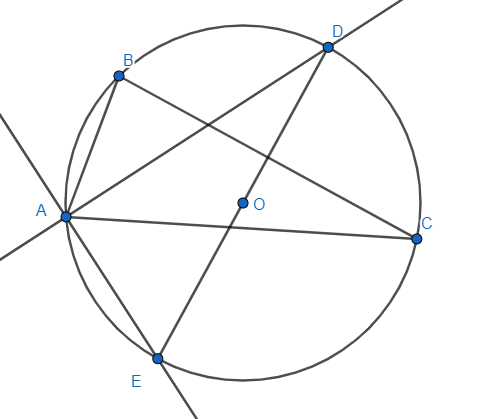
We know that the angle between the external and internal bisectors of any angle is always $ \dfrac{\pi }{2} $ . Now we try to draw the diagram.
Step: 1
Point A is fixed. The internal and external bisectors of $ \angle BAC $, AD and AE intersect the circle at D and E respectively.
The angle $ \angle DAE $ for the $ \Delta DAE $ is $ \dfrac{\pi }{2} $ . So, $ \Delta DAE $ is a right-angle triangle.
Step: 2
All the three vertices of $ \Delta DAE $ are on the circle and the fixed vertices A creates a right angle. We can say that the circle becomes a circumcircle for the $ \Delta DAE $.
Step: 3
The centre will be the middle point of the hypotenuse as we know that for a right-angle triangle, the circumcentre is the middle point of the hypotenuse.
Step: 4
As the $ \Delta DAE $ is created based on the position of the vertices A and the vertices is fixed, the position of the point O will also be fixed as the circumcentre.
The correct option is B.
Note:
The point A is fixed and even if we change the position of the points B and C, the condition of the centre and the circumcentre being fixed at point O is satisfied. We check the below images to understand the condition better.
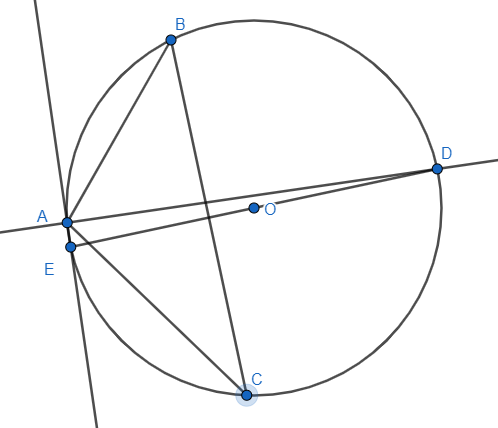
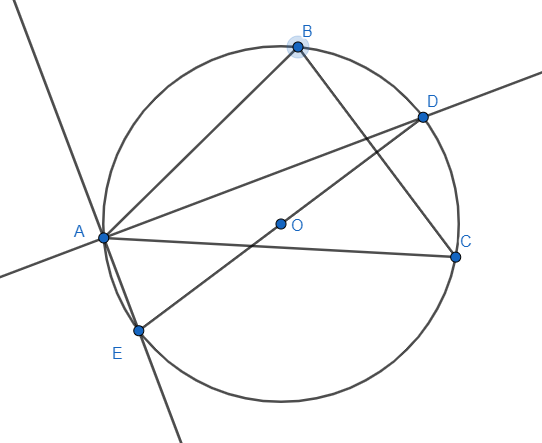
We know that angle between the external and internal bisectors of any angle is always $ \dfrac{\pi }{2} $. We use that theorem to find the inscribed right-angle triangle inside the circle. We form it as a circumcircle for the $ \Delta DAE $. We find the fixed point of centre as the circumcentre.
Complete step by step answer:
ABC is any triangle inscribed in the circle $ {{x}^{2}}+{{y}^{2}}={{r}^{2}} $ such that A is a fixed point.
The external and internal bisectors of $ \angle A $ intersect the circle at D and E.
We know that the angle between the external and internal bisectors of any angle is always $ \dfrac{\pi }{2} $ . Now we try to draw the diagram.
Step: 1
Point A is fixed. The internal and external bisectors of $ \angle BAC $, AD and AE intersect the circle at D and E respectively.
The angle $ \angle DAE $ for the $ \Delta DAE $ is $ \dfrac{\pi }{2} $ . So, $ \Delta DAE $ is a right-angle triangle.
Step: 2
All the three vertices of $ \Delta DAE $ are on the circle and the fixed vertices A creates a right angle. We can say that the circle becomes a circumcircle for the $ \Delta DAE $.
Step: 3
The centre will be the middle point of the hypotenuse as we know that for a right-angle triangle, the circumcentre is the middle point of the hypotenuse.
Step: 4
As the $ \Delta DAE $ is created based on the position of the vertices A and the vertices is fixed, the position of the point O will also be fixed as the circumcentre.
The correct option is B.
Note:
The point A is fixed and even if we change the position of the points B and C, the condition of the centre and the circumcentre being fixed at point O is satisfied. We check the below images to understand the condition better.
Recently Updated Pages
Master Class 11 English: Engaging Questions & Answers for Success

Master Class 11 Maths: Engaging Questions & Answers for Success
Class 11 Question and Answer - Your Ultimate Solutions Guide
Master Class 11 Biology: Engaging Questions & Answers for Success
Master Class 11 Physics: Engaging Questions & Answers for Success
Master Class 11 Accountancy: Engaging Questions & Answers for Success
Trending doubts
Explain the Treaty of Vienna of 1815 class 10 social science CBSE
Who Won 36 Oscar Awards? Record Holder Revealed
What is the median of the first 10 natural numbers class 10 maths CBSE
Why is it 530 pm in india when it is 1200 afternoon class 10 social science CBSE
Why is there a time difference of about 5 hours between class 10 social science CBSE
What is the full form of POSCO class 10 social science CBSE