




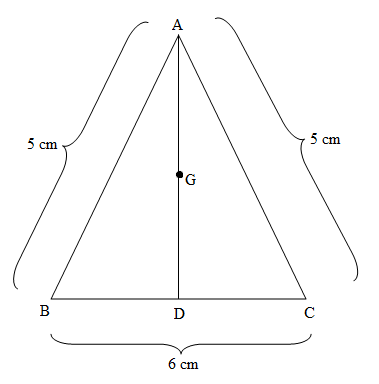
ABC is an isosceles triangle with AB = AC = 5 and BC = 6. If G is the centroid of $\Delta ABC$, then AG is equal to
\[
A.{\text{ }}\dfrac{1}{3} \\
B.{\text{ }}\dfrac{2}{3} \\
C.{\text{ }}\dfrac{4}{3} \\
D.{\text{ }}\dfrac{8}{3} \\
\]
Answer
 Verified
653.4k+ views
Hint: In order to solve this question first we will determine the median of the isosceles triangle and by the property of ratio of proportion we will proceed.
Complete step-by-step solution -
Since the given triangle is isosceles, so the median and altitude will coincide.
So, $\Delta ABD$ is a right angle triangle at D.
As we know by the Pythagoras theorem.
${\left( {{\text{Hypotenuse}}} \right)^2}{\text{ = }}{\left( {{\text{base}}} \right)^2}{\text{ + }}{\left( {{\text{height}}} \right)^2}$
By using Pythagoras theorem in above triangle ABD
$
\Rightarrow {\left( {AB} \right)^2} = {\left( {AD} \right)^2} + {\left( {BD} \right)^2} \\
\Rightarrow {\left( 5 \right)^2} = {\left( {AD} \right)^2} + {\left( 3 \right)^2}{\text{ }}\left[ {\because BD = \dfrac{1}{2}BC,{\text{ since AD is median}}} \right] \\
$
Let us find the value of AD.
\[
\Rightarrow {\left( {AD} \right)^2} = {\left( 5 \right)^2} - {\left( 3 \right)^2} \\
\Rightarrow {\left( {AD} \right)^2} = 25 - 9 \\
\Rightarrow {\left( {AD} \right)^2} = 16 \\
\Rightarrow AD = \sqrt {16} \\
\Rightarrow AD = 4cm \\
\]
As we have now got the value of AD.
As we know that the centroid of the triangle divides the altitude into a 2:1 ratio.
So, $AG:GD = 2:1$
So, let us apply ratio and proportion for altitude.
$
AG = \dfrac{2}{3} \times AD \\
AG = \dfrac{2}{3} \times 4 \\
\Rightarrow AG = \dfrac{8}{3} \\
$
Hence, the value of AG is $\dfrac{8}{3}$.
So, option D is the correct option.
Note: The centroid or geometric center of a plane figure is the arithmetic mean position of all the points in the figure. Informally, it is the point at which a cutout of the shape could be perfectly balanced on the tip of a pin. The centroid of a triangle is the intersection of the three medians of the triangle (each median connecting a vertex with the midpoint of the opposite side).
Complete step-by-step solution -
Since the given triangle is isosceles, so the median and altitude will coincide.
So, $\Delta ABD$ is a right angle triangle at D.
As we know by the Pythagoras theorem.
${\left( {{\text{Hypotenuse}}} \right)^2}{\text{ = }}{\left( {{\text{base}}} \right)^2}{\text{ + }}{\left( {{\text{height}}} \right)^2}$
By using Pythagoras theorem in above triangle ABD
$
\Rightarrow {\left( {AB} \right)^2} = {\left( {AD} \right)^2} + {\left( {BD} \right)^2} \\
\Rightarrow {\left( 5 \right)^2} = {\left( {AD} \right)^2} + {\left( 3 \right)^2}{\text{ }}\left[ {\because BD = \dfrac{1}{2}BC,{\text{ since AD is median}}} \right] \\
$
Let us find the value of AD.
\[
\Rightarrow {\left( {AD} \right)^2} = {\left( 5 \right)^2} - {\left( 3 \right)^2} \\
\Rightarrow {\left( {AD} \right)^2} = 25 - 9 \\
\Rightarrow {\left( {AD} \right)^2} = 16 \\
\Rightarrow AD = \sqrt {16} \\
\Rightarrow AD = 4cm \\
\]
As we have now got the value of AD.
As we know that the centroid of the triangle divides the altitude into a 2:1 ratio.
So, $AG:GD = 2:1$
So, let us apply ratio and proportion for altitude.
$
AG = \dfrac{2}{3} \times AD \\
AG = \dfrac{2}{3} \times 4 \\
\Rightarrow AG = \dfrac{8}{3} \\
$
Hence, the value of AG is $\dfrac{8}{3}$.
So, option D is the correct option.
Note: The centroid or geometric center of a plane figure is the arithmetic mean position of all the points in the figure. Informally, it is the point at which a cutout of the shape could be perfectly balanced on the tip of a pin. The centroid of a triangle is the intersection of the three medians of the triangle (each median connecting a vertex with the midpoint of the opposite side).
Recently Updated Pages
Master Class 11 English: Engaging Questions & Answers for Success

Master Class 11 Social Science: Engaging Questions & Answers for Success
Master Class 11 Maths: Engaging Questions & Answers for Success
Master Class 11 Biology: Engaging Questions & Answers for Success
Master Class 11 Physics: Engaging Questions & Answers for Success
Master Class 11 Chemistry: Engaging Questions & Answers for Success
Trending doubts
Explain the Treaty of Vienna of 1815 class 10 social science CBSE
What is the full form of POSCO class 10 social science CBSE
What planets have no moons Which one has only one moon class 10 physics CBSE
Define Potential, Developed, Stock and Reserved resources
In cricket, which Indian bowler is known as the "Yorker King"?
The diagonals of a rhombus are 10cm and 24cm Find the class 10 maths CBSE