




ABC is a triangle and AD is the median of the triangle. E is any point on the median ED. Which of the following options is correct?
[a] ar(ABE) = ar(ACE)
[b] BE = CE
[c] AB+BE = AC+CE
[d] $AE=\dfrac{CE+BE}{2}$
Answer
 Verified
598.5k+ views
Hint: Solve the question option wise by checking which of the options is correct and which of the options is incorrect. For option [a] use the fact that the median of a triangle divides the triangle into two triangles of equal area. Hence prove that $ar\left( \Delta ADC \right)=ar\left( \Delta ABD \right)$ and $ar\left( \Delta EDC \right)=ar\left( \Delta EDB \right)$. Subtract the two equations and hence arrive at the result. For option [b] consider an example of a scalene triangle and E as point A and hence prove that BE may not be equal to CE. Similarly, prove the result for option [c]. Similarly, prove the result for option [d].
Complete step-by-step answer:
We will solve the question option wise.
Let us check options [b], [c] and [d] first.
Since E is any point in AD, let us consider the case when A coincides with E and $AC\ne AB$ as shown in the diagram below
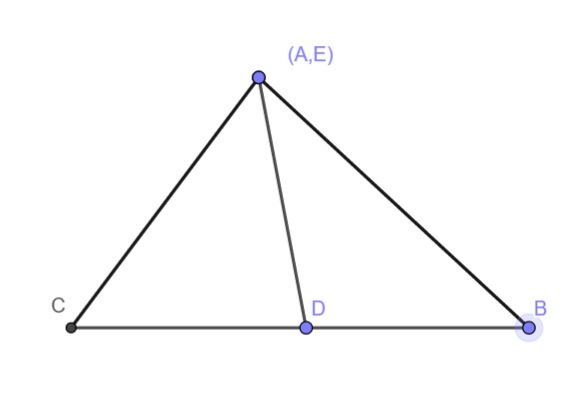
Now, we have $BE=AB$ and $CE=AC$
Since $AC\ne AB$, we have $BE\ne AE$
Hence option [b] is incorrect.
Also, we have$AB+BE=AB+AB=2AB$ and $AC+CE=AC+AC=2AC$
Since $AC\ne AB$, we have $AB+BE\ne AC+CE$
Hence option [c] is incorrect.
Also, we have $AE=0$
Since BE and CE are both positive, we have $\dfrac{BE+CE}{2}\ne 0$
Hence, we have $\dfrac{BE+CE}{2}\ne AE$
Hence option [b] is incorrect.
Now, let us consider a general triangle ABC, with AD as median and E a point on AD as shown below
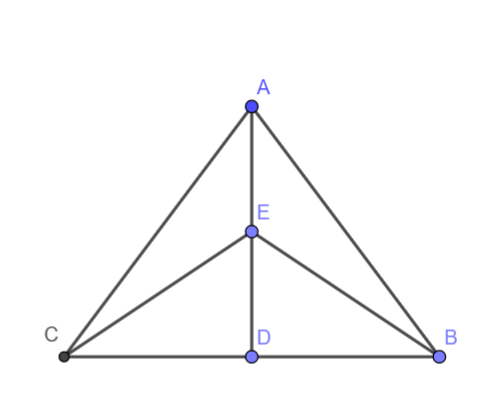
Claim: $ar\left( \Delta ACE \right)=ar\left( \Delta ABE \right)$
Proof:
We know the median of a triangle divides the triangle into two triangles of equal area. Since AD is the median of the triangle ABC, we have
$ar\left( \Delta ADC \right)=ar\left( \Delta ABD \right)\text{ }\left( i \right)$
Since ED is the median of the triangle EBC, we have
$ar\left( \Delta ECD \right)=ar\left( \Delta EBD \right)\text{ }\left( ii \right)$
Subtracting equation (ii) from equation (i), we get
$ar\left( \Delta ADC \right)-ar\left( \Delta ECD \right)=ar\left( \Delta ABD \right)-ar\left( \Delta EBD \right)$
From the figure, we have
$ar\left( \Delta ACD \right)-ar\left( \Delta ECD \right)=ar\left( \Delta ACE \right)$ and $ar\left( \Delta ABD \right)-ar\left( \Delta EBD \right)=ar\left( \Delta ABE \right)$
Hence, we have
$ar\left( \Delta AEC \right)=ar\left( \Delta ABE \right)$
Hence option [a] is correct.
Note: In mathematics in order to prove a result is correct, we need to give a formal proof and prove the result for all the possible conditions, and in order to prove that a result is incorrect, we need to come up with a case where the property fails to hold. This is known as proof by counterexample. In option [b], [c] and [d] we prove the results were incorrect by providing a counterexample.
Complete step-by-step answer:
We will solve the question option wise.
Let us check options [b], [c] and [d] first.
Since E is any point in AD, let us consider the case when A coincides with E and $AC\ne AB$ as shown in the diagram below
Now, we have $BE=AB$ and $CE=AC$
Since $AC\ne AB$, we have $BE\ne AE$
Hence option [b] is incorrect.
Also, we have$AB+BE=AB+AB=2AB$ and $AC+CE=AC+AC=2AC$
Since $AC\ne AB$, we have $AB+BE\ne AC+CE$
Hence option [c] is incorrect.
Also, we have $AE=0$
Since BE and CE are both positive, we have $\dfrac{BE+CE}{2}\ne 0$
Hence, we have $\dfrac{BE+CE}{2}\ne AE$
Hence option [b] is incorrect.
Now, let us consider a general triangle ABC, with AD as median and E a point on AD as shown below
Claim: $ar\left( \Delta ACE \right)=ar\left( \Delta ABE \right)$
Proof:
We know the median of a triangle divides the triangle into two triangles of equal area. Since AD is the median of the triangle ABC, we have
$ar\left( \Delta ADC \right)=ar\left( \Delta ABD \right)\text{ }\left( i \right)$
Since ED is the median of the triangle EBC, we have
$ar\left( \Delta ECD \right)=ar\left( \Delta EBD \right)\text{ }\left( ii \right)$
Subtracting equation (ii) from equation (i), we get
$ar\left( \Delta ADC \right)-ar\left( \Delta ECD \right)=ar\left( \Delta ABD \right)-ar\left( \Delta EBD \right)$
From the figure, we have
$ar\left( \Delta ACD \right)-ar\left( \Delta ECD \right)=ar\left( \Delta ACE \right)$ and $ar\left( \Delta ABD \right)-ar\left( \Delta EBD \right)=ar\left( \Delta ABE \right)$
Hence, we have
$ar\left( \Delta AEC \right)=ar\left( \Delta ABE \right)$
Hence option [a] is correct.
Note: In mathematics in order to prove a result is correct, we need to give a formal proof and prove the result for all the possible conditions, and in order to prove that a result is incorrect, we need to come up with a case where the property fails to hold. This is known as proof by counterexample. In option [b], [c] and [d] we prove the results were incorrect by providing a counterexample.
Recently Updated Pages
Master Class 10 Computer Science: Engaging Questions & Answers for Success

Master Class 10 General Knowledge: Engaging Questions & Answers for Success
Master Class 10 English: Engaging Questions & Answers for Success
Master Class 10 Social Science: Engaging Questions & Answers for Success
Master Class 10 Maths: Engaging Questions & Answers for Success
Master Class 10 Science: Engaging Questions & Answers for Success
Trending doubts
What is the median of the first 10 natural numbers class 10 maths CBSE
Which women's tennis player has 24 Grand Slam singles titles?
Who is the Brand Ambassador of Incredible India?
Why is there a time difference of about 5 hours between class 10 social science CBSE
Write a letter to the principal requesting him to grant class 10 english CBSE
State and prove converse of BPT Basic Proportionality class 10 maths CBSE