




A-bands of the muscle are dark and contain myosin.
B. I- bands are the light bands and contain actin.
C. During muscle contraction the A - band contracts.
D. The part between the two Z - lines are called a sarcomere.
E. The central part of the thin filament, not overlapped by thick filament is called H-zone.
Which of the above statements are correct and which are incorrect?
A) A, B and C are correct, while D and E are incorrect.
B) A, C, E are correct, while B, D are incorrect.
C) A and B are correct, while C, D and E are incorrect.
D) A, B, C and E are correct, while D is incorrect.
E) A, B and D are correct, while C and E are incorrect.
Answer
 Verified
610.2k+ views
Hint: Myosin is ATP-dependent and is responsible for actin-based motility. Actin is a multi-functional protein produced by microfilaments. The complex unit of striated muscle tissue is the sarcomere.
Complete answer: Electron micrographs of groups of filaments aligned with their axes parallel to the length of the fibres reveal thin sections of muscle fibres. There are two types of filaments; thick and thin filaments. There is a light band of low density called the I band in a longitudinal section through a group of myofibrils. There is a prominent dense line called the Z line in the centre of the I band, but in fact, given the myofibril's three-dimensional structure, it is more fitting to speak of Z discs. The primary structural and functional unit is directly responsible for muscle contraction and can be assumed to be the region between two Z lines. Thus, myofibril can be seen as a stack of sarcomeres. The A-band appears black, comprising thick filaments that are partially overlapped with thin filaments.
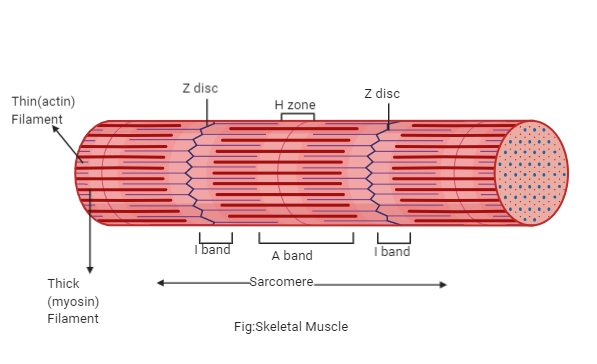
The thick and thin filaments overlap contain myosin to form dark bands called A bands. Alone, thin filaments form light bands, called I bands, and are made from actin. The spacing between Z-lines decreases and the width of the H and I-bands decreases also during muscle contraction. The unit of muscle contraction is delimited by two Z-lines and is called the sarcomere. So, option D is true.
The H band, where there is no overlap is within the A band.
Hence, the correct answer is option D.
Note: Via rapid, intense contractions called phasic contractions, skeletal muscles respond to a single electric shock of sufficient magnitude. If the ends of the muscle of the frog sartorius (at ) are set to stop shortening, the stress increases for approximately 200 milliseconds and then starts to decrease, at first very quickly and then more slowly. During this mechanical reaction to a single stimulus, called a twitch, more happens than the tension record indicates.
Complete answer: Electron micrographs of groups of filaments aligned with their axes parallel to the length of the fibres reveal thin sections of muscle fibres. There are two types of filaments; thick and thin filaments. There is a light band of low density called the I band in a longitudinal section through a group of myofibrils. There is a prominent dense line called the Z line in the centre of the I band, but in fact, given the myofibril's three-dimensional structure, it is more fitting to speak of Z discs. The primary structural and functional unit is directly responsible for muscle contraction and can be assumed to be the region between two Z lines. Thus, myofibril can be seen as a stack of sarcomeres. The A-band appears black, comprising thick filaments that are partially overlapped with thin filaments.
The thick and thin filaments overlap contain myosin to form dark bands called A bands. Alone, thin filaments form light bands, called I bands, and are made from actin. The spacing between Z-lines decreases and the width of the H and I-bands decreases also during muscle contraction. The unit of muscle contraction is delimited by two Z-lines and is called the sarcomere. So, option D is true.
The H band, where there is no overlap is within the A band.
Hence, the correct answer is option D.
Note: Via rapid, intense contractions called phasic contractions, skeletal muscles respond to a single electric shock of sufficient magnitude. If the ends of the muscle of the frog sartorius (at ) are set to stop shortening, the stress increases for approximately 200 milliseconds and then starts to decrease, at first very quickly and then more slowly. During this mechanical reaction to a single stimulus, called a twitch, more happens than the tension record indicates.
Recently Updated Pages
Master Class 11 English: Engaging Questions & Answers for Success

Master Class 11 Physics: Engaging Questions & Answers for Success
Master Class 11 Computer Science: Engaging Questions & Answers for Success
Master Class 11 Chemistry: Engaging Questions & Answers for Success
Master Class 11 Social Science: Engaging Questions & Answers for Success
Master Class 11 Accountancy: Engaging Questions & Answers for Success
Trending doubts
Difference Between Prokaryotic Cells and Eukaryotic Cells
Two of the body parts which do not appear in MRI are class 11 biology CBSE
One Metric ton is equal to kg A 10000 B 1000 C 100 class 11 physics CBSE
10 examples of friction in our daily life
Draw a diagram of nephron and explain its structur class 11 biology CBSE
Draw a diagram of a plant cell and label at least eight class 11 biology CBSE