




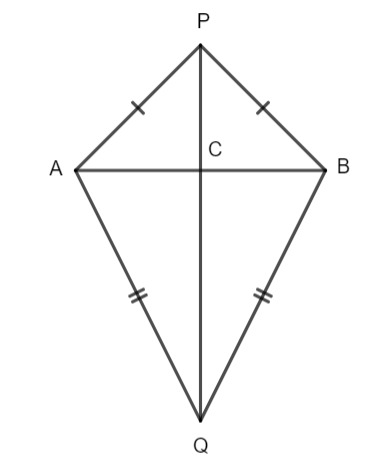
AB is a line segment. P and Q are points on opposite sides of AB such that each of them is equidistant from the points A and B. Show that the line PQ is perpendicular bisector AB.
Answer
 Verified
639k+ views
Hint: It is given that \[AP=BP\] and \[AQ=BQ\] . The side PQ is common in \[\Delta APQ\] and \[\Delta BPQ\] . Now, we can see that \[\Delta APQ\] and \[\Delta BPQ\] are congruent. Therefore, \[\angle APQ=\angle BPQ\] (congruent part of congruent triangles). We know the property that the angles opposite to equal sides are also equal. Since the sides, AP and BP are equal to each other and, \[\angle PAC\] and \[\angle PBC\] are opposite to each other. So, \[\angle PAC\] and \[\angle PBC\] are equal to each other, \[\angle PAC=\angle PBC\] . Now, in \[\Delta PCA\] and \[\Delta PCB\] , we have \[\angle APQ+\angle PAC+\angle PCA=180{}^\circ \] and \[\angle BPQ+\angle PBC+\angle PCB=180{}^\circ \] . So, \[\angle APQ+\angle PAC+\angle PCA=\angle BPQ+\angle PBC+\angle PCB\] . Now, simplify this equation by using the equations \[\angle APQ=\angle BPQ\] and \[\angle PAC=\angle PBC\] . Get the relation between \[\angle PCA\] and \[\angle PCB\] . We know that the sum of the linear pair of angles is \[180{}^\circ \] . The angles \[\angle PCA\] and \[\angle PCB\] are linear pair angles. Now, get the value of \[\angle PCA\] and \[\angle PCB\] . Now, in \[\Delta PCA\] and \[\Delta PCB\] , we have \[\angle PCA=\angle PCB=90{}^\circ \] , \[AP=BP\] , and
\[PC=PC\] . Check whether \[\Delta PCA\] and \[\Delta PCB\] are congruent or not. Now, solve it further and get the required result.
Complete step by step answer:
According to the question, it is given that AB is a line segment. P and Q are points on opposite sides of AB such that each of them is equidistant from the points A and B. It means the side AP and BP are equal to each other. Also, the side AQ and BQ are equal to each other. So,
\[AP=BP\] …………………………….(1)
\[AQ=BQ\] ……………………………….(2)
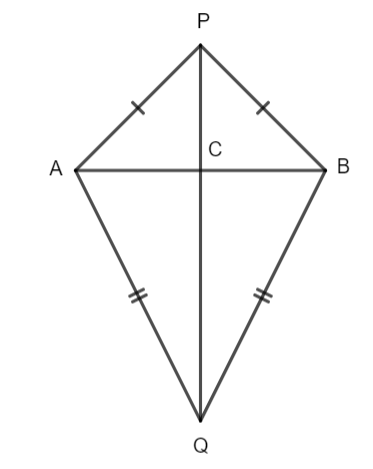
In \[\Delta APQ\] and \[\Delta BPQ\] , we have
\[AP=BP\] (From equation (1))
\[AQ=BQ\] (From equation (2))
\[PQ=PQ\] (common sides in both triangles)
So, \[\Delta APQ\cong \Delta BPQ\] (side side side criteria)
Therefore, \[\angle APQ=\angle BPQ\] (congruent part of congruent triangles) ……………………………………(3)
In \[\Delta PCA\] and \[\Delta PCB\] , we have
\[AP=BP\] (From equation (1)).
We know the property that the angles opposite to equal sides are also equal.
Since the sides, AP and BP are equal to each other and, \[\angle PAC\] and \[\angle PBC\] are opposite to each other. So, \[\angle PAC\] and \[\angle PBC\] are equal to each other.
\[\angle PAC=\angle PBC\] ………………………………..(4)
We know that the summation of all angles of a triangle is \[180{}^\circ \] . So, the sum of all angles of \[\Delta PCA\] and \[\Delta PCB\] is \[180{}^\circ \] .
Now, in \[\Delta PCA\] and \[\Delta PCB\] , we have
\[\angle APQ+\angle PAC+\angle PCA=180{}^\circ \] …………………………….(5)
\[\angle BPQ+\angle PBC+\angle PCB=180{}^\circ \] …………………………….(6)
From equation (5) and equation (6), we have
\[\angle APQ+\angle PAC+\angle PCA=\angle BPQ+\angle PBC+\angle PCB\] …………………………………….(7)
But from equation (3) and equation (4), we have \[\angle APQ=\angle BPQ\] and \[\angle PAC=\angle PBC\] .
Now, replacing \[\angle APQ\] by \[\angle BPQ\] and \[\angle PAC\] by \[\angle PBC\] in equation (7), we get
\[\Rightarrow \angle BPQ+\angle PBC+\angle PCA=\angle BPQ+\angle PBC+\angle PCB\]
\[\Rightarrow \angle PCA=\angle PCB\] ……………………………….(8)
We know that the sum of the linear pair of angles is \[180{}^\circ \] .
The angles \[\angle PCA\] and \[\angle PCB\] are linear pair angles. So,
\[\Rightarrow \angle PCA+\angle PCB=180{}^\circ \] …………………….(9)
From equation (8) and equation (9), we have
\[\begin{align}
& \Rightarrow \angle PCB+\angle PCB=180{}^\circ \\
& \Rightarrow 2\angle PCB=180{}^\circ \\
& \Rightarrow \angle PCB=\dfrac{180{}^\circ }{2} \\
& \Rightarrow \angle PCB=90{}^\circ \\
\end{align}\]
So, \[\angle PCA=\angle PCB=90{}^\circ \] ………………………………….(10)
Now, in \[\Delta PCA\] and \[\Delta PCB\] , we have
\[\angle PCA=\angle PCB=90{}^\circ \] (from equation (10))
\[AP=BP\] (From equation (1))
\[PC=PC\] (common side)
So, \[\angle PCA\cong \angle PCB\] (Right hypotenuse side criteria)
Therefore, \[AC=BC\] (congruent part of congruent triangles) ……………………………………..(11)
From equation (10) and equation (11), we have
\[\angle PCA=\angle PCB=90{}^\circ \] and \[AC=BC\] .
Hence, line segment PQ is a perpendicular bisector of AB.
Proved.
Note: We can also solve this question by another method.
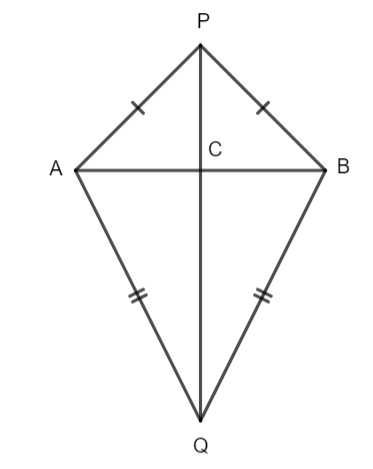
It is given that,
\[AP=BP\] …………………………….(1)
\[AQ=BQ\] ……………………………….(2)
We know that the angles opposite to equal sides are also equal.
Since the sides, AP and BP are equal to each other and, \[\angle PAC\] and \[\angle PBC\] are opposite to each other. So, \[\angle PAC\] and \[\angle PBC\] are equal to each other.
\[\angle PAC=\angle PBC\] ………………………………..(3)
Also, the sides QA and QB are equal to each other and, \[\angle QAC\] and \[\angle QBC\] are opposite to each other. So, \[\angle QAC\] and \[\angle QBC\] are equal to each other.
\[\angle QAC=\angle QBC\] …………………………………..(4)
Now, in \[\Delta PCA\] and \[\Delta PCB\] , we have
\[\angle PAC=\angle PBC\] (from equation (3))
\[AP=BP\] (from equation (1))
\[\angle QAC=\angle QBC\] (from equation (4))
So, \[\angle PCA\cong \angle PCB\] (angle side angle criteria).
Therefore, \[\angle PCA=\angle PCB\] and \[AC=BC\] (congruent part of congruent triangles) …………………………..(5)
We know that the sum of the linear pair of angles is \[180{}^\circ \] .
The angles \[\angle PCA\] and \[\angle PCB\] are linear pair angles. So,
\[\Rightarrow \angle PCA+\angle PCB=180{}^\circ \] ……………………………..(6)
From equation (5) and equation (6)
\[\begin{align}
& \Rightarrow \angle PCB+\angle PCB=180{}^\circ \\
& \Rightarrow 2\angle PCB=180{}^\circ \\
& \Rightarrow \angle PCB=\dfrac{180{}^\circ }{2} \\
& \Rightarrow \angle PCB=90{}^\circ \\
\end{align}\]
So, \[\angle PCA=\angle PCB=90{}^\circ \] ………………………………….(7)
From equation (5) and equation (17), we have
\[AC=BC\] and \[\angle PCA=\angle PCB=90{}^\circ \] .
Hence, line segment PQ is a perpendicular bisector of AB.
Proved.
\[PC=PC\] . Check whether \[\Delta PCA\] and \[\Delta PCB\] are congruent or not. Now, solve it further and get the required result.
Complete step by step answer:
According to the question, it is given that AB is a line segment. P and Q are points on opposite sides of AB such that each of them is equidistant from the points A and B. It means the side AP and BP are equal to each other. Also, the side AQ and BQ are equal to each other. So,
\[AP=BP\] …………………………….(1)
\[AQ=BQ\] ……………………………….(2)
In \[\Delta APQ\] and \[\Delta BPQ\] , we have
\[AP=BP\] (From equation (1))
\[AQ=BQ\] (From equation (2))
\[PQ=PQ\] (common sides in both triangles)
So, \[\Delta APQ\cong \Delta BPQ\] (side side side criteria)
Therefore, \[\angle APQ=\angle BPQ\] (congruent part of congruent triangles) ……………………………………(3)
In \[\Delta PCA\] and \[\Delta PCB\] , we have
\[AP=BP\] (From equation (1)).
We know the property that the angles opposite to equal sides are also equal.
Since the sides, AP and BP are equal to each other and, \[\angle PAC\] and \[\angle PBC\] are opposite to each other. So, \[\angle PAC\] and \[\angle PBC\] are equal to each other.
\[\angle PAC=\angle PBC\] ………………………………..(4)
We know that the summation of all angles of a triangle is \[180{}^\circ \] . So, the sum of all angles of \[\Delta PCA\] and \[\Delta PCB\] is \[180{}^\circ \] .
Now, in \[\Delta PCA\] and \[\Delta PCB\] , we have
\[\angle APQ+\angle PAC+\angle PCA=180{}^\circ \] …………………………….(5)
\[\angle BPQ+\angle PBC+\angle PCB=180{}^\circ \] …………………………….(6)
From equation (5) and equation (6), we have
\[\angle APQ+\angle PAC+\angle PCA=\angle BPQ+\angle PBC+\angle PCB\] …………………………………….(7)
But from equation (3) and equation (4), we have \[\angle APQ=\angle BPQ\] and \[\angle PAC=\angle PBC\] .
Now, replacing \[\angle APQ\] by \[\angle BPQ\] and \[\angle PAC\] by \[\angle PBC\] in equation (7), we get
\[\Rightarrow \angle BPQ+\angle PBC+\angle PCA=\angle BPQ+\angle PBC+\angle PCB\]
\[\Rightarrow \angle PCA=\angle PCB\] ……………………………….(8)
We know that the sum of the linear pair of angles is \[180{}^\circ \] .
The angles \[\angle PCA\] and \[\angle PCB\] are linear pair angles. So,
\[\Rightarrow \angle PCA+\angle PCB=180{}^\circ \] …………………….(9)
From equation (8) and equation (9), we have
\[\begin{align}
& \Rightarrow \angle PCB+\angle PCB=180{}^\circ \\
& \Rightarrow 2\angle PCB=180{}^\circ \\
& \Rightarrow \angle PCB=\dfrac{180{}^\circ }{2} \\
& \Rightarrow \angle PCB=90{}^\circ \\
\end{align}\]
So, \[\angle PCA=\angle PCB=90{}^\circ \] ………………………………….(10)
Now, in \[\Delta PCA\] and \[\Delta PCB\] , we have
\[\angle PCA=\angle PCB=90{}^\circ \] (from equation (10))
\[AP=BP\] (From equation (1))
\[PC=PC\] (common side)
So, \[\angle PCA\cong \angle PCB\] (Right hypotenuse side criteria)
Therefore, \[AC=BC\] (congruent part of congruent triangles) ……………………………………..(11)
From equation (10) and equation (11), we have
\[\angle PCA=\angle PCB=90{}^\circ \] and \[AC=BC\] .
Hence, line segment PQ is a perpendicular bisector of AB.
Proved.
Note: We can also solve this question by another method.
It is given that,
\[AP=BP\] …………………………….(1)
\[AQ=BQ\] ……………………………….(2)
We know that the angles opposite to equal sides are also equal.
Since the sides, AP and BP are equal to each other and, \[\angle PAC\] and \[\angle PBC\] are opposite to each other. So, \[\angle PAC\] and \[\angle PBC\] are equal to each other.
\[\angle PAC=\angle PBC\] ………………………………..(3)
Also, the sides QA and QB are equal to each other and, \[\angle QAC\] and \[\angle QBC\] are opposite to each other. So, \[\angle QAC\] and \[\angle QBC\] are equal to each other.
\[\angle QAC=\angle QBC\] …………………………………..(4)
Now, in \[\Delta PCA\] and \[\Delta PCB\] , we have
\[\angle PAC=\angle PBC\] (from equation (3))
\[AP=BP\] (from equation (1))
\[\angle QAC=\angle QBC\] (from equation (4))
So, \[\angle PCA\cong \angle PCB\] (angle side angle criteria).
Therefore, \[\angle PCA=\angle PCB\] and \[AC=BC\] (congruent part of congruent triangles) …………………………..(5)
We know that the sum of the linear pair of angles is \[180{}^\circ \] .
The angles \[\angle PCA\] and \[\angle PCB\] are linear pair angles. So,
\[\Rightarrow \angle PCA+\angle PCB=180{}^\circ \] ……………………………..(6)
From equation (5) and equation (6)
\[\begin{align}
& \Rightarrow \angle PCB+\angle PCB=180{}^\circ \\
& \Rightarrow 2\angle PCB=180{}^\circ \\
& \Rightarrow \angle PCB=\dfrac{180{}^\circ }{2} \\
& \Rightarrow \angle PCB=90{}^\circ \\
\end{align}\]
So, \[\angle PCA=\angle PCB=90{}^\circ \] ………………………………….(7)
From equation (5) and equation (17), we have
\[AC=BC\] and \[\angle PCA=\angle PCB=90{}^\circ \] .
Hence, line segment PQ is a perpendicular bisector of AB.
Proved.
Recently Updated Pages
Master Class 11 English: Engaging Questions & Answers for Success

Master Class 11 Social Science: Engaging Questions & Answers for Success
Master Class 11 Maths: Engaging Questions & Answers for Success
Master Class 11 Biology: Engaging Questions & Answers for Success
Master Class 11 Physics: Engaging Questions & Answers for Success
Master Class 11 Chemistry: Engaging Questions & Answers for Success
Trending doubts
Explain the Treaty of Vienna of 1815 class 10 social science CBSE
What is the Total Duration of Football Match?
The shortest day of the year in India
In which year voting age was reduced from 21 to 18?
10 examples of evaporation in daily life with explanations
What planets have no moons Which one has only one moon class 10 physics CBSE