




(a) Why is nitrogen important to all living beings?
(b) What is nitrogen fixation?
Answer
 Verified
550.2k+ views
Hint: The chemical element nitrogen has the symbol N and the atomic number 7. Daniel Rutherford, a Scottish physician, was the first to discover and isolate it in 1772. Despite the fact that Carl Wilhelm Scheele and Henry Cavendish had separately done so about the same time, Rutherford is often given credit for his work since it was first published.
Complete answer: Because nitrogen is a key component of amino acids, which are the building blocks of proteins, and nucleic acids, such as DNA, which transmits genetic information to successive generations of organisms, nitrogen is vital for all living things. Nitrogen makes up around 78 percent of the atmosphere, but plants and animals can't get it straight from the air. This is accomplished by a mechanism known as the nitrogen cycle. Protein is found in all human tissue, including muscles, skin, hair, nails, and blood. Nitrogen is required for normal development, cell renewal, and tissue repair, and proteins in the form of enzymes are required for your body's metabolic functions. Nitrogen is required for plant growth and survival. Plants perish without proteins — some as structural components, others as enzymes. Nitrogen makes up a substantial portion of chlorophyll, which plants require for photosynthesis, the process of converting water and carbon dioxide into sugars using the sun's energy. Nitrogen is found in energy-transfer molecules like ATP (adenosine triphosphate), which allows cells to preserve and utilise the energy created during metabolism. Nucleic acids, such as DNA, are also required for plant growth and reproduction. Plants absorb nitrogen in a different method than mammals, receiving it in the form of nitrates and ammonium from the water and soil.
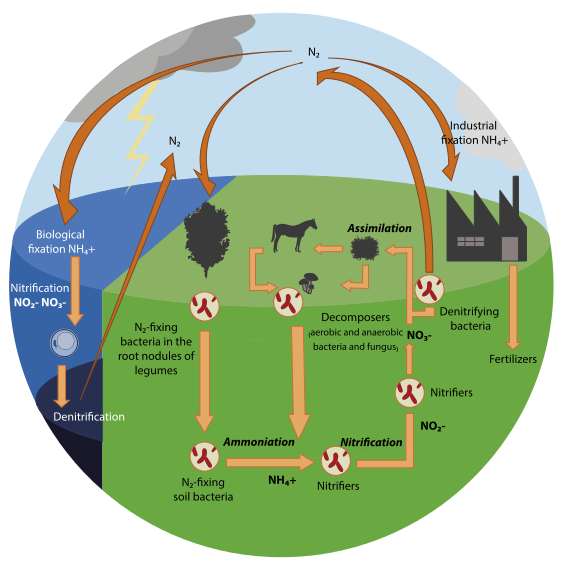
B.Nitrogen fixation is a chemical reaction that converts molecular nitrogen from the air into ammonia or other nitrogenous compounds in soil or aquatic environments. Except for a few microbes, atmospheric nitrogen is molecular dinitrogen, a generally non reactive molecule that is biologically worthless. Biological nitrogen fixation, also known as diazotrophs, is a microbially driven process that uses the nitrogenase protein complex to convert nitrogen gas to ammonia. Because all nitrogen-containing organic substances, including as amino acids and proteins, nucleoside triphosphates, and nucleic acids, require the production of fixed inorganic nitrogen molecules, nitrogen fixation is vital to life. It is necessary for agriculture and fertiliser production as part of the nitrogen cycle. It also has an indirect impact on the production of all nitrogen chemical compounds, including certain explosives, medicines, and colours.
Note:
Microorganisms known as diazotrophs, which include bacteria like Azotobacter and archaea, fix nitrogen naturally in soil. Plants, particularly legumes, have symbiotic interactions with some nitrogen-fixing bacteria. Associative interactions between diazotrophs and plants are generally referred to as looser non-symbiotic connections, such as nitrogen fixation on rice roots. Some termites and fungus work together to fix nitrogen. It occurs naturally in the air as a result of lightning-caused $N{O_x}$ generation.
Complete answer: Because nitrogen is a key component of amino acids, which are the building blocks of proteins, and nucleic acids, such as DNA, which transmits genetic information to successive generations of organisms, nitrogen is vital for all living things. Nitrogen makes up around 78 percent of the atmosphere, but plants and animals can't get it straight from the air. This is accomplished by a mechanism known as the nitrogen cycle. Protein is found in all human tissue, including muscles, skin, hair, nails, and blood. Nitrogen is required for normal development, cell renewal, and tissue repair, and proteins in the form of enzymes are required for your body's metabolic functions. Nitrogen is required for plant growth and survival. Plants perish without proteins — some as structural components, others as enzymes. Nitrogen makes up a substantial portion of chlorophyll, which plants require for photosynthesis, the process of converting water and carbon dioxide into sugars using the sun's energy. Nitrogen is found in energy-transfer molecules like ATP (adenosine triphosphate), which allows cells to preserve and utilise the energy created during metabolism. Nucleic acids, such as DNA, are also required for plant growth and reproduction. Plants absorb nitrogen in a different method than mammals, receiving it in the form of nitrates and ammonium from the water and soil.
B.Nitrogen fixation is a chemical reaction that converts molecular nitrogen from the air into ammonia or other nitrogenous compounds in soil or aquatic environments. Except for a few microbes, atmospheric nitrogen is molecular dinitrogen, a generally non reactive molecule that is biologically worthless. Biological nitrogen fixation, also known as diazotrophs, is a microbially driven process that uses the nitrogenase protein complex to convert nitrogen gas to ammonia. Because all nitrogen-containing organic substances, including as amino acids and proteins, nucleoside triphosphates, and nucleic acids, require the production of fixed inorganic nitrogen molecules, nitrogen fixation is vital to life. It is necessary for agriculture and fertiliser production as part of the nitrogen cycle. It also has an indirect impact on the production of all nitrogen chemical compounds, including certain explosives, medicines, and colours.
Note:
Microorganisms known as diazotrophs, which include bacteria like Azotobacter and archaea, fix nitrogen naturally in soil. Plants, particularly legumes, have symbiotic interactions with some nitrogen-fixing bacteria. Associative interactions between diazotrophs and plants are generally referred to as looser non-symbiotic connections, such as nitrogen fixation on rice roots. Some termites and fungus work together to fix nitrogen. It occurs naturally in the air as a result of lightning-caused $N{O_x}$ generation.
Recently Updated Pages
Master Class 11 English: Engaging Questions & Answers for Success

Master Class 11 Social Science: Engaging Questions & Answers for Success
Master Class 11 Maths: Engaging Questions & Answers for Success
Master Class 11 Biology: Engaging Questions & Answers for Success
Master Class 11 Physics: Engaging Questions & Answers for Success
Master Class 11 Chemistry: Engaging Questions & Answers for Success
Trending doubts
Difference Between Plant Cell and Animal Cell
Fill the blanks with the suitable prepositions 1 The class 9 english CBSE
What is pollution? How many types of pollution? Define it
Name 10 Living and Non living things class 9 biology CBSE
What is the full form of pH?
On an outline map of India show its neighbouring c class 9 social science CBSE