




(a) What does the figure given below show?
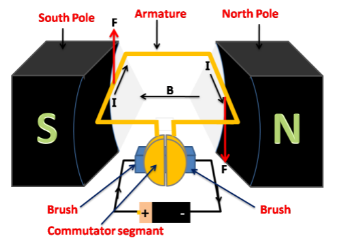
(b) Which principle is used in this device
(c) State its uses
Answer
 Verified
534k+ views
Hint:Electric motors provide torque (linear or rotational force) that is used to move an external mechanism such as a fan or an elevator. Electric motors are often built for continuous rotation or linear movement over a large distance given their size. Magnetic solenoids are likewise transducers that transfer electrical power to mechanical motion, but they have a restricted range of motion.
Complete answer:
(a) Following figure shows an Electric motor. An electric motor is a mechanism that transforms electricity into mechanical energy. The interaction between the motor's magnetic field and electric current in a wire winding generates force in the form of torque delivered to the motor's shaft in most electric motors. Direct current (DC) sources, such as batteries or rectifiers, or alternating current (AC) sources, such as a power grid, inverters, or electrical generators, can power electric motors. An electric generator is technically equivalent to an electric motor, but it converts mechanical energy into electrical energy using a reversed flow of power.
(b) The electric motor operates on the concept of current magnetic effects. It works on the basis that when a rectangular coil is put in a magnetic field and electricity is fed through it, the coil spins due to the forces acting on it.
(c) Electric motors are utilised for a wide range of purposes. The following is a list of some of them:
-Drills.
-Hard Disc Drives, Water Pumps
-Machines for washing clothes.
-Industrial machinery.
The remaining energy is lost in heat generation and sound emitted, thus a functional motor's efficiency should be about 70–85 percent.
Note:Electric motors provide torque (linear or rotational force) that is used to move an external mechanism such as a fan or an elevator. Electric motors are often built for continuous rotation or linear movement over a large distance given their size. Magnetic solenoids are likewise transducers that transfer electrical power to mechanical motion, but they have a restricted range of motion.
Complete answer:
(a) Following figure shows an Electric motor. An electric motor is a mechanism that transforms electricity into mechanical energy. The interaction between the motor's magnetic field and electric current in a wire winding generates force in the form of torque delivered to the motor's shaft in most electric motors. Direct current (DC) sources, such as batteries or rectifiers, or alternating current (AC) sources, such as a power grid, inverters, or electrical generators, can power electric motors. An electric generator is technically equivalent to an electric motor, but it converts mechanical energy into electrical energy using a reversed flow of power.
(b) The electric motor operates on the concept of current magnetic effects. It works on the basis that when a rectangular coil is put in a magnetic field and electricity is fed through it, the coil spins due to the forces acting on it.
(c) Electric motors are utilised for a wide range of purposes. The following is a list of some of them:
-Drills.
-Hard Disc Drives, Water Pumps
-Machines for washing clothes.
-Industrial machinery.
The remaining energy is lost in heat generation and sound emitted, thus a functional motor's efficiency should be about 70–85 percent.
Note:Electric motors provide torque (linear or rotational force) that is used to move an external mechanism such as a fan or an elevator. Electric motors are often built for continuous rotation or linear movement over a large distance given their size. Magnetic solenoids are likewise transducers that transfer electrical power to mechanical motion, but they have a restricted range of motion.
Recently Updated Pages
Master Class 12 Economics: Engaging Questions & Answers for Success

Master Class 12 English: Engaging Questions & Answers for Success
Master Class 12 Social Science: Engaging Questions & Answers for Success
Master Class 12 Maths: Engaging Questions & Answers for Success
Master Class 12 Physics: Engaging Questions & Answers for Success
Master Class 10 English: Engaging Questions & Answers for Success
Trending doubts
Explain the Treaty of Vienna of 1815 class 10 social science CBSE
Why is it 530 pm in india when it is 1200 afternoon class 10 social science CBSE
What is the full form of POSCO class 10 social science CBSE
Define Potential, Developed, Stock and Reserved resources
Which Country Has the Largest Border with India?
Complete the sentence with the most appropriate word class 10 english CBSE