




A well with 10m inside diameter is dug 8.4 m deep. Earth taken out of it is spread all around it to a width of 7.5m to form an embankment. Find the height of the embankment.
Answer
 Verified
655.5k+ views
Hint:- Embankment is a cylinder formed outside the cylinder (well). Let us draw a figure of embankment of the well and find the volume of the soil taken out and that will be equal to the volume of the embankment.
Complete step-by-step solution -
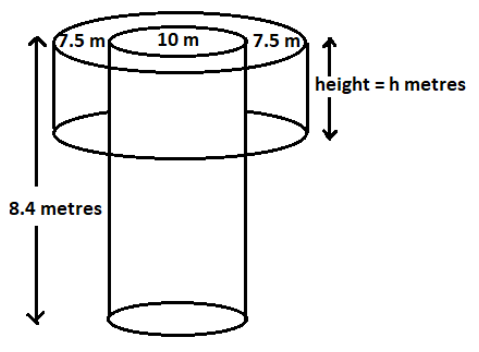
Now as we can see from the above figure that the well is of the shape of a cylinder. So, to find the volume of soil taken out we had to find the volume of the cylinder with diameter 10m and height 8.4m.
Now as we know that the radius is equal to the half of the cylinder. So, the radius of the well will be 5m.
Now according to the formula of volume of cylinder that is \[\pi {r^2}h\], where r is the radius and h is the height of the cylinder.
Volume of soil taken out of the well will be
\[\pi {\left( 5 \right)^2}8.4 = \pi \times 25 \times 8.4 = 210\pi {\text{ }}{{\text{m}}^3}\]
Now as we know that the soil taken out to form an embankment. So, the volume of embankment will be equal to \[210\pi {\text{ }}{{\text{m}}^3}\].
Now as we can see from the above figure that the embankment is a cylinder that is around the well (cylinder). An embankment is also a shape of a cylinder. But the volume of embankment will be equal to the volume of the outer cylinder minus the volume of the well because soil is spread outside the well.
So, as the width of the embankment is 7.5 m.
So, we can see from the above figure that the diameter of the cylinder will be width + diameter of well + width
So, the diameter of the embankment will be 7.5 + 10 + 7.5 = 25m.
So, the radius of embankment will be 12.5m.
Now let the height of the embankment be h metres.
Then volume of the embankment will be equal to \[\pi h\left( {{R^2} - {r^2}} \right){\text{ }}{{\text{m}}^3}\], where R is the radius of embankment and r is the radius of the well and h is the height of the embankment. Because soil is spread out of the well.
So, \[210\pi {\text{ }}{{\text{m}}^3}\] = \[\pi h\left( {{R^2} - {r^2}} \right){\text{ }}{{\text{m}}^3}\]
\[210\pi \] = \[\pi h\left( {{{\left( {12.5} \right)}^2} - {{\left( 5 \right)}^2}} \right)\]
\[
210\pi = \left( {156.25 - 25} \right)\pi h \\
210\pi = 131.25\pi h \\
\]
Now dividing both sides of the above equation by \[131.25\pi \]. We get,
h = \[\dfrac{{210}}{{131.25}} = 1.6\]m
Hence, the height of the embankment will be 1.6 metres.
Note:- Whenever we come up with this type of problem then first, we had to find the volume of the soil taken out of the well by using the formula to find the volume of the cylinder that is \[\pi {r^2}h\], where r is the radius and h is the height of the cylinder. And after that we had to compare that volume with the volume of embankment but the formula for the volume of embankment should be to \[\pi h\left( {{R^2} - {r^2}} \right){\text{ }}{{\text{m}}^3}\], where R is the radius of embankment and r is the radius of the well and h is the height of the embankment. We had a subtracted volume of embankment because soil is spread outside the cylinder. This will be the easiest and efficient way to find the height of the embankment.
Complete step-by-step solution -
Now as we can see from the above figure that the well is of the shape of a cylinder. So, to find the volume of soil taken out we had to find the volume of the cylinder with diameter 10m and height 8.4m.
Now as we know that the radius is equal to the half of the cylinder. So, the radius of the well will be 5m.
Now according to the formula of volume of cylinder that is \[\pi {r^2}h\], where r is the radius and h is the height of the cylinder.
Volume of soil taken out of the well will be
\[\pi {\left( 5 \right)^2}8.4 = \pi \times 25 \times 8.4 = 210\pi {\text{ }}{{\text{m}}^3}\]
Now as we know that the soil taken out to form an embankment. So, the volume of embankment will be equal to \[210\pi {\text{ }}{{\text{m}}^3}\].
Now as we can see from the above figure that the embankment is a cylinder that is around the well (cylinder). An embankment is also a shape of a cylinder. But the volume of embankment will be equal to the volume of the outer cylinder minus the volume of the well because soil is spread outside the well.
So, as the width of the embankment is 7.5 m.
So, we can see from the above figure that the diameter of the cylinder will be width + diameter of well + width
So, the diameter of the embankment will be 7.5 + 10 + 7.5 = 25m.
So, the radius of embankment will be 12.5m.
Now let the height of the embankment be h metres.
Then volume of the embankment will be equal to \[\pi h\left( {{R^2} - {r^2}} \right){\text{ }}{{\text{m}}^3}\], where R is the radius of embankment and r is the radius of the well and h is the height of the embankment. Because soil is spread out of the well.
So, \[210\pi {\text{ }}{{\text{m}}^3}\] = \[\pi h\left( {{R^2} - {r^2}} \right){\text{ }}{{\text{m}}^3}\]
\[210\pi \] = \[\pi h\left( {{{\left( {12.5} \right)}^2} - {{\left( 5 \right)}^2}} \right)\]
\[
210\pi = \left( {156.25 - 25} \right)\pi h \\
210\pi = 131.25\pi h \\
\]
Now dividing both sides of the above equation by \[131.25\pi \]. We get,
h = \[\dfrac{{210}}{{131.25}} = 1.6\]m
Hence, the height of the embankment will be 1.6 metres.
Note:- Whenever we come up with this type of problem then first, we had to find the volume of the soil taken out of the well by using the formula to find the volume of the cylinder that is \[\pi {r^2}h\], where r is the radius and h is the height of the cylinder. And after that we had to compare that volume with the volume of embankment but the formula for the volume of embankment should be to \[\pi h\left( {{R^2} - {r^2}} \right){\text{ }}{{\text{m}}^3}\], where R is the radius of embankment and r is the radius of the well and h is the height of the embankment. We had a subtracted volume of embankment because soil is spread outside the cylinder. This will be the easiest and efficient way to find the height of the embankment.
Recently Updated Pages
Master Class 11 English: Engaging Questions & Answers for Success

Master Class 11 Social Science: Engaging Questions & Answers for Success
Master Class 11 Maths: Engaging Questions & Answers for Success
Master Class 11 Biology: Engaging Questions & Answers for Success
Master Class 11 Physics: Engaging Questions & Answers for Success
Master Class 11 Chemistry: Engaging Questions & Answers for Success
Trending doubts
Explain the Treaty of Vienna of 1815 class 10 social science CBSE
What is the full form of POSCO class 10 social science CBSE
Define Potential, Developed, Stock and Reserved resources
The diagonals of a rhombus are 10cm and 24cm Find the class 10 maths CBSE
Fill the blanks with proper collective nouns 1 A of class 10 english CBSE
What planets have no moons Which one has only one moon class 10 physics CBSE