




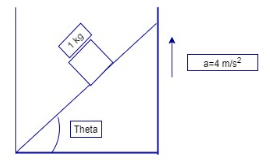
A wedge is moving with an acceleration a= $ 4\text{m/}{{\text{s}}^{2}} $ vertically up as shown in figure. What is acceleration of block of mass $ 1\text{kg} $ w.r.t wedge normal reaction by wedge on block respectively. All surfaces are smooth. Choose correct pair $ \left( \text{g=10m/}{{\text{s}}^{2}} \right) $
(A) $ 7\text{ m/}{{\text{s}}^{2}},7\sqrt{3}\text{ N} $
(B) $ \text{5 m/}{{\text{s}}^{2}},5\sqrt{3}\text{ N} $
(C) $ 4\cdot 9\text{ m/}{{\text{s}}^{2}},\text{ 4}\cdot \text{9}\sqrt{3}\text{ N} $
(D) $ \text{10 m/}{{\text{s}}^{2}},10\sqrt{3}\text{ N} $
Answer
 Verified
574.8k+ views
Hint: The magnitude of the force of limiting friction between any two bodies in constant is directly proportional to the normal reaction between them. Direction of the force of limiting friction is always opposite to the direction in which one body is at the verge of moving over the other.
Limiting friction: Is the maximum opposing force that comes into play, when one body is just at the verge of moving over the surface of the other body.
Complete step by step solution
A wedge is moving in upward direction with acceleration $ 4\text{ m/}{{\text{s}}^{2}} $ . A block is placed on the wedge having mass ‘m’.
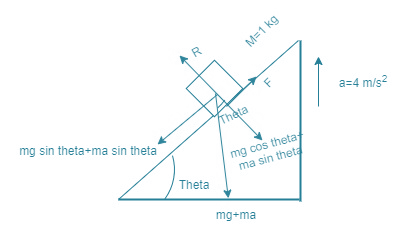
The various forces involved are:
Weight, mg of the body, acting vertically downwards.
Normal reaction, R, acting perpendicular to the inclined plane of wedge.
Force of friction, F acting up the plane.
Now, mg can be resolved into two rectangular components:
mg $ \text{cos }\!\!\theta\!\!\text{ } $ opposite to R
mg $ \text{sin }\!\!\theta\!\!\text{ } $ opposite to F
As the wedge is accelerated in upward direction with acceleration, then the Pseudo force will act on the body. It is the product of the mass of the body and acceleration. i.e.
F=ma
In the frame of wedge:
Horizontal component:
Left side forces=Right sides forces
mg $ \text{sin }\!\!\theta\!\!\text{ }+ $ ma $ \text{sin }\!\!\theta\!\!\text{ } $ =ma
In this a= acceleration of wedge
$ {{\text{a}}_{1}} $ =according of Bex
$ \begin{align}
& \text{mg}\left( \text{g}+\text{a} \right)\sin \text{ }\!\!\theta\!\!\text{ }=\text{m }{{\text{a}}_{1}} \\
& {{\text{a}}_{1}}=\left( \text{g}+\text{a} \right)\sin \text{ }\!\!\theta\!\!\text{ } \\
& =\left( 10+4 \right)\sin 30 \\
& =14\times \dfrac{1}{2} \\
& =7\text{ m/}{{\text{s}}^{2}} \\
\end{align} $
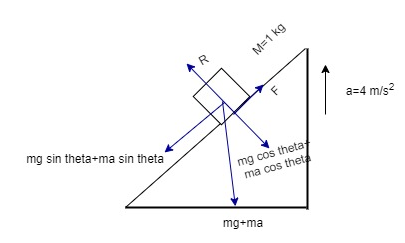
To find out the normal reaction vertically upward force is balanced by velocity downward force.
$ \begin{align}
& \text{R=mg cos }\!\!\theta\!\!\text{ }+\text{ma cos }\!\!\theta\!\!\text{ } \\
& =\text{m}\left( \text{g}+\text{a} \right)\text{cos }\!\!\theta\!\!\text{ } \\
& =1\left( 10+4 \right)\text{cos 30} \\
& \text{=14}\times \sqrt{3} \\
& =7\sqrt{3}\text{ N} \\
\end{align} $
Therefore, acceleration of block w.r.t to wedge is $ 7\text{ m/}{{\text{s}}^{2}} $ and normal wedge on block is $ 7\sqrt{3}\text{ N} $
So option (A) is correct answer.
Note
Remember that friction is always opposed to relative motion. Angle of repose is defined as the minimum angle of inclination of a plane with the horizontal, such that a body placed on the plane just begins to slide down. Friction is a non-conservation force i.e. work done against friction is path dependent.
Limiting friction: Is the maximum opposing force that comes into play, when one body is just at the verge of moving over the surface of the other body.
Complete step by step solution
A wedge is moving in upward direction with acceleration $ 4\text{ m/}{{\text{s}}^{2}} $ . A block is placed on the wedge having mass ‘m’.
The various forces involved are:
Weight, mg of the body, acting vertically downwards.
Normal reaction, R, acting perpendicular to the inclined plane of wedge.
Force of friction, F acting up the plane.
Now, mg can be resolved into two rectangular components:
mg $ \text{cos }\!\!\theta\!\!\text{ } $ opposite to R
mg $ \text{sin }\!\!\theta\!\!\text{ } $ opposite to F
As the wedge is accelerated in upward direction with acceleration, then the Pseudo force will act on the body. It is the product of the mass of the body and acceleration. i.e.
F=ma
In the frame of wedge:
Horizontal component:
Left side forces=Right sides forces
mg $ \text{sin }\!\!\theta\!\!\text{ }+ $ ma $ \text{sin }\!\!\theta\!\!\text{ } $ =ma
In this a= acceleration of wedge
$ {{\text{a}}_{1}} $ =according of Bex
$ \begin{align}
& \text{mg}\left( \text{g}+\text{a} \right)\sin \text{ }\!\!\theta\!\!\text{ }=\text{m }{{\text{a}}_{1}} \\
& {{\text{a}}_{1}}=\left( \text{g}+\text{a} \right)\sin \text{ }\!\!\theta\!\!\text{ } \\
& =\left( 10+4 \right)\sin 30 \\
& =14\times \dfrac{1}{2} \\
& =7\text{ m/}{{\text{s}}^{2}} \\
\end{align} $
To find out the normal reaction vertically upward force is balanced by velocity downward force.
$ \begin{align}
& \text{R=mg cos }\!\!\theta\!\!\text{ }+\text{ma cos }\!\!\theta\!\!\text{ } \\
& =\text{m}\left( \text{g}+\text{a} \right)\text{cos }\!\!\theta\!\!\text{ } \\
& =1\left( 10+4 \right)\text{cos 30} \\
& \text{=14}\times \sqrt{3} \\
& =7\sqrt{3}\text{ N} \\
\end{align} $
Therefore, acceleration of block w.r.t to wedge is $ 7\text{ m/}{{\text{s}}^{2}} $ and normal wedge on block is $ 7\sqrt{3}\text{ N} $
So option (A) is correct answer.
Note
Remember that friction is always opposed to relative motion. Angle of repose is defined as the minimum angle of inclination of a plane with the horizontal, such that a body placed on the plane just begins to slide down. Friction is a non-conservation force i.e. work done against friction is path dependent.
Recently Updated Pages
Basicity of sulphurous acid and sulphuric acid are

Master Class 11 Business Studies: Engaging Questions & Answers for Success
Master Class 11 Computer Science: Engaging Questions & Answers for Success
Master Class 11 Economics: Engaging Questions & Answers for Success
Master Class 11 Social Science: Engaging Questions & Answers for Success
Master Class 11 English: Engaging Questions & Answers for Success
Trending doubts
One Metric ton is equal to kg A 10000 B 1000 C 100 class 11 physics CBSE
The largest wind power cluster is located in the state class 11 social science CBSE
Explain zero factorial class 11 maths CBSE
State and prove Bernoullis theorem class 11 physics CBSE
What steps did the French revolutionaries take to create class 11 social science CBSE
Which among the following are examples of coming together class 11 social science CBSE