




A vertical stick 1 m long cast a shadow 50 cm long. At the same time, a tower casts a shadow 35cm. Determine the height of the tower.
Answer
 Verified
663k+ views
Hint: First, find the ratio of the height of the vertical stick to its shadow. Now, find the ratio of the height of the tower to its shadow. Now, compare both the ratio and simplify the equation to determine the height of the tower.
Complete step-by-step answer:
To find:- The height of the tower.
Let the height of the tower be x.
The figure for the problem is,
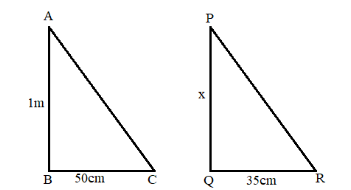
Now, find the ratio of the height of the vertical stick to its shadow,
\[Ratio = \dfrac{{1m}}{{50cm}}\]
Replace the height of the vertical stick from meter to centimeter,
\[Ratio = \dfrac{{100cm}}{{50cm}}\]
Cancel out the common factor from both numerator and denominator,
\[Ratio = 2\] …..(1)
Now, find the ratio of the height of the tower to its shadow,
$Ratio = \dfrac{x}{{35cm}}$ …..(2)
Compare both ratios and equate them,
$\dfrac{x}{{35cm}} = 2$
Cross multiply the equation,
$x = 70cm$
Hence, the height of the tower is 70cm.
Note: This can be done in another way.
To find:- the height of the tower.
Let the height of the tower be x.
The figure for the problem is,
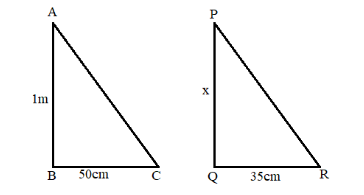
In $\Delta ABC$ and $\Delta PQR$,
$\angle B = \angle Q$ (right angle triangle)
Since the tower and the stick cast their shadows at the same time on the ground,
$\angle C = \angle R$
By AA similarity,
$\Delta ABC \sim \Delta PQR$
By CPCT,
$\dfrac{{AB}}{{PQ}} = \dfrac{{BC}}{{QR}}$
Substitute the values in the equation,
$\dfrac{{1m}}{{50cm}} = \dfrac{x}{{35cm}}$
Replace the height of the vertical stick from meter to centimeter,
$\dfrac{{100cm}}{{50cm}} = \dfrac{x}{{35cm}}$
Cancel out the common factor from both numerator and denominator,
$\dfrac{x}{{35cm}} = 2$
Cross multiply the equation,
$x = 70cm$
Hence, the height of the tower is 70cm.
Points to remember: The ratio should exist between the quantities of the same kind.
While comparing two things, the units should be similar.
There should be significant order of terms.
The comparison of two ratios can be performed, if the ratios are equivalent like the fractions.
Complete step-by-step answer:
To find:- The height of the tower.
Let the height of the tower be x.
The figure for the problem is,
Now, find the ratio of the height of the vertical stick to its shadow,
\[Ratio = \dfrac{{1m}}{{50cm}}\]
Replace the height of the vertical stick from meter to centimeter,
\[Ratio = \dfrac{{100cm}}{{50cm}}\]
Cancel out the common factor from both numerator and denominator,
\[Ratio = 2\] …..(1)
Now, find the ratio of the height of the tower to its shadow,
$Ratio = \dfrac{x}{{35cm}}$ …..(2)
Compare both ratios and equate them,
$\dfrac{x}{{35cm}} = 2$
Cross multiply the equation,
$x = 70cm$
Hence, the height of the tower is 70cm.
Note: This can be done in another way.
To find:- the height of the tower.
Let the height of the tower be x.
The figure for the problem is,
In $\Delta ABC$ and $\Delta PQR$,
$\angle B = \angle Q$ (right angle triangle)
Since the tower and the stick cast their shadows at the same time on the ground,
$\angle C = \angle R$
By AA similarity,
$\Delta ABC \sim \Delta PQR$
By CPCT,
$\dfrac{{AB}}{{PQ}} = \dfrac{{BC}}{{QR}}$
Substitute the values in the equation,
$\dfrac{{1m}}{{50cm}} = \dfrac{x}{{35cm}}$
Replace the height of the vertical stick from meter to centimeter,
$\dfrac{{100cm}}{{50cm}} = \dfrac{x}{{35cm}}$
Cancel out the common factor from both numerator and denominator,
$\dfrac{x}{{35cm}} = 2$
Cross multiply the equation,
$x = 70cm$
Hence, the height of the tower is 70cm.
Points to remember: The ratio should exist between the quantities of the same kind.
While comparing two things, the units should be similar.
There should be significant order of terms.
The comparison of two ratios can be performed, if the ratios are equivalent like the fractions.

Recently Updated Pages
Master Class 10 Computer Science: Engaging Questions & Answers for Success

Master Class 12 Physics: Engaging Questions & Answers for Success
Master Class 12 Social Science: Engaging Questions & Answers for Success
Master Class 12 English: Engaging Questions & Answers for Success
Master Class 12 Maths: Engaging Questions & Answers for Success
Master Class 12 Business Studies: Engaging Questions & Answers for Success
Trending doubts
Full Form of IASDMIPSIFSIRSPOLICE class 7 social science CBSE
List of coprime numbers from 1 to 100 class 7 maths CBSE
The plural of Chief is Chieves A True B False class 7 english CBSE
What is the use of kink in a clinical thermometer class 7 physics CBSE
Write a short note on the great bath of MohenjoDar class 7 social science CBSE
Fill in the blank with the most appropriate word What class 7 english CBSE