




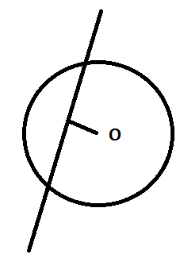
A uniformly charged and infinitely long line having a linear charge density is placed at a normal distance y from a point O. Consider a sphere of radius R with O as the center and R>y. Electric flux through the surface of the sphere is :
A. Zero
B. $\dfrac{2\lambda R}{{{\epsilon }_{0}}}$
C. $\dfrac{2\lambda \sqrt{{{R}^{2}}-{{y}^{2}}}}{{{\epsilon }_{0}}}$
D. $\dfrac{\lambda \sqrt{{{R}^{2}}-{{y}^{2}}}}{{{\epsilon }_{0}}}$
Answer
 Verified
570.9k+ views
Hint: Here, the charge on the system is only due to the long infinite wire as the sphere is neutral and hence possesses no other charge. We will find the charge enclosed in the sphere by using the linear charge density and calculate the length of the wire which is inside the sphere and apply Gauss’ law to obtain the electric flux.
Complete step by step answer:
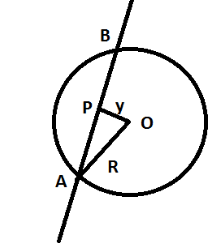
Here, the length between O and P is y, while OA is the radius of the circle which is denoted by R. Also, AB is the part of the wire which is passing through the sphere; hence AB is the diameter of the sphere. Now, the long infinite wire has a charge density on it, while the sphere is neutral.The linear charge density on the long infinite wire is. Now, the triangle OAP forms a Pythagorean triangle, which is a right angled triangle. Thus, we can find the distance AP, such that:
\[
A{P^2} = {R^2} - {y^2} \\
\Rightarrow AP = \sqrt {{R^2} - {y^2}} \\
\]
Now, AP is only the half of the distance covered by the wire inside the sphere. Thus, the charge enclosed inside the sphere due to the wire is:
Now, from Gauss's law, we know that the electric flux through any surface is given by the ratio of the charge enclosed inside the surface and the electric permittivity. Here,\[\phi \] is the electric flux and \[Q\] is the charge enclosed and is the permittivity of the material. Thus,
\[\phi =\dfrac{q}{{{\epsilon }_{0}}}\\
\therefore\phi =\dfrac{2\lambda \centerdot \sqrt{{{R}^{2}}-{{y}^{2}}}}{{{\epsilon }_{0}}}\]
Hence, option C is the correct answer.
Note: From the relation of the electric flux, we can observe that the more the distance of the wire is from the center of the sphere, the lesser would the electric flux of the sphere will be as the length of the wire passing through the sphere will decrease, while the maximum electric flux will be obtained when the wire passes through the center of the sphere.
Complete step by step answer:
Here, the length between O and P is y, while OA is the radius of the circle which is denoted by R. Also, AB is the part of the wire which is passing through the sphere; hence AB is the diameter of the sphere. Now, the long infinite wire has a charge density on it, while the sphere is neutral.The linear charge density on the long infinite wire is. Now, the triangle OAP forms a Pythagorean triangle, which is a right angled triangle. Thus, we can find the distance AP, such that:
\[
A{P^2} = {R^2} - {y^2} \\
\Rightarrow AP = \sqrt {{R^2} - {y^2}} \\
\]
Now, AP is only the half of the distance covered by the wire inside the sphere. Thus, the charge enclosed inside the sphere due to the wire is:
Now, from Gauss's law, we know that the electric flux through any surface is given by the ratio of the charge enclosed inside the surface and the electric permittivity. Here,\[\phi \] is the electric flux and \[Q\] is the charge enclosed and is the permittivity of the material. Thus,
\[\phi =\dfrac{q}{{{\epsilon }_{0}}}\\
\therefore\phi =\dfrac{2\lambda \centerdot \sqrt{{{R}^{2}}-{{y}^{2}}}}{{{\epsilon }_{0}}}\]
Hence, option C is the correct answer.
Note: From the relation of the electric flux, we can observe that the more the distance of the wire is from the center of the sphere, the lesser would the electric flux of the sphere will be as the length of the wire passing through the sphere will decrease, while the maximum electric flux will be obtained when the wire passes through the center of the sphere.
Recently Updated Pages
Basicity of sulphurous acid and sulphuric acid are

Master Class 12 English: Engaging Questions & Answers for Success
Master Class 12 Social Science: Engaging Questions & Answers for Success
Master Class 12 Maths: Engaging Questions & Answers for Success
Master Class 12 Economics: Engaging Questions & Answers for Success
Master Class 12 Physics: Engaging Questions & Answers for Success
Trending doubts
Which are the Top 10 Largest Countries of the World?
Draw a labelled sketch of the human eye class 12 physics CBSE
Draw ray diagrams each showing i myopic eye and ii class 12 physics CBSE
Give 10 examples of unisexual and bisexual flowers
Give simple chemical tests to distinguish between the class 12 chemistry CBSE
Define Vant Hoff factor How is it related to the degree class 12 chemistry CBSE