




A typical gymnosperms plant has 8 chromosomes in leaf cells. What will be the number of chromosomes in the cells of its gametophyte?
A. 16
B. 8
C. 4
D. 24
Answer
 Verified
581.4k+ views
Hint: Gymnosperms are a group of nonflowering plants that produce naked seeds or produce seeds without any fruit formation. The seeds are produced in cones and spores on the surface of the leaves or scales. The gametophytic phase involves the production of male and female gametophytes which are haploid cells. Thus, if the gymnosperm plant has 8 chromosomes the gametophyte will have 4 chromosomes.
Complete answer: Gymnosperms are a group of nonflowering vascular plants that are found in several geographical locations in and around the world. The main distinction is that these produce naked seeds in the sense that there is no fruit formation or external covering during seed formation. The seeds are formed from cones or spores on the surface of the leaves or scales of the plant.
Common examples of gymnosperms are ferns, conifers, etc. Gymnosperms reproduce primarily through sporophytic generation. Here the diploid plant produces specialized microspores and megaspores in the pollen cones and ovulates cones of the plant respectively. The pollen grains within the pollen cone mature from the microgametophyte to a microspore (gametophyte), similarly megagametophytes develop from the megaspores in the ovule cone.
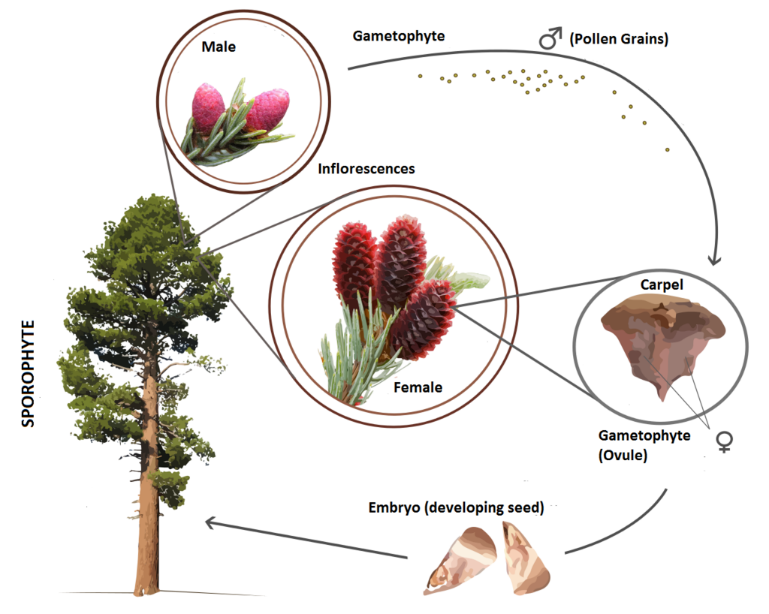
Like all gametophytes, both the microspore and the megaspore are haploid. This ensures proper fertilization when the gametes fuse. Thus, if the plant has a diploid cell it would mean that it has 2n chromosomes and the haploid cell of the same plant would have n chromosomes.
Once the microspores (n) and megaspores (n) are matured the pollen is physically deposited onto the ovule cone where fertilization occurs. This pollination is predominantly aided by wind and or insects. After fusion, the zygote develops into a sporophyte (2n).
Thus, for a given plant having a chromosome count of 8, the chromosome in the gametophyte would be 4, therefore the correct option is C.
Note:Gymnosperms have a sporophyte dominant life cycle; this refers to the fact that most vascular tissue and other cellular generation within the plant are sporophytes. Here sporophytes refer to diploid cells. Thus, it is only during gametophyte generation do the gymnosperms produce haploid cells. This is true for any gymnosperm given that they are vascular plants.
Complete answer: Gymnosperms are a group of nonflowering vascular plants that are found in several geographical locations in and around the world. The main distinction is that these produce naked seeds in the sense that there is no fruit formation or external covering during seed formation. The seeds are formed from cones or spores on the surface of the leaves or scales of the plant.
Common examples of gymnosperms are ferns, conifers, etc. Gymnosperms reproduce primarily through sporophytic generation. Here the diploid plant produces specialized microspores and megaspores in the pollen cones and ovulates cones of the plant respectively. The pollen grains within the pollen cone mature from the microgametophyte to a microspore (gametophyte), similarly megagametophytes develop from the megaspores in the ovule cone.
Like all gametophytes, both the microspore and the megaspore are haploid. This ensures proper fertilization when the gametes fuse. Thus, if the plant has a diploid cell it would mean that it has 2n chromosomes and the haploid cell of the same plant would have n chromosomes.
Once the microspores (n) and megaspores (n) are matured the pollen is physically deposited onto the ovule cone where fertilization occurs. This pollination is predominantly aided by wind and or insects. After fusion, the zygote develops into a sporophyte (2n).
Thus, for a given plant having a chromosome count of 8, the chromosome in the gametophyte would be 4, therefore the correct option is C.
Note:Gymnosperms have a sporophyte dominant life cycle; this refers to the fact that most vascular tissue and other cellular generation within the plant are sporophytes. Here sporophytes refer to diploid cells. Thus, it is only during gametophyte generation do the gymnosperms produce haploid cells. This is true for any gymnosperm given that they are vascular plants.
Recently Updated Pages
Master Class 11 Social Science: Engaging Questions & Answers for Success

Master Class 11 Physics: Engaging Questions & Answers for Success
Master Class 11 Maths: Engaging Questions & Answers for Success
Master Class 11 Economics: Engaging Questions & Answers for Success
Master Class 11 Computer Science: Engaging Questions & Answers for Success
Master Class 11 Chemistry: Engaging Questions & Answers for Success
Trending doubts
One Metric ton is equal to kg A 10000 B 1000 C 100 class 11 physics CBSE
There are 720 permutations of the digits 1 2 3 4 5 class 11 maths CBSE
1 Quintal is equal to a 110 kg b 10 kg c 100kg d 1000 class 11 physics CBSE
State and prove Bernoullis theorem class 11 physics CBSE
Difference Between Prokaryotic Cells and Eukaryotic Cells
Which among the following are examples of coming together class 11 social science CBSE