




What is a two-kingdom classification? Give its drawbacks.
Answer
 Verified
660k+ views
Hint: The kingdom discussed only the plants and animals along with their various characteristics and is a primitive system of classification that involves only the differentiation of groups based on their habitat.
Complete answer:
In the taxonomic hierarchy, kingdoms stand second in line. In 1793 Carl Linnaeus gave the term kingdom and introduced the nomenclature based on the rank system. The two-kingdom classification was introduced by Aristotle in his book ‘History of Animals ‘ while his student Theophrastus has written the book History of Plants, named Historia Plantarum. During ancient times, living beings were classified into two groups, plants, and animals.
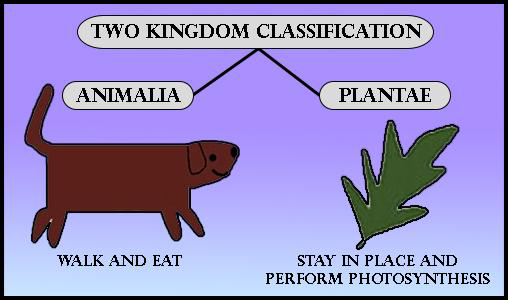
Later, in 1735 Carolus Linnaeus first published the two kingdoms of living organisms. These kingdoms include the kingdom Plantae for plants and the kingdom Animalia for animals. The classification was based on the nutrition and locomotion of an individual. Linnaeus under the kingdom Animalia placed all the multicellular organisms along with the unicellular protozoans. The animal’s kingdom was based on holozoic nutrition, locomotion, and complex body structure. The plant’s kingdom was based on autotrophic nutrition, locomotion absent (immobile), and the body structure is simple and spread out which includes algae, fungi, plants, and bacteria.
Drawbacks
-It has placed the two different groups, the eukaryotes and the prokaryotes in the same kingdom.
-It has placed the unicellular and multicellular organisms in the same kingdom.
-It did not give any evidence regarding the evolutionary relationship between the plants and animals.
-The acellular organisms like viruses are not placed in any of the kingdoms.
Note: There were various other kingdoms that were produced, the two kingdom classification (Linnaeus), three kingdom classification Linnaeus introduced plants, animals, and vegetable kingdom), later three kingdom classification was proposed by Antoine van Leeuwenhoek which include plants, animals, and protists. The fourth kingdom classification (Herbert F. Copeland he described the kingdom Plantae, the kingdom Animalia, the kingdom Monera, and the kingdom Protista). The five-kingdom classification was introduced by R. H. Whittaker which includes the kingdom Monera, Protista, Fungi, Plantae, and Animalia.
Complete answer:
In the taxonomic hierarchy, kingdoms stand second in line. In 1793 Carl Linnaeus gave the term kingdom and introduced the nomenclature based on the rank system. The two-kingdom classification was introduced by Aristotle in his book ‘History of Animals ‘ while his student Theophrastus has written the book History of Plants, named Historia Plantarum. During ancient times, living beings were classified into two groups, plants, and animals.
Later, in 1735 Carolus Linnaeus first published the two kingdoms of living organisms. These kingdoms include the kingdom Plantae for plants and the kingdom Animalia for animals. The classification was based on the nutrition and locomotion of an individual. Linnaeus under the kingdom Animalia placed all the multicellular organisms along with the unicellular protozoans. The animal’s kingdom was based on holozoic nutrition, locomotion, and complex body structure. The plant’s kingdom was based on autotrophic nutrition, locomotion absent (immobile), and the body structure is simple and spread out which includes algae, fungi, plants, and bacteria.
Drawbacks
-It has placed the two different groups, the eukaryotes and the prokaryotes in the same kingdom.
-It has placed the unicellular and multicellular organisms in the same kingdom.
-It did not give any evidence regarding the evolutionary relationship between the plants and animals.
-The acellular organisms like viruses are not placed in any of the kingdoms.
Note: There were various other kingdoms that were produced, the two kingdom classification (Linnaeus), three kingdom classification Linnaeus introduced plants, animals, and vegetable kingdom), later three kingdom classification was proposed by Antoine van Leeuwenhoek which include plants, animals, and protists. The fourth kingdom classification (Herbert F. Copeland he described the kingdom Plantae, the kingdom Animalia, the kingdom Monera, and the kingdom Protista). The five-kingdom classification was introduced by R. H. Whittaker which includes the kingdom Monera, Protista, Fungi, Plantae, and Animalia.
Recently Updated Pages
If x a + bt + ct2 where x is in meters and t is in class 11 physics CBSE

A car covers the first half distance between two places class 11 physics CBSE
The resultant of two vectors overrightarrow P and overrightarrow class 11 physics CBSE
Find the value of cos 135 class 11 maths CBSE
A mass M is held in place by an applied force F and class 11 physics CBSE
A solution of glucose in water is labelled as 10 dfracwv class 11 chemistry CBSE
Trending doubts
One Metric ton is equal to kg A 10000 B 1000 C 100 class 11 physics CBSE
Find the value of the expression given below sin 30circ class 11 maths CBSE
What do you mean by retardation What is its SI uni class 11 physics CBSE
Draw a diagram of nephron and explain its structur class 11 biology CBSE
10 examples of friction in our daily life
Difference between physical and chemical change class 11 chemistry CBSE