




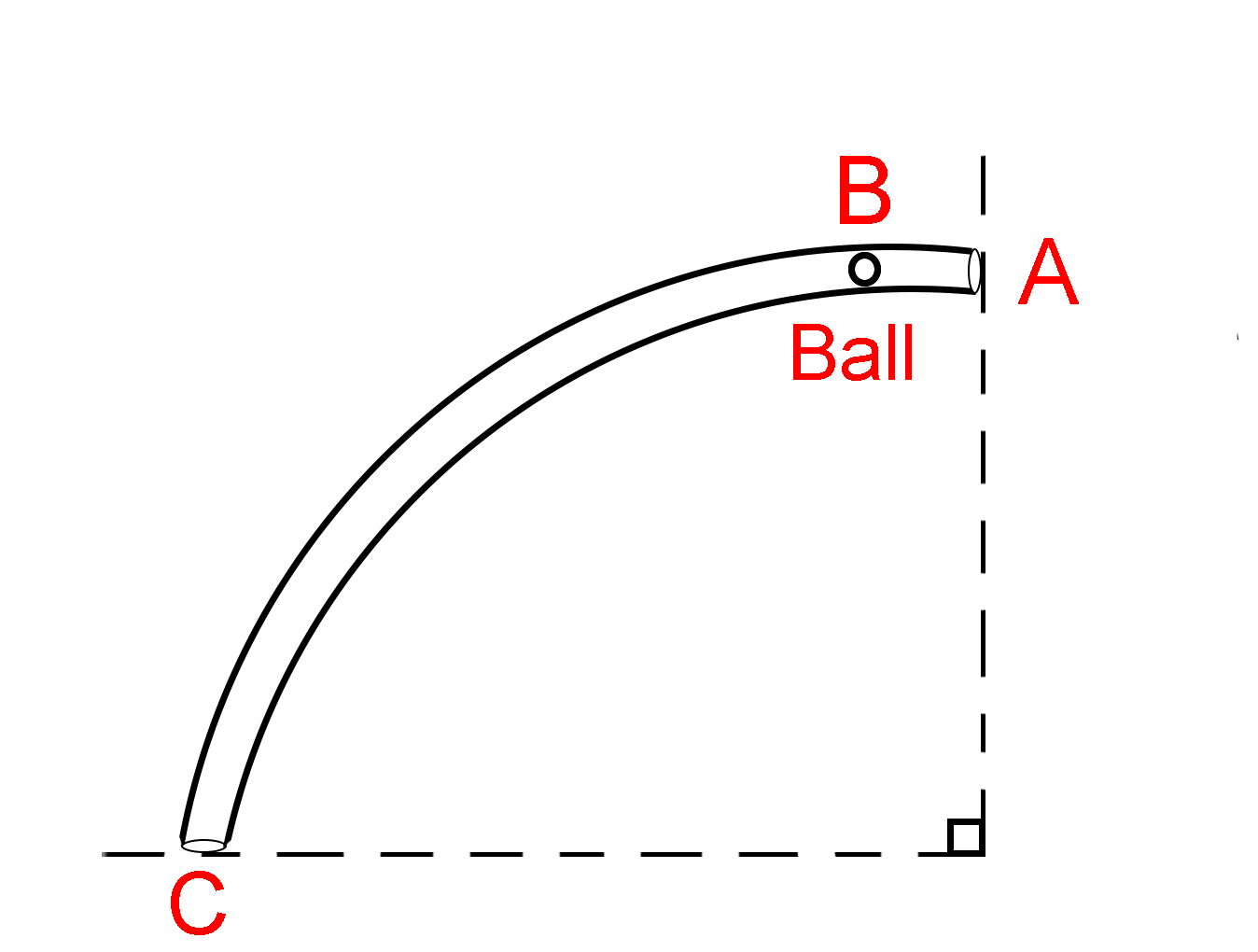
A tube AC forms a quarter circle in a vertical plane. The ball B has an area of cross-section slightly smaller than that of the tube and can move without friction through it. Ball is placed at A and is slightly displaced. The ball is
A. Always in contact with the inner wall.
B. Always in contact with the outer wall.
C. Initially in contact with the inner wall and at some point it comes in contact with the outer wall.
D. Initially in contact with outer wall and finally comes in contact with inner wall
Answer
 Verified
610.2k+ views
Hint: You can start by describing how the ball will only experience downwards force (i.e. gravitational force) at point A and will remain in contact with the inner wall. Then move on to describe how the ball will remain in contact with the outer wall of the tube due to centrifugal force acting on the ball. Use this method to choose the correct choice.
Complete step by step answer:
At point A the ball only has potential energy. At point A only one force is acting on the ball i.e. gravitational force on the ball. This force is in the downwards direction i.e. towards the inner wall of the tube. So at point A the ball is in contact with the inner wall of the tube.
After falling through the tube, at point C the potential energy has converted into kinetic energy. Kinetic energy means that the ball has some velocity. The ball is moving in a circle and we know that a body in circular motion always experiences a centrifugal force that wants to push it out of its circular path. Thus the ball will exert force against the outer wall of the tube, so the ball will be in contact with the outer wall.
Thus, the ball is initially in contact with the inner wall and then it comes in contact with the outer wall at some point.
So, the correct answer is “Option C”.
Note: In the problem given it is specifically mentioned that there is no force of friction between the ball and the walls of the tube. But in reality the ball will experience some force of friction. This will greatly affect the speed and motion of the ball. So it is really important to keep in mind the specific conditions mentioned in the problem.
Complete step by step answer:
At point A the ball only has potential energy. At point A only one force is acting on the ball i.e. gravitational force on the ball. This force is in the downwards direction i.e. towards the inner wall of the tube. So at point A the ball is in contact with the inner wall of the tube.
After falling through the tube, at point C the potential energy has converted into kinetic energy. Kinetic energy means that the ball has some velocity. The ball is moving in a circle and we know that a body in circular motion always experiences a centrifugal force that wants to push it out of its circular path. Thus the ball will exert force against the outer wall of the tube, so the ball will be in contact with the outer wall.
Thus, the ball is initially in contact with the inner wall and then it comes in contact with the outer wall at some point.
So, the correct answer is “Option C”.
Note: In the problem given it is specifically mentioned that there is no force of friction between the ball and the walls of the tube. But in reality the ball will experience some force of friction. This will greatly affect the speed and motion of the ball. So it is really important to keep in mind the specific conditions mentioned in the problem.
Recently Updated Pages
Master Class 11 Social Science: Engaging Questions & Answers for Success

Master Class 11 Physics: Engaging Questions & Answers for Success
Master Class 11 Maths: Engaging Questions & Answers for Success
Master Class 11 Economics: Engaging Questions & Answers for Success
Master Class 11 Computer Science: Engaging Questions & Answers for Success
Master Class 11 Chemistry: Engaging Questions & Answers for Success
Trending doubts
One Metric ton is equal to kg A 10000 B 1000 C 100 class 11 physics CBSE
How many bones are in the spine class 11 biology CBSE
1 Quintal is equal to a 110 kg b 10 kg c 100kg d 1000 class 11 physics CBSE
There are 720 permutations of the digits 1 2 3 4 5 class 11 maths CBSE
State and prove Bernoullis theorem class 11 physics CBSE
Difference Between Prokaryotic Cells and Eukaryotic Cells