




A truck travelling due north at $20m/s$ turns west and travels at the same speed. Then the change in velocity is
(A) $20\sqrt 2 m{s^{ - 1}}$ southwest
(B) $40m{s^{ - 1}}$southwest
(C) $20\sqrt 2 m{s^{ - 1}}$ northwest
(D) $40m{s^{ - 1}}$ northwest
Answer
 Verified
597.6k+ views
Hint
Velocity is a vector quantity. So, with the change in direction, velocity is also changed even if the magnitude remains the same. We solve this question by representing the velocities given in the question as sides of a right-angle triangle and find the change in velocity using Pythagoras theorem.
Formula used: Pythagoras theorem ${H^2} = {A^2} + {B^2}$
Sides of a triangle are represented by $A,B$
The hypotenuse is represented by $H$
Complete step by step answer
Let the initial and final velocity be ${v_i}$ and ${v_f}$ respectively.
Change in velocity is the difference of initial velocity from final velocity, ${v_f} - {v_i} = {v_f} + ( - {v_i})$
The truck is first traveling from south to north and then takes a turn towards the west. The vectors for this are represented as
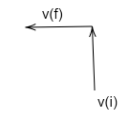
Since the change in velocity is final velocity minus the initial velocity, the position of vector changes,
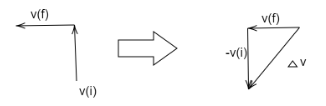
The resultant of these two vectors is found by using Pythagoras theorem
$ \Rightarrow \Delta {v^2} = {v_f}^2 + ( - v_i^2)$
The truck is traveling at $20m/s$
$ \vartriangle v = \sqrt {{{20}^2} + {{20}^2}} $
$ \Rightarrow \vartriangle v = 20\sqrt 2 m{s^{ - 1}}$
Since the truck starts from the south and goes towards the north and then turns west at the end, the direction is southwest.
Hence, option (A) $20\sqrt 2 m{s^{ - 1}}$ southwest is the correct answer.
Note
The method which is used in the question is also known as the triangle law of vector addition. This question can also be solved by writing the velocities in vector form and then using the formula for the resultant vector to find the change in velocity. Students might get confused while finding the direction of the change in velocity. The truck is moving from south to north and then turns towards the west. Hence the direction is taken as southwest.
Velocity is a vector quantity. So, with the change in direction, velocity is also changed even if the magnitude remains the same. We solve this question by representing the velocities given in the question as sides of a right-angle triangle and find the change in velocity using Pythagoras theorem.
Formula used: Pythagoras theorem ${H^2} = {A^2} + {B^2}$
Sides of a triangle are represented by $A,B$
The hypotenuse is represented by $H$
Complete step by step answer
Let the initial and final velocity be ${v_i}$ and ${v_f}$ respectively.
Change in velocity is the difference of initial velocity from final velocity, ${v_f} - {v_i} = {v_f} + ( - {v_i})$
The truck is first traveling from south to north and then takes a turn towards the west. The vectors for this are represented as
Since the change in velocity is final velocity minus the initial velocity, the position of vector changes,
The resultant of these two vectors is found by using Pythagoras theorem
$ \Rightarrow \Delta {v^2} = {v_f}^2 + ( - v_i^2)$
The truck is traveling at $20m/s$
$ \vartriangle v = \sqrt {{{20}^2} + {{20}^2}} $
$ \Rightarrow \vartriangle v = 20\sqrt 2 m{s^{ - 1}}$
Since the truck starts from the south and goes towards the north and then turns west at the end, the direction is southwest.
Hence, option (A) $20\sqrt 2 m{s^{ - 1}}$ southwest is the correct answer.
Note
The method which is used in the question is also known as the triangle law of vector addition. This question can also be solved by writing the velocities in vector form and then using the formula for the resultant vector to find the change in velocity. Students might get confused while finding the direction of the change in velocity. The truck is moving from south to north and then turns towards the west. Hence the direction is taken as southwest.
Recently Updated Pages
Master Class 11 Social Science: Engaging Questions & Answers for Success

Master Class 11 Chemistry: Engaging Questions & Answers for Success
Master Class 12 Business Studies: Engaging Questions & Answers for Success
Master Class 12 Chemistry: Engaging Questions & Answers for Success
Master Class 12 Biology: Engaging Questions & Answers for Success
Class 12 Question and Answer - Your Ultimate Solutions Guide
Trending doubts
One Metric ton is equal to kg A 10000 B 1000 C 100 class 11 physics CBSE
Difference Between Prokaryotic Cells and Eukaryotic Cells
Two of the body parts which do not appear in MRI are class 11 biology CBSE
Explain zero factorial class 11 maths CBSE
10 examples of friction in our daily life
Name the Largest and the Smallest Cell in the Human Body ?