




What is a trimerous flower? Which group of plants has trimerous flowers?
Answer
 Verified
538.8k+ views
Hint: Flowers are a plant's reproductive organ. They are not only involved in reproduction, but also serve as a food supply for other living things. They produce a lot of nectar. There are two types of flowers: complete and incomplete. The sepals, petals, stamens, and pistils all make up a whole flower. On the other hand, an incomplete bloom is one that lacks one or more of these structures. A whole flower is made up of two distinct parts: Parts that are vegetative and those that are reproductive.
Complete answer:
Floral symmetry refers to the ability of a flower, specifically its perianth, to be divided into two or more identical or mirror-image portions.
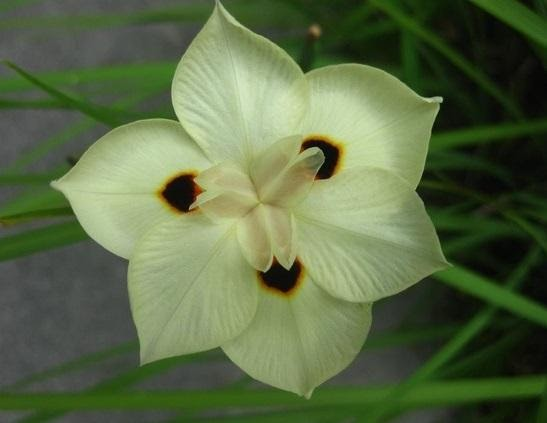
Flowers with only three petals are known as trimerous flowers. Monocotyledons have trimerous flowers. Monocotyledons are plants with only one cotyledon. Monocot leaves feature parallel venation and have a fibrous root structure. Garlic, onions, wheat, corn, and grass, rice, maize, bamboo, palm, banana, ginger, lilies, orchids, and tulips are examples of edible plants.
Additional information:
Petals, Carpels, Sepals, and Stamens are the four whorls that make up every flower. The flower bud is surrounded by sepals, which are leafy structures. The Petals have contrasting colours to encourage pollinating insects. Male reproductive structures are androecium, whereas female reproductive structures are Gynoecium.
Note:
Pollination is the process through which flowers reproduce. Male gametes are transmitted to female ovules, where fertilisation happens and ovules mature into seeds within a fruit, in this process. The male reproductive component of a flower is the stamen, whereas the female reproductive part is the pistil. The filament and anther encircle the stamen. Pollen grains are produced by the anthers. The vegetative portions of a flower are the sepals and petals.
Complete answer:
Floral symmetry refers to the ability of a flower, specifically its perianth, to be divided into two or more identical or mirror-image portions.
Flowers with only three petals are known as trimerous flowers. Monocotyledons have trimerous flowers. Monocotyledons are plants with only one cotyledon. Monocot leaves feature parallel venation and have a fibrous root structure. Garlic, onions, wheat, corn, and grass, rice, maize, bamboo, palm, banana, ginger, lilies, orchids, and tulips are examples of edible plants.
Additional information:
Petals, Carpels, Sepals, and Stamens are the four whorls that make up every flower. The flower bud is surrounded by sepals, which are leafy structures. The Petals have contrasting colours to encourage pollinating insects. Male reproductive structures are androecium, whereas female reproductive structures are Gynoecium.
Note:
Pollination is the process through which flowers reproduce. Male gametes are transmitted to female ovules, where fertilisation happens and ovules mature into seeds within a fruit, in this process. The male reproductive component of a flower is the stamen, whereas the female reproductive part is the pistil. The filament and anther encircle the stamen. Pollen grains are produced by the anthers. The vegetative portions of a flower are the sepals and petals.
Recently Updated Pages
Master Class 12 Economics: Engaging Questions & Answers for Success

Master Class 12 English: Engaging Questions & Answers for Success
Master Class 12 Social Science: Engaging Questions & Answers for Success
Master Class 12 Maths: Engaging Questions & Answers for Success
Master Class 12 Physics: Engaging Questions & Answers for Success
Master Class 9 General Knowledge: Engaging Questions & Answers for Success
Trending doubts
One Metric ton is equal to kg A 10000 B 1000 C 100 class 11 physics CBSE
Difference Between Prokaryotic Cells and Eukaryotic Cells
Two of the body parts which do not appear in MRI are class 11 biology CBSE
1 ton equals to A 100 kg B 1000 kg C 10 kg D 10000 class 11 physics CBSE
10 examples of friction in our daily life
DNA is not present in A Nucleus B Mitochondria C Chloroplast class 11 biology CBSE