




A train starts at 8 O’ clock and moves eastward at the speed of 60 km/h. Another train starts from the same point at 9 O’ clock and travels southward at the speed of 80 km/h. Find the rate at which they are moving away from each other at 12 O’ clock.
Answer
 Verified
598.8k+ views
Hint: Here, we will first find the positions of both the trains at 12 O’ clock and find the distance between them at 12 O’ clock. Establish a relation between known quantities and unknown quantities and find the speed at particular time using differentiation.
Complete step by step answer:
Given, speed along eastward direction, i.e. along x-axis, $dx = 60$ km/h.
Also, given speed along southward direction, i.e. along negative y-axis, $dy = 80$ km/h.
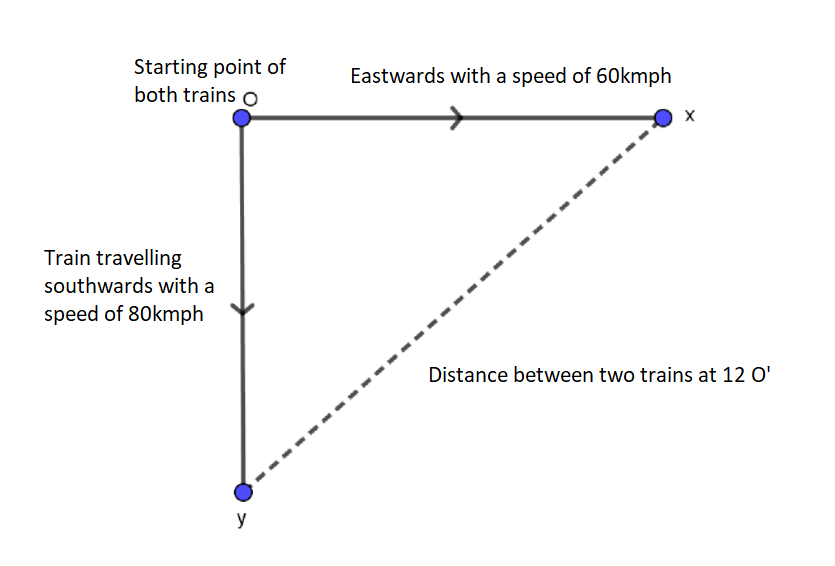
Time taken by train moving towards eastward direction to reach a particular point at 12 O’ Clock = 12 O’ clock – 8 O’ clock = 4 hours
Distance covered by train in eastward direction in 4 hours i.e. train position at 12 O’ clock from initial position, $x = 60 \times 4 = 240$km.
And, time taken by train moving towards southward direction to reach a particular point at 12 O’ Clock = 12 O’ clock – 9 O’ clock = 3 hours
Distance covered by train in southward direction in 3 hours i.e. train position at 12 O’ clock from initial position, \[y = 80 \times 3 = 240\]km.
Distance between two trains at 12 O’ clock, $z = \sqrt {{x^2} + {y^2}} $ …(i)
Z at 12 O’ clock = $\sqrt {{{\left( {240} \right)}^2} + {{\left( {240} \right)}^2}} = \sqrt {57600 + 57600} $
= $\sqrt {114200} = 240\sqrt 2 $ km
Squaring both sides of equation (i), we get
${z^2} = {x^2} + {y^2}$
Differentiating both sides,
$2zdz = 2xdx + 2ydy$
$ \Rightarrow dz = \dfrac{{2xdx + 2ydy}}{{2z}}$
We have at 12 O’ clock, $x = 240,dx = 60,y = 240,dy = 80,z = 240\sqrt 2 $
Putting values in equation (ii), we get
$dz = \dfrac{{2 \times 240 \times 60 + 2 \times 240 \times 80}}{{2 \times 240\sqrt 2 }}$
$ \Rightarrow dz = \dfrac{{28800 + 38400}}{{480\sqrt 2 }}$
$ \Rightarrow dz = \dfrac{{67200}}{{480\sqrt 2 }} = \dfrac{{140}}{{\sqrt 2 }} = 70\sqrt 2 $
Therefore, the rate at which the two trains are moving away from each other at 12 O’ clock is $70\sqrt 2 $ km/h.
Note:
In these types of questions, drawing the figure to understand the relative position, appropriate diagram will help in finding the relative distance between the trains/cars at a particular time. Use differentiation methods to find the speed at a particular time.
Complete step by step answer:
Given, speed along eastward direction, i.e. along x-axis, $dx = 60$ km/h.
Also, given speed along southward direction, i.e. along negative y-axis, $dy = 80$ km/h.
Time taken by train moving towards eastward direction to reach a particular point at 12 O’ Clock = 12 O’ clock – 8 O’ clock = 4 hours
Distance covered by train in eastward direction in 4 hours i.e. train position at 12 O’ clock from initial position, $x = 60 \times 4 = 240$km.
And, time taken by train moving towards southward direction to reach a particular point at 12 O’ Clock = 12 O’ clock – 9 O’ clock = 3 hours
Distance covered by train in southward direction in 3 hours i.e. train position at 12 O’ clock from initial position, \[y = 80 \times 3 = 240\]km.
Distance between two trains at 12 O’ clock, $z = \sqrt {{x^2} + {y^2}} $ …(i)
Z at 12 O’ clock = $\sqrt {{{\left( {240} \right)}^2} + {{\left( {240} \right)}^2}} = \sqrt {57600 + 57600} $
= $\sqrt {114200} = 240\sqrt 2 $ km
Squaring both sides of equation (i), we get
${z^2} = {x^2} + {y^2}$
Differentiating both sides,
$2zdz = 2xdx + 2ydy$
$ \Rightarrow dz = \dfrac{{2xdx + 2ydy}}{{2z}}$
We have at 12 O’ clock, $x = 240,dx = 60,y = 240,dy = 80,z = 240\sqrt 2 $
Putting values in equation (ii), we get
$dz = \dfrac{{2 \times 240 \times 60 + 2 \times 240 \times 80}}{{2 \times 240\sqrt 2 }}$
$ \Rightarrow dz = \dfrac{{28800 + 38400}}{{480\sqrt 2 }}$
$ \Rightarrow dz = \dfrac{{67200}}{{480\sqrt 2 }} = \dfrac{{140}}{{\sqrt 2 }} = 70\sqrt 2 $
Therefore, the rate at which the two trains are moving away from each other at 12 O’ clock is $70\sqrt 2 $ km/h.
Note:
In these types of questions, drawing the figure to understand the relative position, appropriate diagram will help in finding the relative distance between the trains/cars at a particular time. Use differentiation methods to find the speed at a particular time.
Recently Updated Pages
Master Class 10 Computer Science: Engaging Questions & Answers for Success

Master Class 10 General Knowledge: Engaging Questions & Answers for Success
Master Class 10 English: Engaging Questions & Answers for Success
Master Class 10 Social Science: Engaging Questions & Answers for Success
Master Class 10 Maths: Engaging Questions & Answers for Success
Master Class 10 Science: Engaging Questions & Answers for Success
Trending doubts
What is the median of the first 10 natural numbers class 10 maths CBSE
Which women's tennis player has 24 Grand Slam singles titles?
Who is the Brand Ambassador of Incredible India?
Why is there a time difference of about 5 hours between class 10 social science CBSE
Write a letter to the principal requesting him to grant class 10 english CBSE
State and prove converse of BPT Basic Proportionality class 10 maths CBSE