




A three way light bulb has three brightness settings (low, medium, high) but only two filaments. A particular light bulb (of the said description) when connected across a 120 V line can with higher resistance burns out. The two filaments are arranged in three settings.
(i) higher resistance filament only working for 60 W
(ii) low resistance filament working for 120 W
(iii) low resistance filament working for 60 W
(iv) high resistance filament working for 120 W
(v) low and high resistance filaments in parallel for 180 W
(vi) low and high resistance filament in series for 180 W
A. (i), (ii) and (v) are correct
B. (i), (ii) and (vi) are correct
C. (iii), (iv) and (v) are correct
D. (iii), (iv) and (vi) are correct
Answer
 Verified
632.4k+ views
Hint: In order to solve this type of question, let us arrange the three way bulb which is having two filaments in the circuit connected with a battery. Also we should have an idea about open switch and closed switch.
Complete step by step answer:
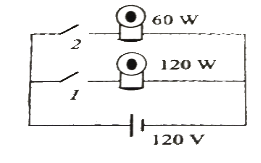
The 60W bulb will be of higher resistance. If we consider only switch 1 is closed, the 120W bulb will glow instantly. If only switch 2 is closed, the 60W bulb will glow. If both the switches are closed, both bulbs will glow with high intensity that is total illumination or intensity of 180 W. When the bulb filament of higher resistance (60 power watt bulb) burns out, then the power dissipated will be 120 watt when either 1 is closed or both are closed.Because if the higher resistance filament burns out. Then the circuit must work for 60 watt. If lower the resistance then it doesn't burn out and hence the whole circuit works for 120 watt. Now the parallel voltage across two bulbs remains the same (which we are supplying).The powers of two resistors must add up. We get the total power in the circuit is 60+120=180W in parallel.
Hence, option A is correct.
Note: If we have several on-off switches connected in parallel in the circuit only one switch needs to be closed which is ON to complete the circuit. The diagram shows a simple circuit with two switches connected in parallel to control the bulb. If we close both the Switch S1 OR Switch S2 then we can illuminate the bulb.
Complete step by step answer:
The 60W bulb will be of higher resistance. If we consider only switch 1 is closed, the 120W bulb will glow instantly. If only switch 2 is closed, the 60W bulb will glow. If both the switches are closed, both bulbs will glow with high intensity that is total illumination or intensity of 180 W. When the bulb filament of higher resistance (60 power watt bulb) burns out, then the power dissipated will be 120 watt when either 1 is closed or both are closed.Because if the higher resistance filament burns out. Then the circuit must work for 60 watt. If lower the resistance then it doesn't burn out and hence the whole circuit works for 120 watt. Now the parallel voltage across two bulbs remains the same (which we are supplying).The powers of two resistors must add up. We get the total power in the circuit is 60+120=180W in parallel.
Hence, option A is correct.
Note: If we have several on-off switches connected in parallel in the circuit only one switch needs to be closed which is ON to complete the circuit. The diagram shows a simple circuit with two switches connected in parallel to control the bulb. If we close both the Switch S1 OR Switch S2 then we can illuminate the bulb.
Recently Updated Pages
Basicity of sulphurous acid and sulphuric acid are

Master Class 10 Computer Science: Engaging Questions & Answers for Success
Master Class 10 Social Science: Engaging Questions & Answers for Success
Master Class 10 Science: Engaging Questions & Answers for Success
Class 10 Question and Answer - Your Ultimate Solutions Guide
Master Class 10 Maths: Engaging Questions & Answers for Success
Trending doubts
What is the Total Duration of Football Match?
Explain the Treaty of Vienna of 1815 class 10 social science CBSE
In football, which nation is called "La Roja"?
Why is there a time difference of about 5 hours between class 10 social science CBSE
10 examples of evaporation in daily life with explanations
What is the full form of POSCO class 10 social science CBSE