




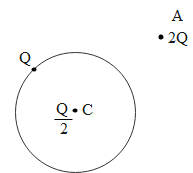
A thin metallic spherical shell of radius R carries a charge Q on its surface. A point charge $\dfrac{Q}{2}$ is placed at its center C and another charge +2Q is placed outside the shell at a distance x from the centre as shown in the figure. Find (i) force on the charge at the centre of the shell and at point A. (ii)the electric flux through the shell.
Answer
 Verified
566.1k+ views
Hint: The determine the electrostatic force at any point in the above system we need to obtain the electric field at that point. Hence further using the relation between the electric field and force on a charge, we can determine the magnitude of the force acting on the charge at the required point. To determine the flux we can use Gaussian expression can be used for flux across a closed surface.
Formula used:
$\phi =\dfrac{q}{{{\in }_{\circ }}}$
$\phi =E\Delta S$
$F=EQ$
Complete answer:
Let us say there is a charge ‘q’ enclosed by a closed surface. If ${{\in }_{\circ }}$ is the permittivity of free space, the flux $\phi $ through the closed surface is given by,
$\phi =\dfrac{q}{{{\in }_{\circ }}}.....(1)$
If the electric field at the surface closed surface is ‘E’ and the surface area of the closed Gaussian surface is $\Delta S$, the total flux across the closed is also given by,
$\phi =E\Delta S.....(2)$
Let us enclose the spherical shell in a closed spherical Gaussian surface of radius ‘x’. Hence the flux through the closed surface from equation 2 is given by,
$\begin{align}
& \phi =E\Delta S \\
& \therefore \phi =E4\pi {{x}^{2}}.....(3) \\
\end{align}$
The total charge ‘q’ enclosed by the Gaussian surface is,
$q=Q+\dfrac{Q}{2}=\dfrac{3Q}{2}$
Hence using equation 1, the flux through the spherical surface of radius ‘x’ is given by,
$\begin{align}
& \phi =\dfrac{q}{{{\in }_{\circ }}} \\
& \because q=\dfrac{3Q}{2} \\
& \therefore \phi =\dfrac{\dfrac{3Q}{2}}{{{\in }_{\circ }}}=\dfrac{3Q}{2{{\in }_{\circ }}}.....(4) \\
\end{align}$
Equating equation 3 and 4 we obtain,
$\begin{align}
& E4\pi {{x}^{2}}=\dfrac{3Q}{2{{\in }_{\circ }}} \\
& \Rightarrow E=\dfrac{3}{2}\left( \dfrac{Q}{4\pi {{\in }_{\circ }}{{x}^{2}}} \right) \\
\end{align}$
The electric force (F) experienced by the charge Q=+2Q is placed outside the shell at a distance x is given by,
$\begin{align}
& F=EQ \\
& \because E=\dfrac{3}{2}\left( \dfrac{Q}{4\pi {{\in }_{\circ }}{{x}^{2}}} \right),\text{ }Q=+2Q \\
& \Rightarrow F=\dfrac{3}{2}\left( \dfrac{Q}{4\pi {{\in }_{\circ }}{{x}^{2}}} \right)\left( +2Q \right) \\
& \therefore F=\left( \dfrac{3{{Q}^{2}}}{4\pi {{\in }_{\circ }}{{x}^{2}}} \right) \\
\end{align}$
Therefore the force on charge +2Q is equal to $\dfrac{3{{Q}^{2}}}{4\pi {{\in }_{\circ }}{{x}^{2}}}$.
The electric field inside a closed metallic surface is zero. Hence the force experienced by the charge placed at the centre C is also zero.
The flux through the metallic spherical shell is equal to,
$\begin{align}
& \phi =\dfrac{q}{{{\in }_{\circ }}} \\
& \because q=\dfrac{3Q}{2} \\
& \Rightarrow \phi =\dfrac{\dfrac{3Q}{2}}{{{\in }_{\circ }}}=\dfrac{3Q}{2{{\in }_{\circ }}} \\
\end{align}$
Note:
The above expression for flux can only be obtained for closed Gaussian surface. The flux through the surface does not depend on the radius of the surface. It only depends on the medium enclosed within the surface and the charge enclosed.
Formula used:
$\phi =\dfrac{q}{{{\in }_{\circ }}}$
$\phi =E\Delta S$
$F=EQ$
Complete answer:
Let us say there is a charge ‘q’ enclosed by a closed surface. If ${{\in }_{\circ }}$ is the permittivity of free space, the flux $\phi $ through the closed surface is given by,
$\phi =\dfrac{q}{{{\in }_{\circ }}}.....(1)$
If the electric field at the surface closed surface is ‘E’ and the surface area of the closed Gaussian surface is $\Delta S$, the total flux across the closed is also given by,
$\phi =E\Delta S.....(2)$
Let us enclose the spherical shell in a closed spherical Gaussian surface of radius ‘x’. Hence the flux through the closed surface from equation 2 is given by,
$\begin{align}
& \phi =E\Delta S \\
& \therefore \phi =E4\pi {{x}^{2}}.....(3) \\
\end{align}$
The total charge ‘q’ enclosed by the Gaussian surface is,
$q=Q+\dfrac{Q}{2}=\dfrac{3Q}{2}$
Hence using equation 1, the flux through the spherical surface of radius ‘x’ is given by,
$\begin{align}
& \phi =\dfrac{q}{{{\in }_{\circ }}} \\
& \because q=\dfrac{3Q}{2} \\
& \therefore \phi =\dfrac{\dfrac{3Q}{2}}{{{\in }_{\circ }}}=\dfrac{3Q}{2{{\in }_{\circ }}}.....(4) \\
\end{align}$
Equating equation 3 and 4 we obtain,
$\begin{align}
& E4\pi {{x}^{2}}=\dfrac{3Q}{2{{\in }_{\circ }}} \\
& \Rightarrow E=\dfrac{3}{2}\left( \dfrac{Q}{4\pi {{\in }_{\circ }}{{x}^{2}}} \right) \\
\end{align}$
The electric force (F) experienced by the charge Q=+2Q is placed outside the shell at a distance x is given by,
$\begin{align}
& F=EQ \\
& \because E=\dfrac{3}{2}\left( \dfrac{Q}{4\pi {{\in }_{\circ }}{{x}^{2}}} \right),\text{ }Q=+2Q \\
& \Rightarrow F=\dfrac{3}{2}\left( \dfrac{Q}{4\pi {{\in }_{\circ }}{{x}^{2}}} \right)\left( +2Q \right) \\
& \therefore F=\left( \dfrac{3{{Q}^{2}}}{4\pi {{\in }_{\circ }}{{x}^{2}}} \right) \\
\end{align}$
Therefore the force on charge +2Q is equal to $\dfrac{3{{Q}^{2}}}{4\pi {{\in }_{\circ }}{{x}^{2}}}$.
The electric field inside a closed metallic surface is zero. Hence the force experienced by the charge placed at the centre C is also zero.
The flux through the metallic spherical shell is equal to,
$\begin{align}
& \phi =\dfrac{q}{{{\in }_{\circ }}} \\
& \because q=\dfrac{3Q}{2} \\
& \Rightarrow \phi =\dfrac{\dfrac{3Q}{2}}{{{\in }_{\circ }}}=\dfrac{3Q}{2{{\in }_{\circ }}} \\
\end{align}$
Note:
The above expression for flux can only be obtained for closed Gaussian surface. The flux through the surface does not depend on the radius of the surface. It only depends on the medium enclosed within the surface and the charge enclosed.
Recently Updated Pages
Master Class 12 Economics: Engaging Questions & Answers for Success

Master Class 12 English: Engaging Questions & Answers for Success
Master Class 12 Social Science: Engaging Questions & Answers for Success
Master Class 12 Maths: Engaging Questions & Answers for Success
Master Class 12 Physics: Engaging Questions & Answers for Success
Master Class 9 General Knowledge: Engaging Questions & Answers for Success
Trending doubts
One Metric ton is equal to kg A 10000 B 1000 C 100 class 11 physics CBSE
Difference Between Prokaryotic Cells and Eukaryotic Cells
Two of the body parts which do not appear in MRI are class 11 biology CBSE
1 ton equals to A 100 kg B 1000 kg C 10 kg D 10000 class 11 physics CBSE
Draw a diagram of nephron and explain its structur class 11 biology CBSE
10 examples of friction in our daily life