




A telegraph post gets broken at a point against a storm and its top touches the ground at a distance 20 m from the base of the post making an angle \[30^\circ \] with the ground. What is the height of the post?
A) \[\dfrac{{40}}{{\sqrt 3 }}\] m
B) \[20\sqrt 3 \] m
C) \[40\sqrt 3 \] m
D) 30 m
Answer
 Verified
671.7k+ views
Hint: Use trigonometry ratio \[\tan \theta = \dfrac{{{\text{Perpendicular}}}}{{{\text{Base}}}}\] to find remaining height of the post after breakage and \[\sec \theta = \dfrac{{{\text{Hypotenuses}}}}{{{\text{Base}}}}\] to find the broken height of the post and then add both the heights to find the total height of the post.
Complete Step-by-Step solution:
First, we will draw the figure to understand the question,
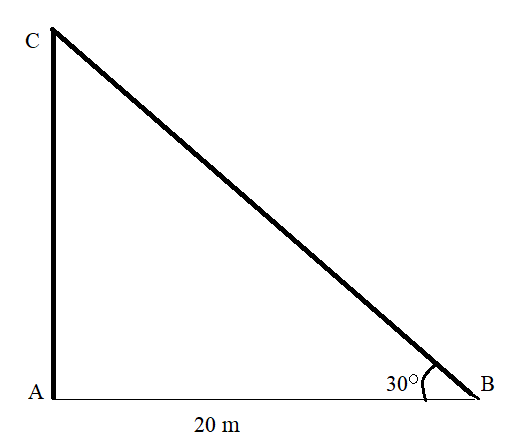
From the figure, the height of the post is \[AC + CB\] where AC is the remaining height of the post after breakage and CB is the broken height of the post.
Our first task is to find AC and BC. So, let’s move forward to find AC first.
As we know that, \[\tan \theta = \dfrac{{{\text{Perpendicular}}}}{{{\text{Base}}}}\] and we have the value of \[\theta \] and base and have to find perpendicular so, this trigonometry is best fit to find AC.
Now we are applying this trigonometric ratio into the triangle ABC and substituting the values into trigonometric ratio,
\[
\tan 30^\circ = \dfrac{{{\text{AC}}}}{{{\text{AB}}}} \\
\tan 30^\circ = \dfrac{{{\text{AC}}}}{{{\text{20}}}} \\
\]
From this, we can find AC as,
\[AC = 20\tan 30^\circ \]
We know that \[\tan 30^\circ = \dfrac{{\text{1}}}{{\sqrt 3 }}\], substituting this in the last result, we get
\[AC = \dfrac{{20}}{{\sqrt 3 }}\]
Now we will find CB, means we have to find hypotenuses of the triangle and for this the trigonometry ratio \[\sec \theta = \dfrac{{{\text{Hypotenuses}}}}{{{\text{Base}}}}\] is best fit.
Now we are applying this trigonometric ratio into the triangle ABC and substituting the values into trigonometric ratio,
\[
\sec 30^\circ = \dfrac{{{\text{CB}}}}{{{\text{AB}}}} \\
\sec 30^\circ = \dfrac{{{\text{CB}}}}{{{\text{20}}}} \\
\]
From this, we can find CB as,
\[CB = 20\sec 30^\circ \]
We know that \[\sec 30^\circ = \dfrac{2}{{\sqrt 3 }}\], substituting this in the last result, we get
\[
CB = \dfrac{{20 \cdot 2}}{{\sqrt 3 }} \\
= \dfrac{{40}}{{\sqrt 3 }} \\
\]
Now we have both AC and CB.
We are adding AC and CB to find the actual height of the post,
\[
AC + CB = \dfrac{{20}}{{\sqrt 3 }} + \dfrac{{40}}{{\sqrt 3 }} \\
= \dfrac{{20 + 40}}{{\sqrt 3 }} \\
= \dfrac{{60}}{{\sqrt 3 }} \\
\]
This is not an option.
So, we will rationalize denominator to get the correct option,
\[
AC + CB = \dfrac{{60}}{{\sqrt 3 }} \cdot \dfrac{{\sqrt 3 }}{{\sqrt 3 }} \\
= \dfrac{{60\sqrt 3 }}{3} \\
= 20\sqrt 3 \\
\]
Thus, the height of the post is \[20\sqrt 3 \] meters.
Hence option B is correct.
Note:
Any of the trigonometric functions can be used to find the answer but while solving these types of questions we have to first focus on “what we have to find” and then on “what data we have” so make our calculation shorter.
Complete Step-by-Step solution:
First, we will draw the figure to understand the question,
From the figure, the height of the post is \[AC + CB\] where AC is the remaining height of the post after breakage and CB is the broken height of the post.
Our first task is to find AC and BC. So, let’s move forward to find AC first.
As we know that, \[\tan \theta = \dfrac{{{\text{Perpendicular}}}}{{{\text{Base}}}}\] and we have the value of \[\theta \] and base and have to find perpendicular so, this trigonometry is best fit to find AC.
Now we are applying this trigonometric ratio into the triangle ABC and substituting the values into trigonometric ratio,
\[
\tan 30^\circ = \dfrac{{{\text{AC}}}}{{{\text{AB}}}} \\
\tan 30^\circ = \dfrac{{{\text{AC}}}}{{{\text{20}}}} \\
\]
From this, we can find AC as,
\[AC = 20\tan 30^\circ \]
We know that \[\tan 30^\circ = \dfrac{{\text{1}}}{{\sqrt 3 }}\], substituting this in the last result, we get
\[AC = \dfrac{{20}}{{\sqrt 3 }}\]
Now we will find CB, means we have to find hypotenuses of the triangle and for this the trigonometry ratio \[\sec \theta = \dfrac{{{\text{Hypotenuses}}}}{{{\text{Base}}}}\] is best fit.
Now we are applying this trigonometric ratio into the triangle ABC and substituting the values into trigonometric ratio,
\[
\sec 30^\circ = \dfrac{{{\text{CB}}}}{{{\text{AB}}}} \\
\sec 30^\circ = \dfrac{{{\text{CB}}}}{{{\text{20}}}} \\
\]
From this, we can find CB as,
\[CB = 20\sec 30^\circ \]
We know that \[\sec 30^\circ = \dfrac{2}{{\sqrt 3 }}\], substituting this in the last result, we get
\[
CB = \dfrac{{20 \cdot 2}}{{\sqrt 3 }} \\
= \dfrac{{40}}{{\sqrt 3 }} \\
\]
Now we have both AC and CB.
We are adding AC and CB to find the actual height of the post,
\[
AC + CB = \dfrac{{20}}{{\sqrt 3 }} + \dfrac{{40}}{{\sqrt 3 }} \\
= \dfrac{{20 + 40}}{{\sqrt 3 }} \\
= \dfrac{{60}}{{\sqrt 3 }} \\
\]
This is not an option.
So, we will rationalize denominator to get the correct option,
\[
AC + CB = \dfrac{{60}}{{\sqrt 3 }} \cdot \dfrac{{\sqrt 3 }}{{\sqrt 3 }} \\
= \dfrac{{60\sqrt 3 }}{3} \\
= 20\sqrt 3 \\
\]
Thus, the height of the post is \[20\sqrt 3 \] meters.
Hence option B is correct.
Note:
Any of the trigonometric functions can be used to find the answer but while solving these types of questions we have to first focus on “what we have to find” and then on “what data we have” so make our calculation shorter.
Recently Updated Pages
Master Class 10 Computer Science: Engaging Questions & Answers for Success

Differentiate between voluntary action and reflex class 10 biology CBSE
The uses of bleaching powder are A It is used bleaching class 10 chemistry CBSE
Fill in the blanks with abstract nouns of the words class 10 english CBSE
How many threedigit numbers are there class 10 maths CBSE
What is a reflex arc class 10 biology CBSE
Trending doubts
Explain the Treaty of Vienna of 1815 class 10 social science CBSE
10 examples of evaporation in daily life with explanations
Which country is known as "The land of Fire and Ice"?
What is the full form of POSCO class 10 social science CBSE
Make a sketch of the human nerve cell What function class 10 biology CBSE
In which year voting age was reduced from 21 to 18?