




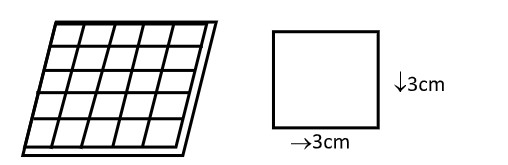
A table top is covered with $25$ squares of equal size. The side of the square is \[3cm\]. The area of the table top is:
\[\begin{array}{*{20}{l}}
{A.{\text{ }}300sq{\text{ }}cm} \\
{B.{\text{ }}250sq{\text{ }}cm} \\
{C.{\text{ }}225sq{\text{ }}cm} \\
{D.{\text{ }}300sq{\text{ }}cm}
\end{array}\]
Answer
 Verified
594k+ views
Hint: Here we see $25$ squares of equal size then \[{1^{st}}\] we find the area of one square and then multiply that area by \[25\].
Formula used: Area of \[square = side \times side = {(side)^2}.\]
Step by step solution:
There are $25$ squares covering the table top and each square has a side of\[3cm\] .
Let \[A = 3cm\] and here A is a side of square.
$\therefore $Total area of the table top$ = $ area of one square \[ \times 25\]
Area of square\[\; = side \times side.\]
Area of square\[ = A \times A\]
Area of one square \[ = 3 \times 3 = 9{\text{ }}c{m^2}\]
Total area of the table top
\[ = 9 \times 25 = 225sq{\text{ }}cm.\]
Hence, the correct option is C.
Additional information:
In this type of question first we analyze the type of quadrilateral given after that we find the area of $1$ quadrilateral then in order to get the area of whole figure consisting of multiple quadrilateral we simply multiply the area of one quadrilateral with the number of quadrilateral which makes the whole figure.
Note: Always find the area of one square first, thereafter proceed to find the area of the whole figure. Students should take extra care while mentioning the unit of the area and side.
Formula used: Area of \[square = side \times side = {(side)^2}.\]
Step by step solution:
There are $25$ squares covering the table top and each square has a side of\[3cm\] .
Let \[A = 3cm\] and here A is a side of square.
$\therefore $Total area of the table top$ = $ area of one square \[ \times 25\]
Area of square\[\; = side \times side.\]
Area of square\[ = A \times A\]
Area of one square \[ = 3 \times 3 = 9{\text{ }}c{m^2}\]
Total area of the table top
\[ = 9 \times 25 = 225sq{\text{ }}cm.\]
Hence, the correct option is C.
Additional information:
In this type of question first we analyze the type of quadrilateral given after that we find the area of $1$ quadrilateral then in order to get the area of whole figure consisting of multiple quadrilateral we simply multiply the area of one quadrilateral with the number of quadrilateral which makes the whole figure.
Note: Always find the area of one square first, thereafter proceed to find the area of the whole figure. Students should take extra care while mentioning the unit of the area and side.
Recently Updated Pages
Master Class 10 Computer Science: Engaging Questions & Answers for Success

Master Class 10 General Knowledge: Engaging Questions & Answers for Success
Master Class 10 English: Engaging Questions & Answers for Success
Master Class 10 Social Science: Engaging Questions & Answers for Success
Master Class 10 Maths: Engaging Questions & Answers for Success
Master Class 10 Science: Engaging Questions & Answers for Success
Trending doubts
What is the median of the first 10 natural numbers class 10 maths CBSE
Which women's tennis player has 24 Grand Slam singles titles?
Who is the Brand Ambassador of Incredible India?
Why is there a time difference of about 5 hours between class 10 social science CBSE
Write a letter to the principal requesting him to grant class 10 english CBSE
State and prove converse of BPT Basic Proportionality class 10 maths CBSE