




A student is observing a temporary mount of a leaf peel under a microscope. Draw a labelled diagram of the structure of the stomata as seen under a microscope.
Answer
 Verified
607.2k+ views
Hint: The carbon dioxide enters the plant cells and is utilized in the photosynthesis process which leads to formation of glucose.
Complete Answer:
- The stomata are found in the leaves of plants but also can be found in stems. The stomata are tiny pores in plant tissue that allows gas exchange.These tiny pores allow carbon dioxide to enter the plant tissue.
- Stomata assists in transpiration and also helps in reducing water loss by closing when conditions are dry or hot.
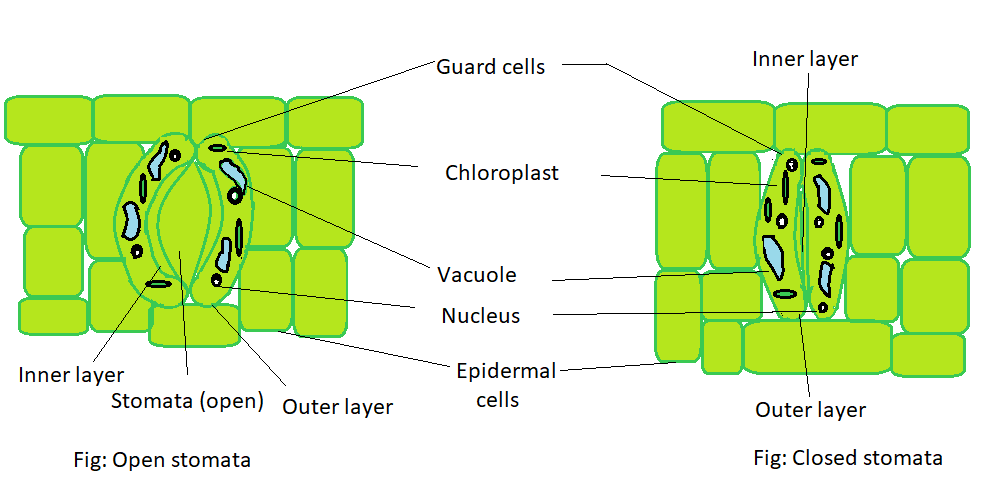
- Guard cells are the specialized cells that surround the stomata and perform the function of opening and closing stomata pores. The guard cells enlarge and contract to open and close stomata and also contain chloroplasts. This cell contains an inner wall that is thicker than the outer wall. The guard cell when filled with water becomes turgid, and the outer wall balloons and causes stomata to enlarge.
- The outer wall of a guard cell is thinner than the inner wall. When the guard cell is filled with water and it becomes turgid, the outer wall balloons outward, drawing the inner wall with it and causing the stomata to enlarge.
- The epidermis is protected against guard cell expansion by subsidiary cells. The subsidiary cells are also called accessory cells which surround and support guard cells. These cells exist in various shapes and sizes in different plants.
- Stomata are closed during night time and prevent escaping water and open during day time to perform photosynthesis. Glucose is the product of photosynthesis and food source for plants. When there is no energy required glucose is stored in the plant in the form of starch.
Note: The stomata of terrestrial plants are located on the inner surface of leaves while in aquatic plants the stomata are located on the upper surface of leaves.
Complete Answer:
- The stomata are found in the leaves of plants but also can be found in stems. The stomata are tiny pores in plant tissue that allows gas exchange.These tiny pores allow carbon dioxide to enter the plant tissue.
- Stomata assists in transpiration and also helps in reducing water loss by closing when conditions are dry or hot.
- Guard cells are the specialized cells that surround the stomata and perform the function of opening and closing stomata pores. The guard cells enlarge and contract to open and close stomata and also contain chloroplasts. This cell contains an inner wall that is thicker than the outer wall. The guard cell when filled with water becomes turgid, and the outer wall balloons and causes stomata to enlarge.
- The outer wall of a guard cell is thinner than the inner wall. When the guard cell is filled with water and it becomes turgid, the outer wall balloons outward, drawing the inner wall with it and causing the stomata to enlarge.
- The epidermis is protected against guard cell expansion by subsidiary cells. The subsidiary cells are also called accessory cells which surround and support guard cells. These cells exist in various shapes and sizes in different plants.
- Stomata are closed during night time and prevent escaping water and open during day time to perform photosynthesis. Glucose is the product of photosynthesis and food source for plants. When there is no energy required glucose is stored in the plant in the form of starch.
Note: The stomata of terrestrial plants are located on the inner surface of leaves while in aquatic plants the stomata are located on the upper surface of leaves.
Recently Updated Pages
Master Class 11 English: Engaging Questions & Answers for Success

Master Class 11 Maths: Engaging Questions & Answers for Success
Class 11 Question and Answer - Your Ultimate Solutions Guide
Master Class 11 Biology: Engaging Questions & Answers for Success
Master Class 11 Physics: Engaging Questions & Answers for Success
Master Class 11 Accountancy: Engaging Questions & Answers for Success
Trending doubts
Explain the Treaty of Vienna of 1815 class 10 social science CBSE
Who Won 36 Oscar Awards? Record Holder Revealed
What is the median of the first 10 natural numbers class 10 maths CBSE
Why is it 530 pm in india when it is 1200 afternoon class 10 social science CBSE
Why is there a time difference of about 5 hours between class 10 social science CBSE
What is the full form of POSCO class 10 social science CBSE