




A student has a freedom to study any subject of his choice. In a group of students with number 1 to 300, the students whose number is divisible by 3 select arts faculty. The students whose number is divisible by 5 select commerce faculty and the students whose number is divisible by 10 select science faculty. Find the number of students who select only one faculty.
Answer
 Verified
591.6k+ views
Hint: Calculate the number of students who selected arts faculty, commerce, faculty, then find the students who are in the intersection of two sets and then the intersection of three sets. Draw the corresponding Venn-diagram and find the number of students who selected only one faculty.
Complete step-by-step answer:
We are given that students have numbers from 1 to 300.
Let $n\left( A \right)$ be the number of students who select arts faculty, $n\left( B \right)$ be the number of students who select commerce faculty, and $n\left( C \right)$ be the number of students who select science faculty.
That is for $n\left( A \right)$, we have to find the numbers from 1 to 300 that are divisible by 3
Hence, there are $\dfrac{{300}}{3} = 100$ such numbers.
Similarly, $n\left( B \right) = \dfrac{{300}}{5} = 60$ numbers divisible by 5.
And $n\left( C \right) = \dfrac{{300}}{{10}} = 30$ numbers divisible by 10.
The numbers which are divisible by 3 and 5 will be the numbers that are divisible by 15.
$n\left( {A \cap B} \right) = \dfrac{{300}}{{15}} = 20$ students.
The numbers which are divisible by 3 and 10 are the numbers which are divisible by 30
$n\left( {A \cap C} \right) = \dfrac{{300}}{{30}} = 10$ students.
Also, the numbers which are divisible by 5 and 10 are the numbers which are divisible by 10
$n\left( {B \cap C} \right) = \dfrac{{300}}{{10}} = 30$ students.
And, now find the numbers that are divisible by all three numbers, that is numbers will be divisible by 30
$n\left( {A \cap B \cap C} \right) = \dfrac{{300}}{{30}} = 10$ students.
Now, draw the Venn diagram of the information.
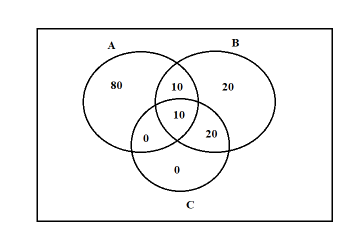
Now, we want to find the number of students that have only one faculty.
$80 + 20 + 0 = 100$
There are 100 students who selected only one faculty.
Note: Many students make mistakes in drawing the corresponding Venn-diagram. While drawing the Venn- diagram, be sure that all that the whole set $A$ includes only $A$, $A \cap B$, $A \cap C$ and $A \cap B \cap C$. Always start writing elements from the intersection of all three sets, then the intersection of two sets and so on.
Complete step-by-step answer:
We are given that students have numbers from 1 to 300.
Let $n\left( A \right)$ be the number of students who select arts faculty, $n\left( B \right)$ be the number of students who select commerce faculty, and $n\left( C \right)$ be the number of students who select science faculty.
That is for $n\left( A \right)$, we have to find the numbers from 1 to 300 that are divisible by 3
Hence, there are $\dfrac{{300}}{3} = 100$ such numbers.
Similarly, $n\left( B \right) = \dfrac{{300}}{5} = 60$ numbers divisible by 5.
And $n\left( C \right) = \dfrac{{300}}{{10}} = 30$ numbers divisible by 10.
The numbers which are divisible by 3 and 5 will be the numbers that are divisible by 15.
$n\left( {A \cap B} \right) = \dfrac{{300}}{{15}} = 20$ students.
The numbers which are divisible by 3 and 10 are the numbers which are divisible by 30
$n\left( {A \cap C} \right) = \dfrac{{300}}{{30}} = 10$ students.
Also, the numbers which are divisible by 5 and 10 are the numbers which are divisible by 10
$n\left( {B \cap C} \right) = \dfrac{{300}}{{10}} = 30$ students.
And, now find the numbers that are divisible by all three numbers, that is numbers will be divisible by 30
$n\left( {A \cap B \cap C} \right) = \dfrac{{300}}{{30}} = 10$ students.
Now, draw the Venn diagram of the information.
Now, we want to find the number of students that have only one faculty.
$80 + 20 + 0 = 100$
There are 100 students who selected only one faculty.
Note: Many students make mistakes in drawing the corresponding Venn-diagram. While drawing the Venn- diagram, be sure that all that the whole set $A$ includes only $A$, $A \cap B$, $A \cap C$ and $A \cap B \cap C$. Always start writing elements from the intersection of all three sets, then the intersection of two sets and so on.
Recently Updated Pages
Basicity of sulphurous acid and sulphuric acid are

Master Class 11 Business Studies: Engaging Questions & Answers for Success
Master Class 11 Computer Science: Engaging Questions & Answers for Success
Master Class 11 Economics: Engaging Questions & Answers for Success
Master Class 11 Social Science: Engaging Questions & Answers for Success
Master Class 11 English: Engaging Questions & Answers for Success
Trending doubts
One Metric ton is equal to kg A 10000 B 1000 C 100 class 11 physics CBSE
The largest wind power cluster is located in the state class 11 social science CBSE
Explain zero factorial class 11 maths CBSE
State and prove Bernoullis theorem class 11 physics CBSE
What steps did the French revolutionaries take to create class 11 social science CBSE
Which among the following are examples of coming together class 11 social science CBSE