




A stick of length 10 units rests against the floor and a wall of a room. If the stick begins to slide on the floor then the locus of its middle point is:
\[\left( \text{a} \right)\text{ }{{x}^{2}}+{{y}^{2}}=2.5\]
\[\left( \text{b} \right)\text{ }{{x}^{2}}+{{y}^{2}}=25\]
\[\left( \text{c} \right)\text{ }{{x}^{2}}+{{y}^{2}}=100\]
(d) None of these
Answer
 Verified
599.7k+ views
Hint: To solve the above question, we will first find out what a locus is. Then we will consider the floor as the x-axis and wall as the y-axis. We will assume that the mid-point has coordinates h and k. Also, we will assume that the point at which stick touches the floor is \[A\left( {{x}_{1}},0 \right)\] and the point at which stick touches the wall is \[B\left( 0,{{y}_{1}} \right).\] Then we will develop the relation between \[{{x}_{1}}\] and h and \[{{y}_{1}}\] and k. After doing this, we will determine the locus by applying the Pythagoras theorem in the triangle formed due to the stick, wall, and the floor.
Complete step-by-step solution -
Locus is the set of points that satisfy a certain property. Now, we have to determine the property of the midpoint of the stick when it starts sliding. Now we consider the floor as the x-axis and wall as the y-axis. The stick in the sliding position is drawn below.
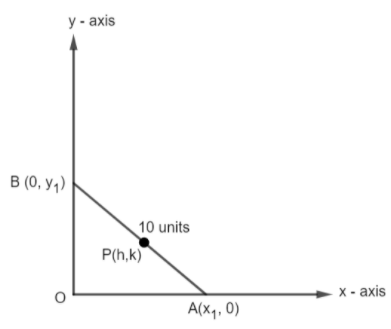
Now AB is the stick that is sliding and P is its midpoint. As point A touches the floor, it has y – coordinate as 0. Similarly, point B touches the wall, it has x – coordinate as 0. Now, P is the midpoint of stick AB. By midpoint formula, if there are two points E (a, b) and F (c, d), then its midpoint will be given by,
\[M\left( \alpha ,\beta \right)=\left( \dfrac{a+b}{2},\dfrac{c+d}{2} \right)\]
Similarly, we can say that,
\[P\left( h,k \right)=\left( \dfrac{{{x}_{1}}+0}{2},\dfrac{0+{{y}_{1}}}{2} \right)\]
\[\Rightarrow h=\dfrac{{{x}_{1}}}{2}.....\left( i \right)\]
\[\Rightarrow k=\dfrac{{{y}_{1}}}{2}.....\left( ii \right)\]
Now, we will apply the Pythagoras theorem in the right-angled triangle AOB. According to Pythagoras theorem, we can say that if H is the hypotenuse, B is the base and P is the perpendicular, then,
\[{{H}^{2}}={{P}^{2}}+{{B}^{2}}\]
In our case, H = AB, P = OB and B = OA. Thus, we have,
\[{{\left( AB \right)}^{2}}={{\left( OB \right)}^{2}}+{{\left( OA \right)}^{2}}\]
\[\Rightarrow {{\left( 10 \right)}^{2}}={{y}_{1}}^{2}+{{x}_{1}}^{2}\]
\[\Rightarrow {{x}_{1}}^{2}+{{y}_{1}}^{2}=100.....\left( iii \right)\]
From (i) and (ii), we have,
\[h=\dfrac{{{x}_{1}}}{2}\]
\[\Rightarrow {{x}_{1}}=2h.....\left( iv \right)\]
\[k=\dfrac{{{y}_{1}}}{2}\]
\[\Rightarrow {{y}_{1}}=2k.....\left( v \right)\]
Now, we will put the values of \[{{x}_{1}}\] and \[{{y}_{1}}\] from (iv) and (v) to (iii). Thus, we will get,
\[\Rightarrow {{\left( 2h \right)}^{2}}+{{\left( 2k \right)}^{2}}=100\]
\[\Rightarrow 4{{h}^{2}}+4{{k}^{2}}=100\]
\[\Rightarrow 4\left( {{h}^{2}}+{{k}^{2}} \right)=100\]
\[\Rightarrow {{h}^{2}}+{{k}^{2}}=\dfrac{100}{4}\]
\[\Rightarrow {{h}^{2}}+{{k}^{2}}=25\]
On putting h = x and k = y, we will get,
\[\Rightarrow {{x}^{2}}+{{y}^{2}}=25\]
Hence, option (b) is the correct answer.
Note: Here, we have considered that the stick is present in two dimensions and as its slides, only x and y coordinates of the midpoint of the stick vary and z coordinate remains constant. Also, the locus obtained is a circle but the actual locus will only be the arc of the circle in the first quadrant.
Complete step-by-step solution -
Locus is the set of points that satisfy a certain property. Now, we have to determine the property of the midpoint of the stick when it starts sliding. Now we consider the floor as the x-axis and wall as the y-axis. The stick in the sliding position is drawn below.
Now AB is the stick that is sliding and P is its midpoint. As point A touches the floor, it has y – coordinate as 0. Similarly, point B touches the wall, it has x – coordinate as 0. Now, P is the midpoint of stick AB. By midpoint formula, if there are two points E (a, b) and F (c, d), then its midpoint will be given by,
\[M\left( \alpha ,\beta \right)=\left( \dfrac{a+b}{2},\dfrac{c+d}{2} \right)\]
Similarly, we can say that,
\[P\left( h,k \right)=\left( \dfrac{{{x}_{1}}+0}{2},\dfrac{0+{{y}_{1}}}{2} \right)\]
\[\Rightarrow h=\dfrac{{{x}_{1}}}{2}.....\left( i \right)\]
\[\Rightarrow k=\dfrac{{{y}_{1}}}{2}.....\left( ii \right)\]
Now, we will apply the Pythagoras theorem in the right-angled triangle AOB. According to Pythagoras theorem, we can say that if H is the hypotenuse, B is the base and P is the perpendicular, then,
\[{{H}^{2}}={{P}^{2}}+{{B}^{2}}\]
In our case, H = AB, P = OB and B = OA. Thus, we have,
\[{{\left( AB \right)}^{2}}={{\left( OB \right)}^{2}}+{{\left( OA \right)}^{2}}\]
\[\Rightarrow {{\left( 10 \right)}^{2}}={{y}_{1}}^{2}+{{x}_{1}}^{2}\]
\[\Rightarrow {{x}_{1}}^{2}+{{y}_{1}}^{2}=100.....\left( iii \right)\]
From (i) and (ii), we have,
\[h=\dfrac{{{x}_{1}}}{2}\]
\[\Rightarrow {{x}_{1}}=2h.....\left( iv \right)\]
\[k=\dfrac{{{y}_{1}}}{2}\]
\[\Rightarrow {{y}_{1}}=2k.....\left( v \right)\]
Now, we will put the values of \[{{x}_{1}}\] and \[{{y}_{1}}\] from (iv) and (v) to (iii). Thus, we will get,
\[\Rightarrow {{\left( 2h \right)}^{2}}+{{\left( 2k \right)}^{2}}=100\]
\[\Rightarrow 4{{h}^{2}}+4{{k}^{2}}=100\]
\[\Rightarrow 4\left( {{h}^{2}}+{{k}^{2}} \right)=100\]
\[\Rightarrow {{h}^{2}}+{{k}^{2}}=\dfrac{100}{4}\]
\[\Rightarrow {{h}^{2}}+{{k}^{2}}=25\]
On putting h = x and k = y, we will get,
\[\Rightarrow {{x}^{2}}+{{y}^{2}}=25\]
Hence, option (b) is the correct answer.
Note: Here, we have considered that the stick is present in two dimensions and as its slides, only x and y coordinates of the midpoint of the stick vary and z coordinate remains constant. Also, the locus obtained is a circle but the actual locus will only be the arc of the circle in the first quadrant.
Recently Updated Pages
Master Class 10 Computer Science: Engaging Questions & Answers for Success

Master Class 10 General Knowledge: Engaging Questions & Answers for Success
Master Class 10 English: Engaging Questions & Answers for Success
Master Class 10 Social Science: Engaging Questions & Answers for Success
Master Class 10 Maths: Engaging Questions & Answers for Success
Master Class 10 Science: Engaging Questions & Answers for Success
Trending doubts
What is the median of the first 10 natural numbers class 10 maths CBSE
Which women's tennis player has 24 Grand Slam singles titles?
Who is the Brand Ambassador of Incredible India?
Why is there a time difference of about 5 hours between class 10 social science CBSE
Write a letter to the principal requesting him to grant class 10 english CBSE
State and prove converse of BPT Basic Proportionality class 10 maths CBSE