




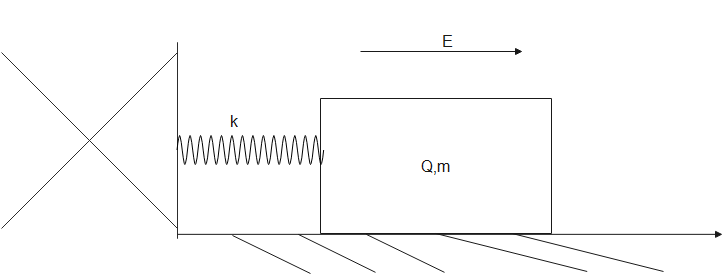
A spring-block system undergoes simple harmonic motion on a smooth horizontal surface. The block is now given some positive charge, and a uniform horizontal electric field to the right is switched on, as a result
Answer
 Verified
551.7k+ views
Hint: We know that SHM or the simple harmonic motion is a type of periodic motion or oscillation where the force called as the restoring force tries to displace or move the moving object to its equilibrium position.
Formula used:
$F=-kx$ , $T=2\pi\sqrt{\dfrac{m}{k}}$
Complete step-by-step solution: -
In SHM the motion of the particle which is moving in a straight line experiences an acceleration which directs the object to its equilibrium position. The common examples of SHM are the periodic oscillation of a pendulum and a system where a mass is attached to a spring which when disturbed undergoes SHM.
The elastic restoring force which puts the mass spring system in oscillation follows Hooke’s law. This can be expressed as $F=-kx$ where $F$ is the restoring force exerted by the spring with spring constant $k$ due to $x$ displacement.
The negative sign in Hooke’s law indicates that the force is restoring or opposing the motion of the system.
Consider the image given to us, clearly the given system undergoes SHM when the charged block $Q$ experiences an electric field $E$.
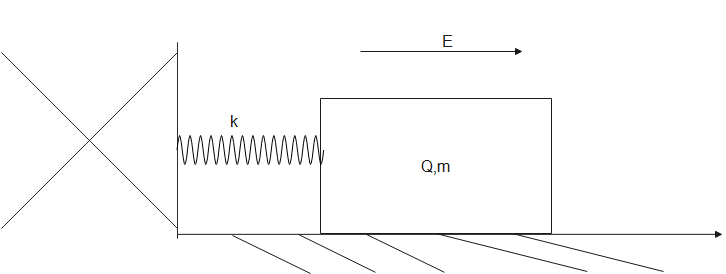
Then the time period $T$ of the SHM is given as
$T=2\pi\sqrt{\dfrac{m}{k}}$, where $m$ is the mass of the block and $k$ is the spring constant.
Clearly, the time period $T$ is independent of the charge or the electric field acting on the mass.
Note: In an ideal SHM, the periodic oscillation continues for an infinite amount of time if there were no dissipating energy acting on the body, like gravity and friction for example. Generally the magnitude of the acceleration depends on the displacement of the object from the equilibrium position.
Formula used:
$F=-kx$ , $T=2\pi\sqrt{\dfrac{m}{k}}$
Complete step-by-step solution: -
In SHM the motion of the particle which is moving in a straight line experiences an acceleration which directs the object to its equilibrium position. The common examples of SHM are the periodic oscillation of a pendulum and a system where a mass is attached to a spring which when disturbed undergoes SHM.
The elastic restoring force which puts the mass spring system in oscillation follows Hooke’s law. This can be expressed as $F=-kx$ where $F$ is the restoring force exerted by the spring with spring constant $k$ due to $x$ displacement.
The negative sign in Hooke’s law indicates that the force is restoring or opposing the motion of the system.
Consider the image given to us, clearly the given system undergoes SHM when the charged block $Q$ experiences an electric field $E$.
Then the time period $T$ of the SHM is given as
$T=2\pi\sqrt{\dfrac{m}{k}}$, where $m$ is the mass of the block and $k$ is the spring constant.
Clearly, the time period $T$ is independent of the charge or the electric field acting on the mass.
Note: In an ideal SHM, the periodic oscillation continues for an infinite amount of time if there were no dissipating energy acting on the body, like gravity and friction for example. Generally the magnitude of the acceleration depends on the displacement of the object from the equilibrium position.
Recently Updated Pages
Master Class 11 Social Science: Engaging Questions & Answers for Success

Master Class 11 English: Engaging Questions & Answers for Success
Master Class 11 Maths: Engaging Questions & Answers for Success
Master Class 11 Chemistry: Engaging Questions & Answers for Success
Master Class 11 Biology: Engaging Questions & Answers for Success
Class 11 Question and Answer - Your Ultimate Solutions Guide
Trending doubts
One Metric ton is equal to kg A 10000 B 1000 C 100 class 11 physics CBSE
Difference Between Prokaryotic Cells and Eukaryotic Cells
Find the value of the expression given below sin 30circ class 11 maths CBSE
1 ton equals to A 100 kg B 1000 kg C 10 kg D 10000 class 11 physics CBSE
Two of the body parts which do not appear in MRI are class 11 biology CBSE
Draw a diagram of nephron and explain its structur class 11 biology CBSE