




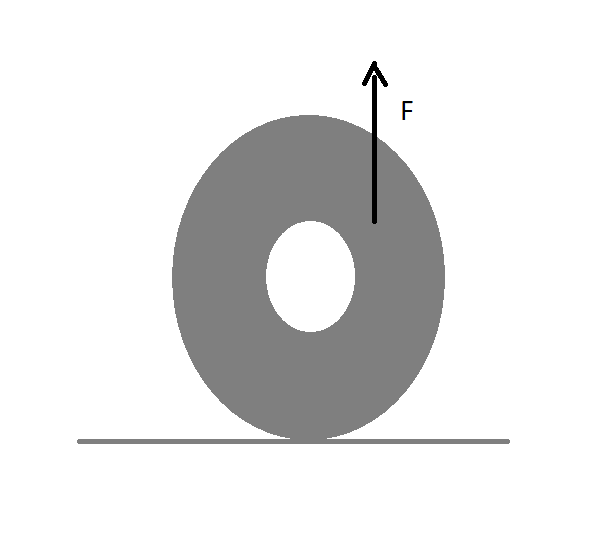
A spool is pulled by a force in a vertical direction as shown in the figure. What is the direction of friction in this case? The spool does not lose contact with the ground.
Answer
 Verified
622.8k+ views
Hint: When a rigid body is not undergoing any change in rotational or translational motion then the rigid body is said to be in equilibrium.
Complete step by step answer:
Let us consider the given diagram. We can see that friction is acting in the ground and torque is acting in the anti-clockwise direction. The center of the spool is denoted as $O$.
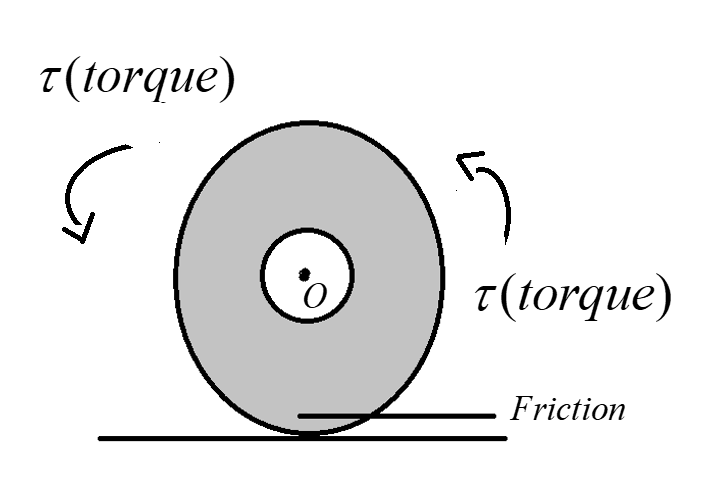
That is $\tau F$ about the center $O$ is anti-clockwise and the spool will roll leftwards where the friction is acting vertically.
Therefore, the spool will shift in an anti-clockwise direction. Since it is given that the spool does not lose contact with the ground, we can determine that friction acts to the left of the spool.
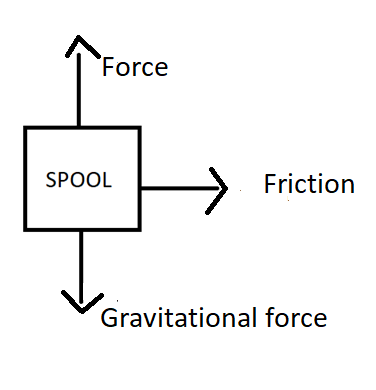
Free body diagram:
Additional Information:
Sometimes a body remains stationary even when a force acts on it. This state of the body being stationary even when a force acts on it is known as equilibrium. There are two main kinds of equilibrium, Static equilibrium, and Dynamic Equilibrium.
When a body stays in its state of rest after a force is applied the body is said to be in static equilibrium. When a body continues moving even after applying force, the body is said to be in dynamic equilibrium.
The equilibrium is classified into three types. They are:
- Stable equilibrium.
- Unstable equilibrium
- Neutral Equilibrium
In case of stable equilibrium, the object when displaced returns back to its original position. In the case of unstable equilibrium, the object when displaced does not come back to its original position. In the case of neutral equilibrium, the object when displaced makes the position it goes to its new equilibrium position.
Moment of force is the measure of the tendency of a force to cause rotation of a body about an axis or any specific point. We can now consider the net moment on a body is computed by the formula,
${\text{Momentum = Force} \times \text{Displacement}}$
Note:
Remember the information that they gave. In question, it is given that the spool does not lose contact with the ground. The horizontal force is provided by the friction to give linear acceleration $(a)$. Hence the friction will act leftwards.
Complete step by step answer:
Let us consider the given diagram. We can see that friction is acting in the ground and torque is acting in the anti-clockwise direction. The center of the spool is denoted as $O$.
That is $\tau F$ about the center $O$ is anti-clockwise and the spool will roll leftwards where the friction is acting vertically.
Therefore, the spool will shift in an anti-clockwise direction. Since it is given that the spool does not lose contact with the ground, we can determine that friction acts to the left of the spool.
Free body diagram:
Additional Information:
Sometimes a body remains stationary even when a force acts on it. This state of the body being stationary even when a force acts on it is known as equilibrium. There are two main kinds of equilibrium, Static equilibrium, and Dynamic Equilibrium.
When a body stays in its state of rest after a force is applied the body is said to be in static equilibrium. When a body continues moving even after applying force, the body is said to be in dynamic equilibrium.
The equilibrium is classified into three types. They are:
- Stable equilibrium.
- Unstable equilibrium
- Neutral Equilibrium
In case of stable equilibrium, the object when displaced returns back to its original position. In the case of unstable equilibrium, the object when displaced does not come back to its original position. In the case of neutral equilibrium, the object when displaced makes the position it goes to its new equilibrium position.
Moment of force is the measure of the tendency of a force to cause rotation of a body about an axis or any specific point. We can now consider the net moment on a body is computed by the formula,
${\text{Momentum = Force} \times \text{Displacement}}$
Note:
Remember the information that they gave. In question, it is given that the spool does not lose contact with the ground. The horizontal force is provided by the friction to give linear acceleration $(a)$. Hence the friction will act leftwards.
Recently Updated Pages
Master Class 11 English: Engaging Questions & Answers for Success

Master Class 11 Social Science: Engaging Questions & Answers for Success
Master Class 11 Maths: Engaging Questions & Answers for Success
Master Class 11 Biology: Engaging Questions & Answers for Success
Master Class 11 Physics: Engaging Questions & Answers for Success
Master Class 11 Chemistry: Engaging Questions & Answers for Success
Trending doubts
Find the value of the expression given below sin 30circ class 11 maths CBSE
Draw a diagram of nephron and explain its structur class 11 biology CBSE
Difference between physical and chemical change class 11 chemistry CBSE
How do I convert ms to kmh Give an example class 11 physics CBSE
What is the atomic mass of Sodium a 22 gmol b 23 gmol class 11 chemistry CBSE
In which country Lascaux cave is located A India B class 11 social science CBSE