




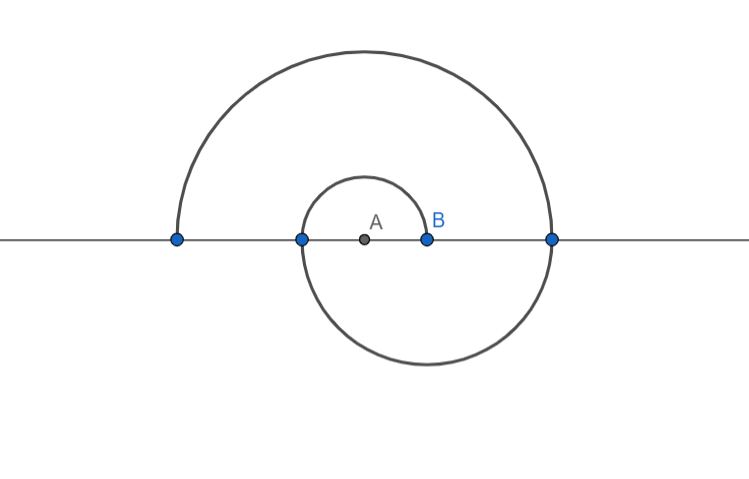
A spiral is made of successive semicircles with centres alternatively at A and B, starting with A, of radii 0.5cm, 1cm, 1.5cm, 2cm, … as shown in the figure below. What is the total length of the spiral consisting of 13 such spirals. Use $\pi =\dfrac{22}{7}$
Answer
 Verified
652.2k+ views
Hint: Observe that the radii here are in A.P. Since circumference of cirlce $\propto r$,the lengths of semicircles will also be in A.P. Find the common difference and first term of that A.P. Use ${{S}_{n}}=\dfrac{n}{2}\left( 2a+\left( n-1 \right)d \right)$ for finding total length of the spiral.
Complete step-by-step answer:
We know that if $\left\{ {{a}_{n}} \right\}$ is an A.P with common difference d then $\left\{ k{{a}_{n}} \right\}$ is also an A.P with common difference kd.
Here Sequence of radii is 0.5cm, 1cm, 1.5cm, 2cm, … which is clearly an A.P with first term a = 0.5cm and common difference 1-0.5 =0.5cm.
Also Length of semicircle $=\pi r$
So the sequence of lengths of semicircles will also be an A.P with common difference $=0.5\pi cm$ and the first term will be $0.5\pi cm$.
Now we know that ${{S}_{n}}=\dfrac{n}{2}\left( 2a+\left( n-1 \right)d \right)$
Put n = 13, $a=0.5\pi cm$ and $d=0.5\pi cm$, we get
$\begin{align}
& {{S}_{13}}=\dfrac{13}{2}\left( 2\times 0.5\pi +\left( 13-1 \right)0.5\pi \right)cm \\
& =\dfrac{13}{2}\left( \pi +6\pi \right)cm \\
& =\dfrac{91}{2}\pi cm \\
\end{align}$
Substituting $\pi =\dfrac{22}{7}$, we get
\[{{S}_{13}}=\dfrac{91}{2}\times \dfrac{22}{7}=143cm\]
Since ${{S}_{n}}$ is the sum of lengths of first n spirals ${{S}_{13}}$ will be the total length of the spiral consisting of 13 consecutive semicircles.
Hence the total length of the spiral consisting of 13 such spirals is 143cm.
Note: [1] If $\left\{ {{a}_{n}} \right\}$ is an A.P with common difference d then $\left\{ k{{a}_{n}} \right\}$ is also an A.P with common difference kd. This statement can be proved with simple calculations:
$\left\{ {{a}_{n}} \right\}=\left\{ a,a+d,a+2d,...,a+\left( n-1 \right)d \right\}$
so $\left\{ k{{a}_{n}} \right\}=\left\{ ka,ka+kd,ka+2kd,...,ka+\left( n-1 \right)kd \right\}$
Hence the first term of the sequence $\left\{ k{{a}_{n}} \right\}$ is ka and the common difference is kd.
[2] If $\left\{ {{a}_{n}} \right\},\left\{ {{b}_{n}} \right\}$ are two A.Ps, then so is $\left\{ {{a}_{n}}+{{b}_{n}} \right\},\left\{ {{a}_{n}}+k \right\}$ and $\left\{ k{{a}_{n}} \right\}$
Complete step-by-step answer:
We know that if $\left\{ {{a}_{n}} \right\}$ is an A.P with common difference d then $\left\{ k{{a}_{n}} \right\}$ is also an A.P with common difference kd.
Here Sequence of radii is 0.5cm, 1cm, 1.5cm, 2cm, … which is clearly an A.P with first term a = 0.5cm and common difference 1-0.5 =0.5cm.
Also Length of semicircle $=\pi r$
So the sequence of lengths of semicircles will also be an A.P with common difference $=0.5\pi cm$ and the first term will be $0.5\pi cm$.
Now we know that ${{S}_{n}}=\dfrac{n}{2}\left( 2a+\left( n-1 \right)d \right)$
Put n = 13, $a=0.5\pi cm$ and $d=0.5\pi cm$, we get
$\begin{align}
& {{S}_{13}}=\dfrac{13}{2}\left( 2\times 0.5\pi +\left( 13-1 \right)0.5\pi \right)cm \\
& =\dfrac{13}{2}\left( \pi +6\pi \right)cm \\
& =\dfrac{91}{2}\pi cm \\
\end{align}$
Substituting $\pi =\dfrac{22}{7}$, we get
\[{{S}_{13}}=\dfrac{91}{2}\times \dfrac{22}{7}=143cm\]
Since ${{S}_{n}}$ is the sum of lengths of first n spirals ${{S}_{13}}$ will be the total length of the spiral consisting of 13 consecutive semicircles.
Hence the total length of the spiral consisting of 13 such spirals is 143cm.
Note: [1] If $\left\{ {{a}_{n}} \right\}$ is an A.P with common difference d then $\left\{ k{{a}_{n}} \right\}$ is also an A.P with common difference kd. This statement can be proved with simple calculations:
$\left\{ {{a}_{n}} \right\}=\left\{ a,a+d,a+2d,...,a+\left( n-1 \right)d \right\}$
so $\left\{ k{{a}_{n}} \right\}=\left\{ ka,ka+kd,ka+2kd,...,ka+\left( n-1 \right)kd \right\}$
Hence the first term of the sequence $\left\{ k{{a}_{n}} \right\}$ is ka and the common difference is kd.
[2] If $\left\{ {{a}_{n}} \right\},\left\{ {{b}_{n}} \right\}$ are two A.Ps, then so is $\left\{ {{a}_{n}}+{{b}_{n}} \right\},\left\{ {{a}_{n}}+k \right\}$ and $\left\{ k{{a}_{n}} \right\}$
Recently Updated Pages
Master Class 12 Economics: Engaging Questions & Answers for Success

Master Class 12 English: Engaging Questions & Answers for Success
Master Class 12 Social Science: Engaging Questions & Answers for Success
Master Class 12 Maths: Engaging Questions & Answers for Success
Master Class 12 Physics: Engaging Questions & Answers for Success
Master Class 10 English: Engaging Questions & Answers for Success
Trending doubts
Explain the Treaty of Vienna of 1815 class 10 social science CBSE
Why is it 530 pm in india when it is 1200 afternoon class 10 social science CBSE
What is the full form of POSCO class 10 social science CBSE
Define Potential, Developed, Stock and Reserved resources
Which Country Has the Largest Border with India?
Choose the feminine form of the given noun Fox AFoxess class 10 english CBSE