




A spherical ball of lead $3\text{ cm}$in diameter is melted and recast into three spherical balls. The diameters of two of these are 1.5 cm and 2 cm respectively. The diameter of the third ball is…..
A. 2.66 cm
B. 2.5 cm
C. 3 cm
D. 3.5 cm
Answer
 Verified
594k+ views
Hint: In this question it is given that three spherical balls are recast from a spherical ball, so the volume of spherical ball is the sum of volumes of three spherical balls. So, we calculate the volume of the spherical ball by using the formula.
Volume of sphere \[=\dfrac{4}{3}\pi {{r}^{3}}\]
Where, $r=$ radius of sphere
By this we can find the diameter of the third ball.
Complete step-by-step answer:
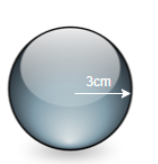
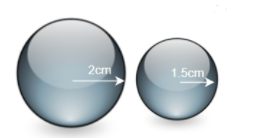
We have given that Diameter of a spherical ball $=3\text{ cm}$, which is melted and recast into three spherical balls. The diameters of two of these are 1.5 cm and 2 cm respectively.
Before melting
After melting
We have to find the diameter of the third ball.
Now, we know that volume of spherical ball will be \[=\dfrac{4}{3}\pi {{r}^{3}}\]
As given the diameter $=3\text{ cm}$.
So, the radius will be $=1.5\text{ cm}$ because we know that $radius=\dfrac{diameter}{2}$
So, the volume of spherical ball will be \[=\dfrac{4}{3}\times \dfrac{22}{7}\times {{\left( 1.5 \right)}^{3\text{ }}}\text{ }\left[ \pi =\dfrac{22}{7} \right]\]
Volume of spherical ball \[=\dfrac{4}{3}\times \dfrac{22}{7}\times 1.5\times 1.5\times 1.5.............(i)\]
Now, as given those three balls are recast from the big spherical ball, so the volume of big spherical ball is equal to the sum of volume of three balls.
We have given the diameter of two balls are 1.5 cm and 2 cm.
Let the radius of three balls will be ${{r}_{1}},{{r}_{2}},{{r}_{3}}$
So, the radius of two balls will be ${{r}_{1}}=\dfrac{1.5}{2}=0.75$ and ${{r}_{2}}=\dfrac{2}{2}=1$.
Now, we have to find ${{r}_{3}}$
Volume of big spherical ball = sum of volume of three small spherical balls
\[\dfrac{4}{3}\pi {{r}^{3}}=\dfrac{4}{3}\pi {{r}_{1}}^{3}+\dfrac{4}{3}\pi {{r}_{2}}^{3}+\dfrac{4}{3}\pi {{r}_{3}}^{3}\]
When we substitute the values, we get
\[\begin{align}
& \dfrac{4}{3}\times \dfrac{22}{7}\times 1.5\times 1.5\times 1.5=\dfrac{4}{3}\times \dfrac{22}{7}\times {{\left( 0.75 \right)}^{3}}+\dfrac{4}{3}\times \dfrac{22}{7}\times {{\left( 1 \right)}^{3}}+\dfrac{4}{3}\times \dfrac{22}{7}\times r_{3}^{3} \\
& \Rightarrow \dfrac{4}{3}\times \dfrac{22}{7}\times 1.5\times 1.5\times 1.5=\dfrac{4}{3}\times \dfrac{22}{7}\left[ 0.75\times 0.75\times 0.75+1+r_{3}^{3} \right] \\
\end{align}\]
Cancel the common terms of both side, we get
$\begin{align}
& \Rightarrow 3.375=0.421+1+r_{3}^{3} \\
& \Rightarrow 3.375-0.421-1=r_{3}^{3} \\
& r_{3}^{3}=1.953 \\
& r=\sqrt[3]{1.953} \\
& r=1.25\text{ cm} \\
\end{align}$
So, we get the radius of third ball \[{{r}_{3}}=1.25\text{ cm}\]
Now, we know that $diameter=2\times radius$
So, the diameter of third ball is $1.25\times 2=2.5\text{ cm}$
Option B is the correct answer.
Note: The key concept to solve this type of question is that those three balls are recast from the big spherical ball, so the volume of the big spherical ball is equal to the sum of volume of three balls. The volume of the sphere always remains constant. Also, we have to find the diameter, so always remember $diameter=2\times radius$.
Volume of sphere \[=\dfrac{4}{3}\pi {{r}^{3}}\]
Where, $r=$ radius of sphere
By this we can find the diameter of the third ball.
Complete step-by-step answer:
We have given that Diameter of a spherical ball $=3\text{ cm}$, which is melted and recast into three spherical balls. The diameters of two of these are 1.5 cm and 2 cm respectively.
Before melting
After melting
We have to find the diameter of the third ball.
Now, we know that volume of spherical ball will be \[=\dfrac{4}{3}\pi {{r}^{3}}\]
As given the diameter $=3\text{ cm}$.
So, the radius will be $=1.5\text{ cm}$ because we know that $radius=\dfrac{diameter}{2}$
So, the volume of spherical ball will be \[=\dfrac{4}{3}\times \dfrac{22}{7}\times {{\left( 1.5 \right)}^{3\text{ }}}\text{ }\left[ \pi =\dfrac{22}{7} \right]\]
Volume of spherical ball \[=\dfrac{4}{3}\times \dfrac{22}{7}\times 1.5\times 1.5\times 1.5.............(i)\]
Now, as given those three balls are recast from the big spherical ball, so the volume of big spherical ball is equal to the sum of volume of three balls.
We have given the diameter of two balls are 1.5 cm and 2 cm.
Let the radius of three balls will be ${{r}_{1}},{{r}_{2}},{{r}_{3}}$
So, the radius of two balls will be ${{r}_{1}}=\dfrac{1.5}{2}=0.75$ and ${{r}_{2}}=\dfrac{2}{2}=1$.
Now, we have to find ${{r}_{3}}$
Volume of big spherical ball = sum of volume of three small spherical balls
\[\dfrac{4}{3}\pi {{r}^{3}}=\dfrac{4}{3}\pi {{r}_{1}}^{3}+\dfrac{4}{3}\pi {{r}_{2}}^{3}+\dfrac{4}{3}\pi {{r}_{3}}^{3}\]
When we substitute the values, we get
\[\begin{align}
& \dfrac{4}{3}\times \dfrac{22}{7}\times 1.5\times 1.5\times 1.5=\dfrac{4}{3}\times \dfrac{22}{7}\times {{\left( 0.75 \right)}^{3}}+\dfrac{4}{3}\times \dfrac{22}{7}\times {{\left( 1 \right)}^{3}}+\dfrac{4}{3}\times \dfrac{22}{7}\times r_{3}^{3} \\
& \Rightarrow \dfrac{4}{3}\times \dfrac{22}{7}\times 1.5\times 1.5\times 1.5=\dfrac{4}{3}\times \dfrac{22}{7}\left[ 0.75\times 0.75\times 0.75+1+r_{3}^{3} \right] \\
\end{align}\]
Cancel the common terms of both side, we get
$\begin{align}
& \Rightarrow 3.375=0.421+1+r_{3}^{3} \\
& \Rightarrow 3.375-0.421-1=r_{3}^{3} \\
& r_{3}^{3}=1.953 \\
& r=\sqrt[3]{1.953} \\
& r=1.25\text{ cm} \\
\end{align}$
So, we get the radius of third ball \[{{r}_{3}}=1.25\text{ cm}\]
Now, we know that $diameter=2\times radius$
So, the diameter of third ball is $1.25\times 2=2.5\text{ cm}$
Option B is the correct answer.
Note: The key concept to solve this type of question is that those three balls are recast from the big spherical ball, so the volume of the big spherical ball is equal to the sum of volume of three balls. The volume of the sphere always remains constant. Also, we have to find the diameter, so always remember $diameter=2\times radius$.
Recently Updated Pages
Master Class 10 Computer Science: Engaging Questions & Answers for Success

Master Class 10 General Knowledge: Engaging Questions & Answers for Success
Master Class 10 English: Engaging Questions & Answers for Success
Master Class 10 Social Science: Engaging Questions & Answers for Success
Master Class 10 Maths: Engaging Questions & Answers for Success
Master Class 10 Science: Engaging Questions & Answers for Success
Trending doubts
Which women's tennis player has 24 Grand Slam singles titles?
Who is the Brand Ambassador of Incredible India?
Why is there a time difference of about 5 hours between class 10 social science CBSE
The Equation xxx + 2 is Satisfied when x is Equal to Class 10 Maths
Which Country is Called "The Land of Festivals"?
What is Contraception List its four different methods class 10 biology CBSE