




A species is taxonomically
A. A group of evolutionary related populations
B. A population with common characteristics as evolutionary base of variation
C. A fundamental unit in the phylogenetic history of organisms
D. A group of individuals capable of reproducing and producing fertile offspring
Answer
 Verified
521.4k+ views
Hint: A species is defined as the basic unit of classification and a taxonomic rank of an organism. It can also be defined based on shared evolutionary history and ancestry.
Complete Answer:
A species is defined as the largest group of organisms in which any two individuals of the appropriate sexes or mating types can produce fertile offspring, typically through sexual reproduction. Some other ways of defining species include their karyotype, DNA sequence, morphology, behaviour or ecological niche. However, there are more than 20 other different concepts defining species. The ecological species concept describes a species as a group of organisms evolved by the resources they depend on (i.e., their ecological niche). The genetic species concept considers all organisms that are capable of inheriting traits from one another, within a common gene pool. The amount of genetic difference between populations of that particular species is called a gene pool. Similar to the biological species concept, the genetic species concept considers individuals capable of interbreeding as well as the amount of genetic difference between populations of that species. It may also be used to estimate the time when the species originated.
Note:
The total number of species is estimated to be between 8 to 8.7 million. However, only about $14\%$ of them have been described and documented by 2011. Species lie at the bottom of the biological classification hierarchy.
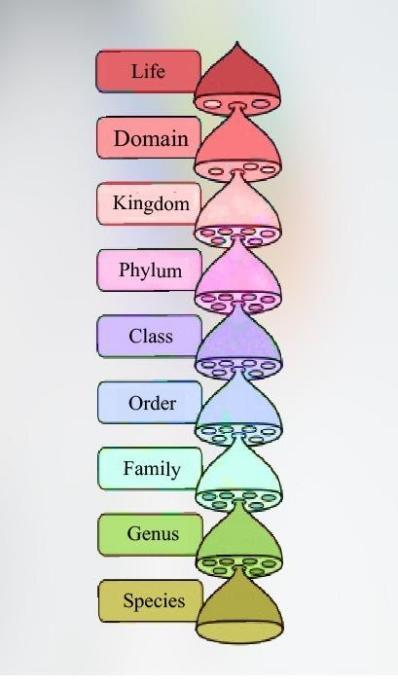
Figure: Location of species in the hierarchy
Complete Answer:
A species is defined as the largest group of organisms in which any two individuals of the appropriate sexes or mating types can produce fertile offspring, typically through sexual reproduction. Some other ways of defining species include their karyotype, DNA sequence, morphology, behaviour or ecological niche. However, there are more than 20 other different concepts defining species. The ecological species concept describes a species as a group of organisms evolved by the resources they depend on (i.e., their ecological niche). The genetic species concept considers all organisms that are capable of inheriting traits from one another, within a common gene pool. The amount of genetic difference between populations of that particular species is called a gene pool. Similar to the biological species concept, the genetic species concept considers individuals capable of interbreeding as well as the amount of genetic difference between populations of that species. It may also be used to estimate the time when the species originated.
Note:
The total number of species is estimated to be between 8 to 8.7 million. However, only about $14\%$ of them have been described and documented by 2011. Species lie at the bottom of the biological classification hierarchy.
Figure: Location of species in the hierarchy
Recently Updated Pages
Master Class 11 Social Science: Engaging Questions & Answers for Success

Master Class 11 Physics: Engaging Questions & Answers for Success
Master Class 11 Maths: Engaging Questions & Answers for Success
Master Class 11 Economics: Engaging Questions & Answers for Success
Master Class 11 Computer Science: Engaging Questions & Answers for Success
Master Class 11 Chemistry: Engaging Questions & Answers for Success
Trending doubts
One Metric ton is equal to kg A 10000 B 1000 C 100 class 11 physics CBSE
There are 720 permutations of the digits 1 2 3 4 5 class 11 maths CBSE
1 Quintal is equal to a 110 kg b 10 kg c 100kg d 1000 class 11 physics CBSE
State and prove Bernoullis theorem class 11 physics CBSE
Difference Between Prokaryotic Cells and Eukaryotic Cells
Which among the following are examples of coming together class 11 social science CBSE