




A solid sphere, solid cylinder and a disc are allowed to roll down from the top of an incline plane from the same height, then,
A. Disc will reach the bottom first
B. Solid cylinder will reach the bottom first
C. Sphere will reach the bottom first
D. all will reach the bottom simultaneously
Answer
 Verified
594.3k+ views
Hint: On recalling the definition of moment of inertia, you will realize that the higher its value is the slower the body will fall to the bottom. Now you could think of the standard expressions for moment of inertia for the given objects. Then, by assuming the mass and radius to be the same for all three, compare and get the answer.
Formula used:
Expression for moment of inertia,
$I=\sum\limits_{i=1}^{n}{{{m}_{i}}}{{r}_{i}}^{2}$
Complete step by step answer:
We are given a solid sphere, a solid cylinder and a disc and all the three objects are being rolled down from the top of an incline plane from the same height. We are asked to find if these three objects will reach the bottom first. Since we are dealing with rolling motion of these objects we have to determine the answer using the concepts of Rotational motion.
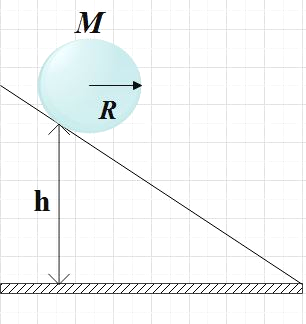
You may be familiar with moments of inertia. It is basically the analogue of mass in rotational motion that expresses a body’s tendency to resist angular acceleration, and is given by the sum of the products of mass of each particle in the body with the square of its distance from the axis of rotation.
$I=\sum\limits_{i=1}^{n}{{{m}_{i}}}{{r}_{i}}^{2}$
By comparing the moment of inertia of these objects we could find the answer. From its definition we know that higher the moment of inertia of a body is higher will the body’s resistance angular acceleration and slower the body will reach the bottom.
Let us assume that the radius and mass of all three objects are R and M respectively, then we have standard expression for moment of inertia of a solid sphere, a solid cylinder and a disc respectively given by,
${{I}_{S}}=\dfrac{2}{5}M{{R}^{2}}$
${{I}_{C}}=\dfrac{1}{2}M{{R}^{2}}$
${{I}_{D}}=\dfrac{1}{2}M{{R}^{2}}$
Comparing the three, we see that the moment of inertia of the solid sphere is smaller than the other two. Which means the resistance of the solid sphere to the angular acceleration will be less and hence it will roll faster than the other three and reach the bottom first.
Hence, the answer to the question is option C.
Note:
Though not given in the question, we have taken the privilege to assume that the mass M and radius R of the bodies to be the same. Doing so makes the comparison of the three easier. In cases where the mass and radius given is different for the three, you could accordingly substitute to get the answer.
Formula used:
Expression for moment of inertia,
$I=\sum\limits_{i=1}^{n}{{{m}_{i}}}{{r}_{i}}^{2}$
Complete step by step answer:
We are given a solid sphere, a solid cylinder and a disc and all the three objects are being rolled down from the top of an incline plane from the same height. We are asked to find if these three objects will reach the bottom first. Since we are dealing with rolling motion of these objects we have to determine the answer using the concepts of Rotational motion.
You may be familiar with moments of inertia. It is basically the analogue of mass in rotational motion that expresses a body’s tendency to resist angular acceleration, and is given by the sum of the products of mass of each particle in the body with the square of its distance from the axis of rotation.
$I=\sum\limits_{i=1}^{n}{{{m}_{i}}}{{r}_{i}}^{2}$
By comparing the moment of inertia of these objects we could find the answer. From its definition we know that higher the moment of inertia of a body is higher will the body’s resistance angular acceleration and slower the body will reach the bottom.
Let us assume that the radius and mass of all three objects are R and M respectively, then we have standard expression for moment of inertia of a solid sphere, a solid cylinder and a disc respectively given by,
${{I}_{S}}=\dfrac{2}{5}M{{R}^{2}}$
${{I}_{C}}=\dfrac{1}{2}M{{R}^{2}}$
${{I}_{D}}=\dfrac{1}{2}M{{R}^{2}}$
Comparing the three, we see that the moment of inertia of the solid sphere is smaller than the other two. Which means the resistance of the solid sphere to the angular acceleration will be less and hence it will roll faster than the other three and reach the bottom first.
Hence, the answer to the question is option C.
Note:
Though not given in the question, we have taken the privilege to assume that the mass M and radius R of the bodies to be the same. Doing so makes the comparison of the three easier. In cases where the mass and radius given is different for the three, you could accordingly substitute to get the answer.
Recently Updated Pages
Master Class 11 Social Science: Engaging Questions & Answers for Success

Master Class 11 Physics: Engaging Questions & Answers for Success
Master Class 11 Maths: Engaging Questions & Answers for Success
Master Class 11 Economics: Engaging Questions & Answers for Success
Master Class 11 Computer Science: Engaging Questions & Answers for Success
Master Class 11 Chemistry: Engaging Questions & Answers for Success
Trending doubts
One Metric ton is equal to kg A 10000 B 1000 C 100 class 11 physics CBSE
There are 720 permutations of the digits 1 2 3 4 5 class 11 maths CBSE
1 Quintal is equal to a 110 kg b 10 kg c 100kg d 1000 class 11 physics CBSE
State and prove Bernoullis theorem class 11 physics CBSE
Difference Between Prokaryotic Cells and Eukaryotic Cells
Which among the following are examples of coming together class 11 social science CBSE