




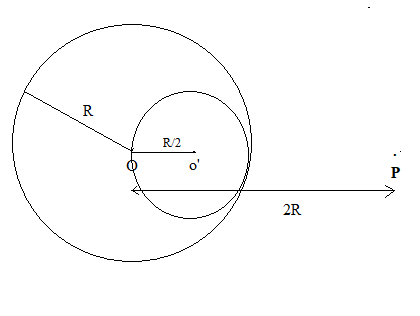
A solid sphere of uniform density and radius R applies a gravitational force of attraction equal to ${F_1}$ on a particle placed at P, distance 2R from the centre O of the sphere. A spherical cavity of radius R/2 is now made in the sphere as shown in figure. The sphere with cavity now applies a gravitational force ${F_2}$ on the same particle placed at P. The ratio of ${F_2}$/${F_1}$ will be
A. 1/2
B. 7/9
C. 3
D. 7
Answer
 Verified
554.2k+ views
Hint: First of all, we will see what is gravitational force and its expression. We will solve this question using superposition principle. For the original sphere, we will calculate the gravitational force ${F_1}$ on particle P and to calculate ${F_2}$, we will subtract the gravitational force due to the sphere of radius R/2 from ${F_1}$.
Complete answer:
The magnitude of the gravitational force that two particles of masses ${m_1}$and ${m_2}$separated by a distance r exert on each other is $F = G\dfrac{{{m_1}{m_2}}}{{{r^2}}}$ .
Here ‘G’ is gravitational constant and its value is $6.67 \times {10^{ - 11}}N{m^2}/k{g^2}$.
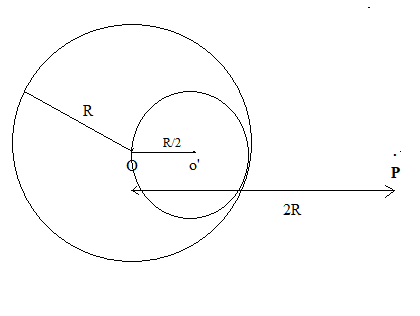
Let the mass of the sphere with radius R be M kg.
For density to be constant:
$\dfrac{{{M_1}}}{{{v_1}}} = \dfrac{{{M_2}}}{{{v_2}}}$ (1)
Using the above equation, we will calculate the mass of the sphere with radius R/2.
Putting values in equation 1, we get:
$\dfrac{M}{{\dfrac{4}{3}\pi {R^3}}} = \dfrac{{{M_2}}}{{\dfrac{4}{3}\pi {{\left( {\dfrac{R}{2}} \right)}^3}}}$
$ \Rightarrow {M_2} = \dfrac{M}{8}$ kg
Now, we will calculate the force ${F_1}$.
Here r = 2R.
${m_1}$= M kg
$\therefore {F_1} = G\dfrac{{{m_1}{m_2}}}{{{r^2}}} = G\dfrac{{M{m_2}}}{{{{\left( {2R} \right)}^2}}} = G\dfrac{{M{m_2}}}{{4{R^2}}}$ = Gravitational force due to sphere of radius R.
= ${F_1}$ - Gravitational force due to sphere of radius R/2.
=$G\dfrac{{M{m_2}}}{{4{R^2}}} - G\dfrac{{\dfrac{M}{8}{m_2}}}{{{{\left( {\dfrac{{3R}}{2}} \right)}^2}}} = \dfrac{{7GM{m_2}}}{{36{R^2}}}$
Therefore, $\dfrac{{{F_2}}}{{{F_1}}}=\dfrac{{\dfrac{{7GM{m_2}}}{{36{R^2}}}}}{{\dfrac{{GM{m_2}}}{{4{R^2}}}}} = \dfrac{7}{9}$.
So, the correct answer is “Option B”.
Additional Information:
Newton was the first to propose a force law for gravitation, which is stated as follow:
Every particle in the universe attracts every other particle with a force directly proportional to the product of their masses and inversely proportional to the square of the distance between them. This force is called gravitational force.
Note:
In this type of question, you remember the formula for finding gravitational force. It should not be confused with ‘G’ and ‘g’. ‘G’ is a universal constant whereas ‘g’ is acceleration due to gravity of earth. The direction of gravitational force is along the line joining the particles.
Complete answer:
The magnitude of the gravitational force that two particles of masses ${m_1}$and ${m_2}$separated by a distance r exert on each other is $F = G\dfrac{{{m_1}{m_2}}}{{{r^2}}}$ .
Here ‘G’ is gravitational constant and its value is $6.67 \times {10^{ - 11}}N{m^2}/k{g^2}$.
Let the mass of the sphere with radius R be M kg.
For density to be constant:
$\dfrac{{{M_1}}}{{{v_1}}} = \dfrac{{{M_2}}}{{{v_2}}}$ (1)
Using the above equation, we will calculate the mass of the sphere with radius R/2.
Putting values in equation 1, we get:
$\dfrac{M}{{\dfrac{4}{3}\pi {R^3}}} = \dfrac{{{M_2}}}{{\dfrac{4}{3}\pi {{\left( {\dfrac{R}{2}} \right)}^3}}}$
$ \Rightarrow {M_2} = \dfrac{M}{8}$ kg
Now, we will calculate the force ${F_1}$.
Here r = 2R.
${m_1}$= M kg
$\therefore {F_1} = G\dfrac{{{m_1}{m_2}}}{{{r^2}}} = G\dfrac{{M{m_2}}}{{{{\left( {2R} \right)}^2}}} = G\dfrac{{M{m_2}}}{{4{R^2}}}$ = Gravitational force due to sphere of radius R.
= ${F_1}$ - Gravitational force due to sphere of radius R/2.
=$G\dfrac{{M{m_2}}}{{4{R^2}}} - G\dfrac{{\dfrac{M}{8}{m_2}}}{{{{\left( {\dfrac{{3R}}{2}} \right)}^2}}} = \dfrac{{7GM{m_2}}}{{36{R^2}}}$
Therefore, $\dfrac{{{F_2}}}{{{F_1}}}=\dfrac{{\dfrac{{7GM{m_2}}}{{36{R^2}}}}}{{\dfrac{{GM{m_2}}}{{4{R^2}}}}} = \dfrac{7}{9}$.
So, the correct answer is “Option B”.
Additional Information:
Newton was the first to propose a force law for gravitation, which is stated as follow:
Every particle in the universe attracts every other particle with a force directly proportional to the product of their masses and inversely proportional to the square of the distance between them. This force is called gravitational force.
Note:
In this type of question, you remember the formula for finding gravitational force. It should not be confused with ‘G’ and ‘g’. ‘G’ is a universal constant whereas ‘g’ is acceleration due to gravity of earth. The direction of gravitational force is along the line joining the particles.
Recently Updated Pages
Master Class 11 Social Science: Engaging Questions & Answers for Success

Master Class 11 English: Engaging Questions & Answers for Success
Master Class 11 Maths: Engaging Questions & Answers for Success
Master Class 11 Chemistry: Engaging Questions & Answers for Success
Master Class 11 Biology: Engaging Questions & Answers for Success
Master Class 11 Physics: Engaging Questions & Answers for Success
Trending doubts
Differentiate between an exothermic and an endothermic class 11 chemistry CBSE
One Metric ton is equal to kg A 10000 B 1000 C 100 class 11 physics CBSE
Difference Between Prokaryotic Cells and Eukaryotic Cells
There are 720 permutations of the digits 1 2 3 4 5 class 11 maths CBSE
Two of the body parts which do not appear in MRI are class 11 biology CBSE
Which gas is abundant in air class 11 chemistry CBSE