




A solid sphere of uniform density and radius $R$ exerts a gravitational force of attraction${F_1}$, on the particle $P$, distance $2R$ from the centre of the sphere. A spherical cavity of radius $R/2$ is now formed in the sphere as shown in figure. The sphere with cavity now applies a gravitational force ${F_2}$, on the same particle P. Find the ratio $\dfrac{{{F_1}}}{{{F_2}}}$.
Answer
 Verified
619.8k+ views
Hint: The Force due to remaining portion is Force due to (A) - Force due to (B). Masses of the spheres can be found using their volumes and density. Use the Universal Law of gravitation: $F = \dfrac{{GMm}}{{{R^2}}}$, which gives the force between two masses $M$and \[m\]separated by a distance $R$
Complete step by step solution:
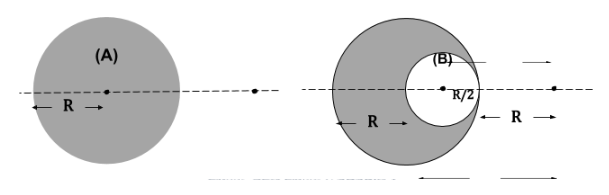
We know that the total gravitational force at a point is the vector sum of gravitational forces from individual masses.
A solid body as in figure can be imagined to be made up of many tiny individual masses.
So the net gravitational force at P due to all these masses can be calculated as:
${F_{net}} = \sum\limits_{all} {{F_i}} = \sum\limits_{all} {\dfrac{{G{m_i}m}}{{{r_i}^2}}} $
Now if, as in question, a sphere is cut out from the initial object, we can easily find the force at $P$ due to the rest of the mass in the following way:
Let us first use separate identities for the masses that are going to be cut out.
Let's say the masses that are going to get removed are represented as ${m_j}$ and let their position from P be ${r_j}$
For the rest of the object, we use ${m_i}$ for individual masses and ${r_i}$ for their position from $P$
Now if the sphere was not removed, the Gravitational force at P would have been :
${F_{net}} = \sum\limits_{all} {{F_i}} = \sum\limits_i {\dfrac{{G{m_i}m}}{{{r_i}^2}} + \sum\limits_j {\dfrac{{G{m_j}m}}{{{r_j}^2}}} } $
Since this is the force due to whole sphere, we know it would be${F_{net}} = \dfrac{{G{M_A}m}}{{{R_1}^2}}$.
Also, the second sum $\left( {\sum\limits_j {\dfrac{{G{m_j}m}}{{{r_j}^2}}} } \right)$ is the force exerted by the smaller sphere (B) at P. We know this Force as ${F_{net}} = \dfrac{{G{M_B}m}}{{{R_2}^2}}$ where ${R_2}$ is the distance from Centre of Sphere to P
That means: \[{F_{net}} = \dfrac{{G{M_A}m}}{{{R_1}^2}} = \sum\limits_i {\dfrac{{G{m_i}m}}{{{r_i}^2}} + \dfrac{{G{M_B}m}}{{{R_2}^2}}} \]
We are asked to find the Force exerted by the remaining portion, which is the first sum \[\left( {\sum\limits_i {\dfrac{{G{m_i}m}}{{{r_i}^2}}} } \right)\]. Let’s call this $F$.
.Rearranging equation (1) gives :
\[\sum\limits_i {\dfrac{{G{m_i}m}}{{{r_i}^2}} = \dfrac{{G{M_A}m}}{{{R_1}^2}} - } \dfrac{{G{M_B}m}}{{{R_2}^2}}\]
\[F = \sum\limits_i {\dfrac{{G{M_A}m}}{{{R_1}^2}} - } \dfrac{{G{M_B}m}}{{{R_2}^2}}\]
So we just verified that we can subtract the Force due to a smaller sphere (B) from that due to the Total Sphere (A) to get the force exerted by the remaining portion.
Now Let’s answer the question
Since the spheres have a constant density, we can find the mass of smaller and larger spheres.
The mass of initial Sphere (A) :
$\rho \dfrac{4}{3}\pi {R^3} = M(say)$
and similarly, that of The cut out sphere (B) would be
$\rho \dfrac{4}{3}\pi {\left( {R/2} \right)^3} = \dfrac{M}{8}$
Now, as we have seen,
Gravitational force at P after cutting = Force due to (A) - Force due to (B).
Force due to (A)
${F_A} = \dfrac{{G{M_A}m}}{{{R_1}^2}} = \dfrac{{GMm}}{{{{(2R)}^2}}} = \dfrac{1}{4}\dfrac{{GMm}}{{{R^2}}}$
Force due to (B)
${F_B} = \dfrac{{G(M/8)m}}{{{{(3R/2)}^2}}} = \dfrac{1}{{18}}\dfrac{{GMm}}{{{R^2}}}$
So Force due to cut out portion is :
${F_A} - {F_B} = \dfrac{1}{4}\dfrac{{GMm}}{{{R^2}}} - \dfrac{1}{{18}}\dfrac{{GMm}}{{{R^2}}} = \dfrac{7}{{36}}\dfrac{{GMm}}{{{R^2}}}$
According to the question, ${F_1}$ is the Force exerted by sphere (A).
So ${F_1} = {F_A}$
${F_2}$ is the force exerted by The remaining portion.
${F_2} = {F_A} - {F_B}$
So the required ratio :
\[\dfrac{{{F_1}}}{{{F_2}}} = \dfrac{{{F_A}}}{{{F_A} - {F_B}}} = \dfrac{{\left( {\dfrac{1}{4}\dfrac{{GMm}}{{{R^2}}}} \right)}}{{\left( {\dfrac{7}{{36}}\dfrac{{GMm}}{{{R^2}}}} \right)}} = \dfrac{9}{7}\], which is the correct solution.
.
Note: Similar argument of splitting the sum can be applied in questions where Moment of inertia or the Electric Potential of a cut out shape is asked.
Also, grouping similar quantities and giving it some name saves a lot of writing in questions involving ratios. For example $\rho \dfrac{4}{3}\pi {R^3} = M(say)$ ; ${F_A} = \dfrac{1}{4}\dfrac{{GMm}}{{{R^2}}} = \dfrac{1}{4}f(say)$
Complete step by step solution:
We know that the total gravitational force at a point is the vector sum of gravitational forces from individual masses.
A solid body as in figure can be imagined to be made up of many tiny individual masses.
So the net gravitational force at P due to all these masses can be calculated as:
${F_{net}} = \sum\limits_{all} {{F_i}} = \sum\limits_{all} {\dfrac{{G{m_i}m}}{{{r_i}^2}}} $
Now if, as in question, a sphere is cut out from the initial object, we can easily find the force at $P$ due to the rest of the mass in the following way:
Let us first use separate identities for the masses that are going to be cut out.
Let's say the masses that are going to get removed are represented as ${m_j}$ and let their position from P be ${r_j}$
For the rest of the object, we use ${m_i}$ for individual masses and ${r_i}$ for their position from $P$
Now if the sphere was not removed, the Gravitational force at P would have been :
${F_{net}} = \sum\limits_{all} {{F_i}} = \sum\limits_i {\dfrac{{G{m_i}m}}{{{r_i}^2}} + \sum\limits_j {\dfrac{{G{m_j}m}}{{{r_j}^2}}} } $
Since this is the force due to whole sphere, we know it would be${F_{net}} = \dfrac{{G{M_A}m}}{{{R_1}^2}}$.
Also, the second sum $\left( {\sum\limits_j {\dfrac{{G{m_j}m}}{{{r_j}^2}}} } \right)$ is the force exerted by the smaller sphere (B) at P. We know this Force as ${F_{net}} = \dfrac{{G{M_B}m}}{{{R_2}^2}}$ where ${R_2}$ is the distance from Centre of Sphere to P
That means: \[{F_{net}} = \dfrac{{G{M_A}m}}{{{R_1}^2}} = \sum\limits_i {\dfrac{{G{m_i}m}}{{{r_i}^2}} + \dfrac{{G{M_B}m}}{{{R_2}^2}}} \]
We are asked to find the Force exerted by the remaining portion, which is the first sum \[\left( {\sum\limits_i {\dfrac{{G{m_i}m}}{{{r_i}^2}}} } \right)\]. Let’s call this $F$.
.Rearranging equation (1) gives :
\[\sum\limits_i {\dfrac{{G{m_i}m}}{{{r_i}^2}} = \dfrac{{G{M_A}m}}{{{R_1}^2}} - } \dfrac{{G{M_B}m}}{{{R_2}^2}}\]
\[F = \sum\limits_i {\dfrac{{G{M_A}m}}{{{R_1}^2}} - } \dfrac{{G{M_B}m}}{{{R_2}^2}}\]
So we just verified that we can subtract the Force due to a smaller sphere (B) from that due to the Total Sphere (A) to get the force exerted by the remaining portion.
Now Let’s answer the question
Since the spheres have a constant density, we can find the mass of smaller and larger spheres.
The mass of initial Sphere (A) :
$\rho \dfrac{4}{3}\pi {R^3} = M(say)$
and similarly, that of The cut out sphere (B) would be
$\rho \dfrac{4}{3}\pi {\left( {R/2} \right)^3} = \dfrac{M}{8}$
Now, as we have seen,
Gravitational force at P after cutting = Force due to (A) - Force due to (B).
Force due to (A)
${F_A} = \dfrac{{G{M_A}m}}{{{R_1}^2}} = \dfrac{{GMm}}{{{{(2R)}^2}}} = \dfrac{1}{4}\dfrac{{GMm}}{{{R^2}}}$
Force due to (B)
${F_B} = \dfrac{{G(M/8)m}}{{{{(3R/2)}^2}}} = \dfrac{1}{{18}}\dfrac{{GMm}}{{{R^2}}}$
So Force due to cut out portion is :
${F_A} - {F_B} = \dfrac{1}{4}\dfrac{{GMm}}{{{R^2}}} - \dfrac{1}{{18}}\dfrac{{GMm}}{{{R^2}}} = \dfrac{7}{{36}}\dfrac{{GMm}}{{{R^2}}}$
According to the question, ${F_1}$ is the Force exerted by sphere (A).
So ${F_1} = {F_A}$
${F_2}$ is the force exerted by The remaining portion.
${F_2} = {F_A} - {F_B}$
So the required ratio :
\[\dfrac{{{F_1}}}{{{F_2}}} = \dfrac{{{F_A}}}{{{F_A} - {F_B}}} = \dfrac{{\left( {\dfrac{1}{4}\dfrac{{GMm}}{{{R^2}}}} \right)}}{{\left( {\dfrac{7}{{36}}\dfrac{{GMm}}{{{R^2}}}} \right)}} = \dfrac{9}{7}\], which is the correct solution.
.
Note: Similar argument of splitting the sum can be applied in questions where Moment of inertia or the Electric Potential of a cut out shape is asked.
Also, grouping similar quantities and giving it some name saves a lot of writing in questions involving ratios. For example $\rho \dfrac{4}{3}\pi {R^3} = M(say)$ ; ${F_A} = \dfrac{1}{4}\dfrac{{GMm}}{{{R^2}}} = \dfrac{1}{4}f(say)$
Recently Updated Pages
Master Class 11 Social Science: Engaging Questions & Answers for Success

Master Class 11 Physics: Engaging Questions & Answers for Success
Master Class 11 Maths: Engaging Questions & Answers for Success
Master Class 11 Economics: Engaging Questions & Answers for Success
Master Class 11 Computer Science: Engaging Questions & Answers for Success
Master Class 11 Chemistry: Engaging Questions & Answers for Success
Trending doubts
One Metric ton is equal to kg A 10000 B 1000 C 100 class 11 physics CBSE
There are 720 permutations of the digits 1 2 3 4 5 class 11 maths CBSE
1 Quintal is equal to a 110 kg b 10 kg c 100kg d 1000 class 11 physics CBSE
State and prove Bernoullis theorem class 11 physics CBSE
Difference Between Prokaryotic Cells and Eukaryotic Cells
Discuss the various forms of bacteria class 11 biology CBSE