




A solid is in the shape of a cone standing on a hemisphere with both their radii being equal to 1 cm and the height of the cone is equal to its radius. Find the volume of the solid in terms of \[\pi \].
Answer
 Verified
532k+ views
Hint: The volume of a hemisphere with radius r is \[\dfrac{2}{3}\pi {r^3}\] and the volume of the cone with radius r and height h is \[\dfrac{1}{3}\pi {r^2}h\]. Find the volumes of hemisphere and cone separately and add them to get the required answer.
Complete step-by-step answer:
A hemisphere is half of the sphere cut by the plane passing through its center. The volume of the hemisphere is half of that of the sphere.
A hemisphere with radius r has a volume given as follows:
\[{V_H} = \dfrac{2}{3}\pi {r^3}...........(1)\]
A cone is a right angle triangle that is rotated with any one of its perpendicular sides as the axis in 3-dimensional space. The volume of the cone is one-third of the volume of the cylinder.
The volume of a cone of radius r and height h is given as follows:
\[{V_C} = \dfrac{1}{3}\pi {r^2}h...........(2)\]
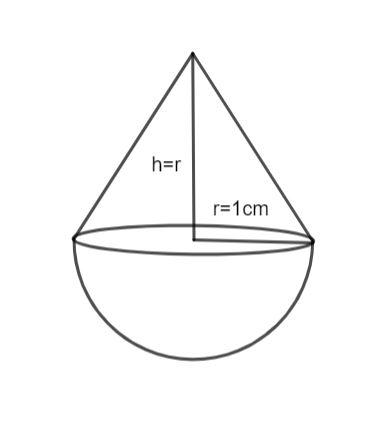
The solid in the given question is composed of a hemisphere and a cone. We can calculate its volume by calculating separately the volumes of cones and hemisphere and adding them.
The volume of the hemisphere of radius 1 cm is given by equation (1) as follows:
\[{V_H} = \dfrac{2}{3}\pi {(1)^3}\]
\[{V_H} = \dfrac{2}{3}\pi c{m^3}\]
The volume of the cone of radius 1 cm and height 1 cm is given by equation (2) as follows:
\[{V_C} = \dfrac{1}{3}\pi {(1)^2}(1)\]
\[{V_C} = \dfrac{1}{3}\pi c{m^3}\]
Adding the two volumes, we have:
\[V = {V_H} + {V_C}\]
\[V = \dfrac{2}{3}\pi + \dfrac{1}{3}\pi \]
\[V = \pi c{m^3}\]
Hence, the volume of the solid is \[\pi \] cubic cm.
Note: The question is asked to find the volume of the solid in terms of \[\pi \], hence, leave the answer in terms of \[\pi \], if you evaluate, then the answer will be wrong.Students should remember formulas of volume of hemisphere and cone for solving these type of problems.
Complete step-by-step answer:
A hemisphere is half of the sphere cut by the plane passing through its center. The volume of the hemisphere is half of that of the sphere.
A hemisphere with radius r has a volume given as follows:
\[{V_H} = \dfrac{2}{3}\pi {r^3}...........(1)\]
A cone is a right angle triangle that is rotated with any one of its perpendicular sides as the axis in 3-dimensional space. The volume of the cone is one-third of the volume of the cylinder.
The volume of a cone of radius r and height h is given as follows:
\[{V_C} = \dfrac{1}{3}\pi {r^2}h...........(2)\]
The solid in the given question is composed of a hemisphere and a cone. We can calculate its volume by calculating separately the volumes of cones and hemisphere and adding them.
The volume of the hemisphere of radius 1 cm is given by equation (1) as follows:
\[{V_H} = \dfrac{2}{3}\pi {(1)^3}\]
\[{V_H} = \dfrac{2}{3}\pi c{m^3}\]
The volume of the cone of radius 1 cm and height 1 cm is given by equation (2) as follows:
\[{V_C} = \dfrac{1}{3}\pi {(1)^2}(1)\]
\[{V_C} = \dfrac{1}{3}\pi c{m^3}\]
Adding the two volumes, we have:
\[V = {V_H} + {V_C}\]
\[V = \dfrac{2}{3}\pi + \dfrac{1}{3}\pi \]
\[V = \pi c{m^3}\]
Hence, the volume of the solid is \[\pi \] cubic cm.
Note: The question is asked to find the volume of the solid in terms of \[\pi \], hence, leave the answer in terms of \[\pi \], if you evaluate, then the answer will be wrong.Students should remember formulas of volume of hemisphere and cone for solving these type of problems.
Recently Updated Pages
Basicity of sulphurous acid and sulphuric acid are

Master Class 11 Business Studies: Engaging Questions & Answers for Success
Master Class 11 Computer Science: Engaging Questions & Answers for Success
Master Class 11 Economics: Engaging Questions & Answers for Success
Master Class 11 Social Science: Engaging Questions & Answers for Success
Master Class 11 English: Engaging Questions & Answers for Success
Trending doubts
One Metric ton is equal to kg A 10000 B 1000 C 100 class 11 physics CBSE
The largest wind power cluster is located in the state class 11 social science CBSE
Explain zero factorial class 11 maths CBSE
State and prove Bernoullis theorem class 11 physics CBSE
What steps did the French revolutionaries take to create class 11 social science CBSE
Which among the following are examples of coming together class 11 social science CBSE