




A soccer ball is kicked into the air and travels 20 meters horizontally before coming back down to the ground.
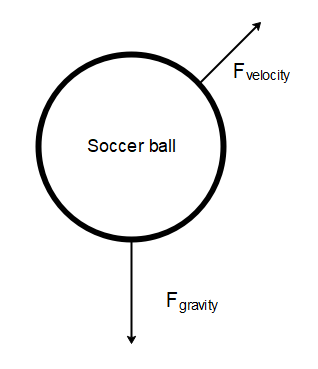
Which diagram best represents the forces acting on the ball while it is in the air?
Each arrow represents a force along with the general direction of the force. The subscripts describe each force. Assume that air resistance is negligible.
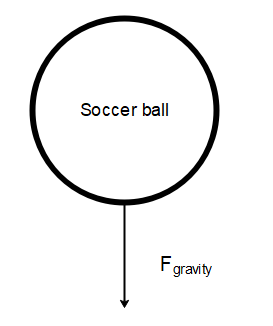
A)
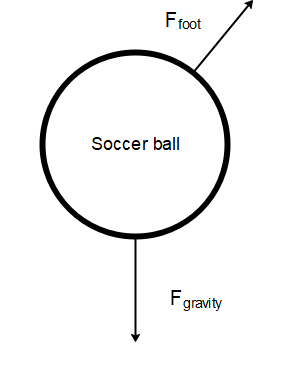
B)
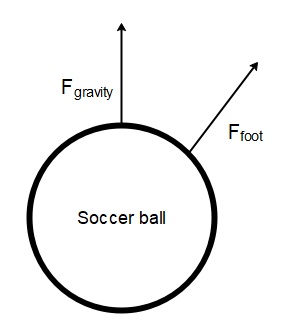
C)
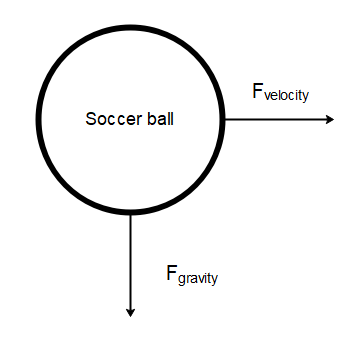
D)
E)
Answer
 Verified
589.8k+ views
Hint: When the ball is in the air, there will be a gravitational force acting on the ball which is always downwards. The velocity of the ball is upwards when it is going upwards and downwards when the ball is falling.
Complete answer: When the football is kicked in the air, there will be two forces acting on it. That is the force applied by the kick on the ball which is upwards and the gravitational acceleration of the ball towards the Earth which is always downwards. Once the ball leaves our foot, only the gravitational force will be acting on it which is always downwards towards the surface of the Earth so option (A) is correct.
-In option (B), it has been shown that there is also a force of our foot on the ball. This is only true when we are in the process of kicking the ball but not when the ball is in the air so option (B) is wrong. This is the reason why option (C) is also incorrect.
-In option (D), there is force shown associated with the velocity of the ball. Even if the ball has a net velocity, there is no force associated with the velocity. So, option (D) is also incorrect. This is the reason why option (E) is also incorrect.
Hence, the correct answer is option A.
Note: As mentioned in the question, we are ignoring air resistance which will slow down the fall and exert a drag force on it. The direction of this drag force will always be opposite to the direction of motion of the ball.
Complete answer: When the football is kicked in the air, there will be two forces acting on it. That is the force applied by the kick on the ball which is upwards and the gravitational acceleration of the ball towards the Earth which is always downwards. Once the ball leaves our foot, only the gravitational force will be acting on it which is always downwards towards the surface of the Earth so option (A) is correct.
-In option (B), it has been shown that there is also a force of our foot on the ball. This is only true when we are in the process of kicking the ball but not when the ball is in the air so option (B) is wrong. This is the reason why option (C) is also incorrect.
-In option (D), there is force shown associated with the velocity of the ball. Even if the ball has a net velocity, there is no force associated with the velocity. So, option (D) is also incorrect. This is the reason why option (E) is also incorrect.
Hence, the correct answer is option A.
Note: As mentioned in the question, we are ignoring air resistance which will slow down the fall and exert a drag force on it. The direction of this drag force will always be opposite to the direction of motion of the ball.
Recently Updated Pages
Master Class 11 Social Science: Engaging Questions & Answers for Success

Master Class 11 English: Engaging Questions & Answers for Success
Master Class 11 Maths: Engaging Questions & Answers for Success
Master Class 11 Chemistry: Engaging Questions & Answers for Success
Master Class 11 Biology: Engaging Questions & Answers for Success
Master Class 11 Physics: Engaging Questions & Answers for Success
Trending doubts
Differentiate between an exothermic and an endothermic class 11 chemistry CBSE
One Metric ton is equal to kg A 10000 B 1000 C 100 class 11 physics CBSE
Difference Between Prokaryotic Cells and Eukaryotic Cells
There are 720 permutations of the digits 1 2 3 4 5 class 11 maths CBSE
Draw a diagram of a plant cell and label at least eight class 11 biology CBSE
Which chemical is known as king of chemicals A H 2 class 11 chemistry CBSE