




A small magnet of moment \[4.8\times {{10}^{-2}}J/T\] is suspended freely in the plane of a uniform magnetic field of magnitude \[3\times {{10}^{-2}}T\]. If the magnet is slightly displaced from its stable equilibrium and released, then what is the angular frequency of its oscillation in \[rad/\operatorname{s}\]? (The moment of inertia of the magnet about the axis of rotation is \[2.25\times {{10}^{-5}}kg{{m}^{2}}\])
Answer
 Verified
661.2k+ views
Hint: We need to analyse the given situation in which a stable equilibrium is distorted and the magnet undergoes an oscillation to restore its equilibrium condition. From this we can find the angular frequency of the oscillating small magnet.
Complete answer:
We are given a small magnet which is kept in a magnetic field. It is said that the system was in equilibrium initially until an external disturbance caused it to oscillate.
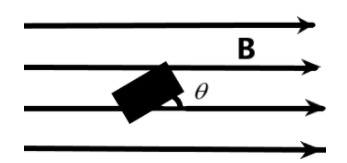
Let us consider the angle of distortion experienced by the magnet to be \[\theta \]. Then we can find the magnetic moment m of the small magnet using the formula for torque as –
\[\tau =mB\sin \theta \]
We know that the angle is small,
\[\therefore \tau =mB\theta \]
Now, let us find the torque introduced to the system by this change.
The torque is given using the relation with the moment of inertia ‘I’ and the angular acceleration as –
\[\tau =I\dfrac{{{d}^{2}}\theta }{d{{t}^{2}}}\]
Now, we can equate the two relations of the torque at equilibrium as –
\[\begin{align}
& \tau =mB\theta \\
& \text{and,} \\
& \tau =I\dfrac{{{d}^{2}}\theta }{d{{t}^{2}}} \\
& \Rightarrow I\dfrac{{{d}^{2}}\theta }{d{{t}^{2}}}=mB\theta \\
& \Rightarrow \dfrac{mB}{I}=\theta \dfrac{{{d}^{2}}\theta }{d{{t}^{2}}} \\
\end{align}\]
We know from the simple harmonic motion, the L.H.S. of the above equation gives the angular frequency of the oscillating magnet. We can substitute the given values to get the angular frequency as –
\[\begin{align}
& {{\omega }^{2}}=\dfrac{mB}{I}=\theta \dfrac{{{d}^{2}}\theta }{d{{t}^{2}}} \\
& \Rightarrow \omega =\sqrt{\dfrac{mB}{I}} \\
& \Rightarrow \omega =\sqrt{\dfrac{(4.8\times {{10}^{-2}})(3\times {{10}^{-2}})}{2.25\times {{10}^{-5}}}} \\
& \therefore \omega =8rad{{s}^{-1}} \\
\end{align}\]
The angular frequency of the oscillating magnet is \[8rad{{s}^{-1}}\].
This is the required solution.
Note:
We know that this is the basic idea we use to find the angular frequency of any magnetic particle in a magnetic field which undergoes an oscillation due to instability. Here, we were given a small magnet and therefore, we could approximate the sine of the angle to be the angle itself.
Complete answer:
We are given a small magnet which is kept in a magnetic field. It is said that the system was in equilibrium initially until an external disturbance caused it to oscillate.
Let us consider the angle of distortion experienced by the magnet to be \[\theta \]. Then we can find the magnetic moment m of the small magnet using the formula for torque as –
\[\tau =mB\sin \theta \]
We know that the angle is small,
\[\therefore \tau =mB\theta \]
Now, let us find the torque introduced to the system by this change.
The torque is given using the relation with the moment of inertia ‘I’ and the angular acceleration as –
\[\tau =I\dfrac{{{d}^{2}}\theta }{d{{t}^{2}}}\]
Now, we can equate the two relations of the torque at equilibrium as –
\[\begin{align}
& \tau =mB\theta \\
& \text{and,} \\
& \tau =I\dfrac{{{d}^{2}}\theta }{d{{t}^{2}}} \\
& \Rightarrow I\dfrac{{{d}^{2}}\theta }{d{{t}^{2}}}=mB\theta \\
& \Rightarrow \dfrac{mB}{I}=\theta \dfrac{{{d}^{2}}\theta }{d{{t}^{2}}} \\
\end{align}\]
We know from the simple harmonic motion, the L.H.S. of the above equation gives the angular frequency of the oscillating magnet. We can substitute the given values to get the angular frequency as –
\[\begin{align}
& {{\omega }^{2}}=\dfrac{mB}{I}=\theta \dfrac{{{d}^{2}}\theta }{d{{t}^{2}}} \\
& \Rightarrow \omega =\sqrt{\dfrac{mB}{I}} \\
& \Rightarrow \omega =\sqrt{\dfrac{(4.8\times {{10}^{-2}})(3\times {{10}^{-2}})}{2.25\times {{10}^{-5}}}} \\
& \therefore \omega =8rad{{s}^{-1}} \\
\end{align}\]
The angular frequency of the oscillating magnet is \[8rad{{s}^{-1}}\].
This is the required solution.
Note:
We know that this is the basic idea we use to find the angular frequency of any magnetic particle in a magnetic field which undergoes an oscillation due to instability. Here, we were given a small magnet and therefore, we could approximate the sine of the angle to be the angle itself.
Recently Updated Pages
Write the number of covalent bonds in the molecule class 11 chemistry CBSE

Master Class 10 Computer Science: Engaging Questions & Answers for Success
Master Class 10 General Knowledge: Engaging Questions & Answers for Success
Master Class 10 Maths: Engaging Questions & Answers for Success
Master Class 10 English: Engaging Questions & Answers for Success
Master Class 10 Social Science: Engaging Questions & Answers for Success
Trending doubts
Which of the following viruses contains both DNA and class 11 biology CBSE
Which is the largest gland in the human body A Pancreas class 11 biology CBSE
Difference between physical and chemical change class 11 chemistry CBSE
Draw a diagram of nephron and explain its structur class 11 biology CBSE
Define dispersion without deviation Derive an expression class 11 physics CBSE
Draw a labelled diagram of the neuron and describe class 11 biology CBSE