




A small bulb is placed at the bottom of a tank containing water to a depth of 80 cm. What is the area of the surface of water through which light from the bulb can emerge out? Refractive index of water is 1.33. (Consider the bulb to be a point source.)
Answer
 Verified
591.9k+ views
Hint:To solve this question of total internal refraction, we can approach this question geometrically. Let us form an illustration of the given conditions
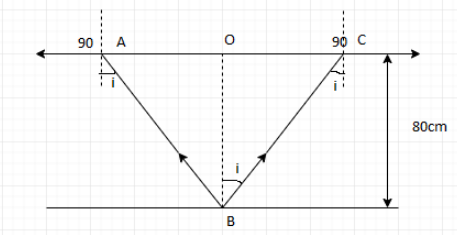
From the figure, when we assume that the bulb is placed at point B ,it is evident that in order to find the area of surface through which the light emerges, we have to find the area of the circle with radius OA.
Formulas used:
Refractive index $\mu =\dfrac{\sin i}{\sin r}$, where I is the angle of incidence and r is the angle of refraction of the ray that we consider.
Complete step by step answer:
We’re given that, the depth of the tank is d1=$80cm=0.8m$
We also know that the refractive index of water $\mu =1.33$
Let us consider the radius to be $R=\dfrac{AC}{2}$
We know that Refractive index $\mu =\dfrac{\sin i}{\sin r}$,
Here,$\mu =\dfrac{\sin 90}{\sin i}$
$\Rightarrow i={{48.75}^{\circ }}$
When we consider $\vartriangle OBC$from the figure,
$
\tan i=\dfrac{OC}{OB}=\dfrac{R}{d1} \\
\Rightarrow R=0.91 \\
$
Now that we’ve obtained the radius, we can find the area of the circle using the formula,
$\therefore A=\pi {{R}^{2}}=\pi {{(0.91)}^{2}}=2.61{{m}^{2}}$
Hence the the area of surface through which the light emerges is $2.61{{m}^{2}}$.
Note:Refractive index is an essential parameter as far as liquids are concerned. We can analyse parameters like dispersion, purity, and diffusion coefficient of liquids with the help of a refractive index. Refractive index is applied in daily life as it is used in instruments like glasses, cameras, microscopes etc.
From the figure, when we assume that the bulb is placed at point B ,it is evident that in order to find the area of surface through which the light emerges, we have to find the area of the circle with radius OA.
Formulas used:
Refractive index $\mu =\dfrac{\sin i}{\sin r}$, where I is the angle of incidence and r is the angle of refraction of the ray that we consider.
Complete step by step answer:
We’re given that, the depth of the tank is d1=$80cm=0.8m$
We also know that the refractive index of water $\mu =1.33$
Let us consider the radius to be $R=\dfrac{AC}{2}$
We know that Refractive index $\mu =\dfrac{\sin i}{\sin r}$,
Here,$\mu =\dfrac{\sin 90}{\sin i}$
$\Rightarrow i={{48.75}^{\circ }}$
When we consider $\vartriangle OBC$from the figure,
$
\tan i=\dfrac{OC}{OB}=\dfrac{R}{d1} \\
\Rightarrow R=0.91 \\
$
Now that we’ve obtained the radius, we can find the area of the circle using the formula,
$\therefore A=\pi {{R}^{2}}=\pi {{(0.91)}^{2}}=2.61{{m}^{2}}$
Hence the the area of surface through which the light emerges is $2.61{{m}^{2}}$.
Note:Refractive index is an essential parameter as far as liquids are concerned. We can analyse parameters like dispersion, purity, and diffusion coefficient of liquids with the help of a refractive index. Refractive index is applied in daily life as it is used in instruments like glasses, cameras, microscopes etc.
Recently Updated Pages
Basicity of sulphurous acid and sulphuric acid are

Master Class 11 Business Studies: Engaging Questions & Answers for Success
Master Class 11 Computer Science: Engaging Questions & Answers for Success
Master Class 11 Economics: Engaging Questions & Answers for Success
Master Class 11 Social Science: Engaging Questions & Answers for Success
Master Class 11 English: Engaging Questions & Answers for Success
Trending doubts
One Metric ton is equal to kg A 10000 B 1000 C 100 class 11 physics CBSE
The largest wind power cluster is located in the state class 11 social science CBSE
Explain zero factorial class 11 maths CBSE
State and prove Bernoullis theorem class 11 physics CBSE
What steps did the French revolutionaries take to create class 11 social science CBSE
Which among the following are examples of coming together class 11 social science CBSE