




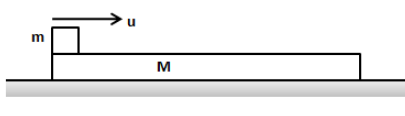
A small block of mass m is placed on a long plank of mass M that is placed on a frictionless horizontal floor. The block is abruptly given a velocity u on the plank. If during sliding of the block a distance L relative to the plank, total heat loss is Q. Find acceleration of the plank during the sliding of the block.
A. \[\dfrac{Q}{{mL}}\]
B. \[\dfrac{Q}{{ML}}\]
C. \[\dfrac{Q}{{\left( {m + M} \right)L}}\]
D. None of these
Answer
 Verified
610.2k+ views
Hint:When the block slides over a plank, the heat is generated. This heat can be determined by the law of conservation of energy as the kinetic energy is being converted into the thermal energy. Use Newton’s second law to express the frictional force and the deceleration by the frictional force.
Formula used:
Thermal energy, \[Q = \mu mgd\],
where, \[\mu \] is the coefficient of friction, m is the mass, g is the acceleration due to gravity and d is the distance travelled by the block.
Complete Step by Step Answer:
We know that when the body slides over a rough surface, the heat is generated. Thus, when the block of mass m slides over a plank, the heat is generated. We have from the law of conservation of energy; the loss in the kinetic energy of the block is used to generate the heat Q. Therefore, we can write,
\[\dfrac{1}{2}m{u^2} = Q = \mu mgL\]
Here, \[\mu \] is the coefficient of friction, m is the mass of the block, g is the acceleration due to gravity and L is the distance travelled by the block on the rough surface.
From the above equation, the coefficient of friction becomes,
\[\mu = \dfrac{Q}{{mgL}}\] …… (1)
Now, the acceleration or deceleration of the block on the plank is due to the frictional force acting on the block.
\[{f_r} = \mu mg = ma\]
\[ \Rightarrow a = \mu g\]
Using equation (1) in the above equation, we get,
\[a = \left( {\dfrac{Q}{{mgL}}} \right)g\]
\[ \therefore a = \dfrac{Q}{{mL}}\]
So, the correct answer is option A.
Note: There is no potential energy change in the motion of the block. The total energy of the system is the addition of kinetic energy and thermal energy produced by the friction. The block will not accelerate since the friction is acting on it to restrict its motion. Therefore, you can say the block has undergone deceleration.
Formula used:
Thermal energy, \[Q = \mu mgd\],
where, \[\mu \] is the coefficient of friction, m is the mass, g is the acceleration due to gravity and d is the distance travelled by the block.
Complete Step by Step Answer:
We know that when the body slides over a rough surface, the heat is generated. Thus, when the block of mass m slides over a plank, the heat is generated. We have from the law of conservation of energy; the loss in the kinetic energy of the block is used to generate the heat Q. Therefore, we can write,
\[\dfrac{1}{2}m{u^2} = Q = \mu mgL\]
Here, \[\mu \] is the coefficient of friction, m is the mass of the block, g is the acceleration due to gravity and L is the distance travelled by the block on the rough surface.
From the above equation, the coefficient of friction becomes,
\[\mu = \dfrac{Q}{{mgL}}\] …… (1)
Now, the acceleration or deceleration of the block on the plank is due to the frictional force acting on the block.
\[{f_r} = \mu mg = ma\]
\[ \Rightarrow a = \mu g\]
Using equation (1) in the above equation, we get,
\[a = \left( {\dfrac{Q}{{mgL}}} \right)g\]
\[ \therefore a = \dfrac{Q}{{mL}}\]
So, the correct answer is option A.
Note: There is no potential energy change in the motion of the block. The total energy of the system is the addition of kinetic energy and thermal energy produced by the friction. The block will not accelerate since the friction is acting on it to restrict its motion. Therefore, you can say the block has undergone deceleration.
Recently Updated Pages
Basicity of sulphurous acid and sulphuric acid are

Master Class 11 English: Engaging Questions & Answers for Success
Master Class 11 Physics: Engaging Questions & Answers for Success
Master Class 11 Computer Science: Engaging Questions & Answers for Success
Master Class 11 Chemistry: Engaging Questions & Answers for Success
Master Class 11 Social Science: Engaging Questions & Answers for Success
Trending doubts
Difference Between Prokaryotic Cells and Eukaryotic Cells
Two of the body parts which do not appear in MRI are class 11 biology CBSE
One Metric ton is equal to kg A 10000 B 1000 C 100 class 11 physics CBSE
10 examples of friction in our daily life
Draw a diagram of nephron and explain its structur class 11 biology CBSE
What will happen if the mucus is not secreted by the class 11 biology CBSE