




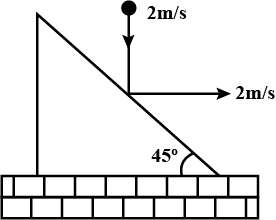
A small ball falling vertically downward with constant velocity, $v=2m/s$, strikes elastically an inclined plane moving with velocity, $2m/s$ as shown in the figure. The velocity of rebound of the ball with respect to the ground is:
$(a)4m/s$
$(b)2\sqrt{5}m/s$
$(c)2\sqrt{2}m/s$
$(d)2m/s$
Answer
 Verified
598.5k+ views
Hint: By Conservation of Momentum, when the ball rebounds off the surface of the inclined plane elastically, it experiences same momentum but in the opposite direction so the net change in momentum is twice the initial momentum of the ball. We will also make use of the relative velocity of the ball with respect to the incline, it will help us visualize the problem better.
Complete answer:
Let the initial momentum of the ball be p.
Since the ball rebounds elastically, total change in momentum is $=2p$.
Now, the Relative velocity of ball with respect to the incline is given by:
Before collision:
$=-v$ directed to the right (horizontal component)
$=-v$ directed upwards (vertical component)
After collision:
$=+v$ directed left (horizontal component)
$=+v$ directed downwards (vertical component)
Therefore, the Velocity of the rebound ball can be written as:
$\Rightarrow {{V}_{rb,g}}=\sqrt{{{(2V\widehat{i})}^{2}}+{{(V\widehat{j})}^{2}}}$ [equation number $(1)$ ]
Where,
${{V}_{rb,g}}=$ velocity of rebound ball with respect to the ground
$2V\widehat{i}=$ horizontal component of rebound ball velocity
$V\widehat{j}=$ vertical component of rebound ball velocity
Putting the values of each term in equation number $(1)$ , we get:
$\Rightarrow {{V}_{rb,g}}=\sqrt{{{(2\times 2)}^{2}}+{{(2)}^{2}}}m/s$
$\begin{align}
& \Rightarrow {{V}_{rb,g}}=\sqrt{20}m/s \\
& \Rightarrow {{V}_{rb,g}}=2\sqrt{5}m/s \\
\end{align}$
Hence, the rebound velocity of the ball is $2\sqrt{5}m/s$ .
Hence, option (b) is the correct option.
Note:
While solving these types of questions, we can choose the frame of reference according to our ease and the velocity of our frame of reference should be kept zero to help solve the question properly and quickly. Hence, making our calculations easier and faster.
Complete answer:
Let the initial momentum of the ball be p.
Since the ball rebounds elastically, total change in momentum is $=2p$.
Now, the Relative velocity of ball with respect to the incline is given by:
Before collision:
$=-v$ directed to the right (horizontal component)
$=-v$ directed upwards (vertical component)
After collision:
$=+v$ directed left (horizontal component)
$=+v$ directed downwards (vertical component)
Therefore, the Velocity of the rebound ball can be written as:
$\Rightarrow {{V}_{rb,g}}=\sqrt{{{(2V\widehat{i})}^{2}}+{{(V\widehat{j})}^{2}}}$ [equation number $(1)$ ]
Where,
${{V}_{rb,g}}=$ velocity of rebound ball with respect to the ground
$2V\widehat{i}=$ horizontal component of rebound ball velocity
$V\widehat{j}=$ vertical component of rebound ball velocity
Putting the values of each term in equation number $(1)$ , we get:
$\Rightarrow {{V}_{rb,g}}=\sqrt{{{(2\times 2)}^{2}}+{{(2)}^{2}}}m/s$
$\begin{align}
& \Rightarrow {{V}_{rb,g}}=\sqrt{20}m/s \\
& \Rightarrow {{V}_{rb,g}}=2\sqrt{5}m/s \\
\end{align}$
Hence, the rebound velocity of the ball is $2\sqrt{5}m/s$ .
Hence, option (b) is the correct option.
Note:
While solving these types of questions, we can choose the frame of reference according to our ease and the velocity of our frame of reference should be kept zero to help solve the question properly and quickly. Hence, making our calculations easier and faster.
Recently Updated Pages
Which will be the least stable resonating structure class 11 chemistry CBSE

How many 5 digit telephone numbers can be construc-class-11-maths-CBSE
How do you find the angle of the resultant vector class 11 physics CBSE
Draw labelled diagram of the following i Gram seed class 11 biology CBSE
1 Quintal is equal to a 110 kg b 10 kg c 100kg d 1000 class 11 physics CBSE
What is the need and importance of classification class 11 biology CBSE
Trending doubts
One Metric ton is equal to kg A 10000 B 1000 C 100 class 11 physics CBSE
Find the value of the expression given below sin 30circ class 11 maths CBSE
Draw a diagram of nephron and explain its structur class 11 biology CBSE
10 examples of friction in our daily life
Proton was discovered by A Thomson B Rutherford C Chadwick class 11 chemistry CBSE
The teeth used for biting and cutting food are called class 11 biology CBSE