




A ship A is moving Westwards with a speed of \[10km/h\] and a ship B \[100km\] South of A is moving northwards with a speed of \[10km/h\]. The time after which the distance between them becomes shortest is:
\[\begin{align}
& A)0h \\
& B)5h \\
& C)5\sqrt{2}h \\
& D)10\sqrt{2}h \\
\end{align}\]
Answer
 Verified
583.8k+ views
Hint: Here, the velocities of ships A and B are given. From this, we can find the velocity of A with respect to B. Then, draw a vector diagram and mark the distances and angles. Consider the triangle made by the resultant velocity and the path of ship B and find out all the sides and thereby the time taken by the ships to reach their shortest distance can be calculated.
Formula used:
\[\text{time = }\dfrac{\text{distance}}{\text{velocity}}\]
Complete step by step answer:
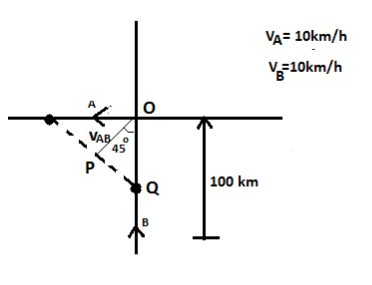
Velocity of A with respect to B is,
\[{{\vec{v}}_{AB}}={{\vec{v}}_{A}}-\left( -{{{\vec{v}}}_{B}} \right)={{\vec{v}}_{A}}+{{\vec{v}}_{B}}\]
Then,
\[{{v}_{AB}}=\sqrt{{{v}_{A}}+{{v}_{B}}}\] ------- 1
Given that,
Velocity of A, \[{{v}_{A}}=10km/h\]
Velocity of B, \[{{v}_{B}}=10km/h\]
Substitute the velocities of ships A and B in equation 1 we get,
Velocity of A with respect to B, \[{{v}_{AB}}=\sqrt{{{10}^{2}}+{{10}^{2}}}=10\sqrt{2}\]
From the above diagram the shortest distance between ships A and B is PQ.
Consider triangle POQ,
\[\sin 45=\dfrac{PQ}{OQ}\]
\[OQ=100km\]
Then,
\[PQ=OQ\times \sin 45=100\times \dfrac{1}{\sqrt{2}}=50\sqrt{2}m\]
We have, \[\text{time = }\dfrac{\text{distance}}{\text{velocity}}\]
Substitute the values of PQ and \[{{v}_{AB}}\]in the above equation, we get,
Then, the time taken to reach the shortest distance,
\[t=\dfrac{PQ}{{{v}_{AB}}}=\dfrac{50\sqrt{2}}{10\sqrt{2}}=5h\]
Therefore, the answer is option B.
Note:
Alternate method to solve the question
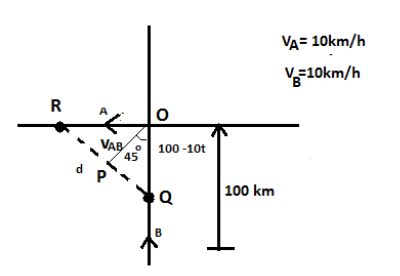
Given,
Velocity of A, \[{{v}_{A}}=10km/h\]
Velocity of B, \[{{v}_{B}}=10km/h\]
Given that, both ships A and B are travelling with the same velocity. Then, at any instant \[t\] the distance traveled by the ships will be the same.
i.e.,
Distance travelled by ship A = Distance travelled by ship B \[=10t\]
Then, the remaining distance for B is, \[100-10t\].
Then, considering triangle ROQ,
\[{{d}^{2}}=P{{O}^{2}}+O{{Q}^{2}}\]
\[{{d}^{2}}={{\left( 10t \right)}^{2}}+{{\left( 100-t \right)}^{2}}\]
\[d=\sqrt{100{{t}^{2}}+10000+100{{t}^{2}}-200t}=\sqrt{200{{t}^{2}}+10000-2000t}\]
Differentiating both sides with respect to time,
\[\dfrac{d\left( d \right)}{dt}=0\]
\[\Rightarrow 0=400t-2000\]
\[\Rightarrow 400t=2000\]
\[\Rightarrow t=5hr\]
Formula used:
\[\text{time = }\dfrac{\text{distance}}{\text{velocity}}\]
Complete step by step answer:
Velocity of A with respect to B is,
\[{{\vec{v}}_{AB}}={{\vec{v}}_{A}}-\left( -{{{\vec{v}}}_{B}} \right)={{\vec{v}}_{A}}+{{\vec{v}}_{B}}\]
Then,
\[{{v}_{AB}}=\sqrt{{{v}_{A}}+{{v}_{B}}}\] ------- 1
Given that,
Velocity of A, \[{{v}_{A}}=10km/h\]
Velocity of B, \[{{v}_{B}}=10km/h\]
Substitute the velocities of ships A and B in equation 1 we get,
Velocity of A with respect to B, \[{{v}_{AB}}=\sqrt{{{10}^{2}}+{{10}^{2}}}=10\sqrt{2}\]
From the above diagram the shortest distance between ships A and B is PQ.
Consider triangle POQ,
\[\sin 45=\dfrac{PQ}{OQ}\]
\[OQ=100km\]
Then,
\[PQ=OQ\times \sin 45=100\times \dfrac{1}{\sqrt{2}}=50\sqrt{2}m\]
We have, \[\text{time = }\dfrac{\text{distance}}{\text{velocity}}\]
Substitute the values of PQ and \[{{v}_{AB}}\]in the above equation, we get,
Then, the time taken to reach the shortest distance,
\[t=\dfrac{PQ}{{{v}_{AB}}}=\dfrac{50\sqrt{2}}{10\sqrt{2}}=5h\]
Therefore, the answer is option B.
Note:
Alternate method to solve the question
Given,
Velocity of A, \[{{v}_{A}}=10km/h\]
Velocity of B, \[{{v}_{B}}=10km/h\]
Given that, both ships A and B are travelling with the same velocity. Then, at any instant \[t\] the distance traveled by the ships will be the same.
i.e.,
Distance travelled by ship A = Distance travelled by ship B \[=10t\]
Then, the remaining distance for B is, \[100-10t\].
Then, considering triangle ROQ,
\[{{d}^{2}}=P{{O}^{2}}+O{{Q}^{2}}\]
\[{{d}^{2}}={{\left( 10t \right)}^{2}}+{{\left( 100-t \right)}^{2}}\]
\[d=\sqrt{100{{t}^{2}}+10000+100{{t}^{2}}-200t}=\sqrt{200{{t}^{2}}+10000-2000t}\]
Differentiating both sides with respect to time,
\[\dfrac{d\left( d \right)}{dt}=0\]
\[\Rightarrow 0=400t-2000\]
\[\Rightarrow 400t=2000\]
\[\Rightarrow t=5hr\]
Recently Updated Pages
Basicity of sulphurous acid and sulphuric acid are

Master Class 11 Business Studies: Engaging Questions & Answers for Success
Master Class 11 Computer Science: Engaging Questions & Answers for Success
Master Class 11 Economics: Engaging Questions & Answers for Success
Master Class 11 Social Science: Engaging Questions & Answers for Success
Master Class 11 English: Engaging Questions & Answers for Success
Trending doubts
One Metric ton is equal to kg A 10000 B 1000 C 100 class 11 physics CBSE
The largest wind power cluster is located in the state class 11 social science CBSE
Explain zero factorial class 11 maths CBSE
State and prove Bernoullis theorem class 11 physics CBSE
What steps did the French revolutionaries take to create class 11 social science CBSE
Which among the following are examples of coming together class 11 social science CBSE