




A semi circular sheet of diameter 28 cm is bent to form an open conical cup. Find the capacity of the cup.
Answer
 Verified
574.7k+ views
Hint: In this question it is given that a semi circular sheet of diameter 28 cm is bent to form an open conical cup. We have to find the capacity of the cup.
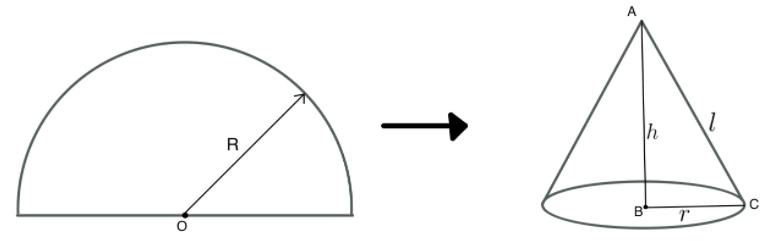
So to find the solution we need to know that the circumference of a circle is $$S=2\pi R$$............(1)
And the volume of a cone $$V=\dfrac{1}{3} \pi r^{2}h$$.........(2)
Where R is the radius of the semicircle and r is the radius of the base of the circular cone.
H and l is the height and slant height of the cone.
Complete step-by-step solution:
Here it is given the diameter of the semicircle is 28 cm.
Therefore the radius(R)= $$\dfrac{28}{2} \ cm=14\ cm$$.
Now this semi circular is converted into a conical cup and as we know that when a semi-circular sheet is bent to form an open conical cup, the radius of the sheet becomes the slant height of the cup and the circumference of the semi circular sheet becomes the circumference of the base of the cone.
Therefore, slant height of cup(l)= Radius of circular sheet((R) =14cm.
Now let us consider the height of the cone is h cm and the radius of the circular base is r cm.
Therefore we can write,
Circumference of the circular base of cone = circumference of semi circular sheet
$$\Rightarrow 2\pi r=\dfrac{2\pi R}{2}$$ [by formula (1)]
$$\Rightarrow 2\pi r=\pi R$$
$$\Rightarrow 2r=R$$ [canceling $$\pi$$ on the both side]
$$\Rightarrow 2r=14$$ [since, R=14 cm]
$$\Rightarrow r=\dfrac{14}{2}$$
$$\Rightarrow r=7$$
Therefore the radius of the cup is r =7 cm.
Now from the cone we can say that the triangle $$\triangle ABC$$ is forming a right angle triangle where $$\angle B$$ is $$90^{\circ }$$.
And as we know that for a right angle triangle we can use the Pythagorean theorem,
i.e, $$\left( \text{Height} \right)^{2} +\left( \text{Base} \right)^{2} =\left( \text{Hypotenuse} \right)^{2} $$
$$\Rightarrow \left( AB\right)^{2} +\left( BC\right)^{2} =\left( AC\right)^{2} $$
$$\Rightarrow h^{2}+r^{2}=l^{2}$$
$$\Rightarrow h^{2}+7^{2}=\left( 14\right)^{2} $$
$$\Rightarrow h^{2}=\left( 14\right)^{2} -7^{2}$$
$$\Rightarrow h^{2}=14\times 14-7\times 7$$
$$\Rightarrow h^{2}=196-46$$
$$\Rightarrow h^{2}=147$$
$$\Rightarrow h=\sqrt{147}$$
$$\Rightarrow h=\sqrt{7\times 7\times 3}$$
$$\Rightarrow h=7\sqrt{3}$$
Therefore the height of the cup is h = $$7\sqrt{3}$$ cm.
Now the capacity of the cup is equal to its volume.
Therefore the volume of the cup(cone),
$$V=\dfrac{1}{3} \pi r^{2}h$$ [by formula (2)]
$$=\dfrac{1}{3} \pi \times 7^{2}\times 7\sqrt{3}\ cm^{3}$$
$$=\dfrac{1}{3} \times \dfrac{22}{7} \times 7^{2}\times 7\sqrt{3}\ cm^{3}$$ [$$\because \pi =\dfrac{22}{7}$$]
$$=\dfrac{1}{3} \times 22\times 7^{2}\times \sqrt{3}\ cm^{3}$$
$$=\dfrac{1}{3} \times 22\times 49\times \sqrt{3}\ cm^{3}$$
$$=\dfrac{1}{3} \times 1078\times \sqrt{3}\ cm^{3}$$
$$=\dfrac{1078\sqrt{3} }{\sqrt{3} \times \sqrt{3} }\ cm^{3}$$ [$$\because a=\sqrt{a} \times \sqrt{a}$$]
$$=\dfrac{1078}{\sqrt{3} }\ cm^{3}$$
$$=622.383\ cm^{3}$$
Therefore the capacity of the conical cup is $$622.383\ cm^{3}$$.
Note: To solve this type of question you need to know the Pythagorean theorem which states that, for a right angle triangle the square of the hypotenuse is equal to the summation of the square of base and height.
Also circumference of a semicircle is nothing but the half of the circumference of a circle i.e $$\pi r$$.
So to find the solution we need to know that the circumference of a circle is $$S=2\pi R$$............(1)
And the volume of a cone $$V=\dfrac{1}{3} \pi r^{2}h$$.........(2)
Where R is the radius of the semicircle and r is the radius of the base of the circular cone.
H and l is the height and slant height of the cone.
Complete step-by-step solution:
Here it is given the diameter of the semicircle is 28 cm.
Therefore the radius(R)= $$\dfrac{28}{2} \ cm=14\ cm$$.
Now this semi circular is converted into a conical cup and as we know that when a semi-circular sheet is bent to form an open conical cup, the radius of the sheet becomes the slant height of the cup and the circumference of the semi circular sheet becomes the circumference of the base of the cone.
Therefore, slant height of cup(l)= Radius of circular sheet((R) =14cm.
Now let us consider the height of the cone is h cm and the radius of the circular base is r cm.
Therefore we can write,
Circumference of the circular base of cone = circumference of semi circular sheet
$$\Rightarrow 2\pi r=\dfrac{2\pi R}{2}$$ [by formula (1)]
$$\Rightarrow 2\pi r=\pi R$$
$$\Rightarrow 2r=R$$ [canceling $$\pi$$ on the both side]
$$\Rightarrow 2r=14$$ [since, R=14 cm]
$$\Rightarrow r=\dfrac{14}{2}$$
$$\Rightarrow r=7$$
Therefore the radius of the cup is r =7 cm.
Now from the cone we can say that the triangle $$\triangle ABC$$ is forming a right angle triangle where $$\angle B$$ is $$90^{\circ }$$.
And as we know that for a right angle triangle we can use the Pythagorean theorem,
i.e, $$\left( \text{Height} \right)^{2} +\left( \text{Base} \right)^{2} =\left( \text{Hypotenuse} \right)^{2} $$
$$\Rightarrow \left( AB\right)^{2} +\left( BC\right)^{2} =\left( AC\right)^{2} $$
$$\Rightarrow h^{2}+r^{2}=l^{2}$$
$$\Rightarrow h^{2}+7^{2}=\left( 14\right)^{2} $$
$$\Rightarrow h^{2}=\left( 14\right)^{2} -7^{2}$$
$$\Rightarrow h^{2}=14\times 14-7\times 7$$
$$\Rightarrow h^{2}=196-46$$
$$\Rightarrow h^{2}=147$$
$$\Rightarrow h=\sqrt{147}$$
$$\Rightarrow h=\sqrt{7\times 7\times 3}$$
$$\Rightarrow h=7\sqrt{3}$$
Therefore the height of the cup is h = $$7\sqrt{3}$$ cm.
Now the capacity of the cup is equal to its volume.
Therefore the volume of the cup(cone),
$$V=\dfrac{1}{3} \pi r^{2}h$$ [by formula (2)]
$$=\dfrac{1}{3} \pi \times 7^{2}\times 7\sqrt{3}\ cm^{3}$$
$$=\dfrac{1}{3} \times \dfrac{22}{7} \times 7^{2}\times 7\sqrt{3}\ cm^{3}$$ [$$\because \pi =\dfrac{22}{7}$$]
$$=\dfrac{1}{3} \times 22\times 7^{2}\times \sqrt{3}\ cm^{3}$$
$$=\dfrac{1}{3} \times 22\times 49\times \sqrt{3}\ cm^{3}$$
$$=\dfrac{1}{3} \times 1078\times \sqrt{3}\ cm^{3}$$
$$=\dfrac{1078\sqrt{3} }{\sqrt{3} \times \sqrt{3} }\ cm^{3}$$ [$$\because a=\sqrt{a} \times \sqrt{a}$$]
$$=\dfrac{1078}{\sqrt{3} }\ cm^{3}$$
$$=622.383\ cm^{3}$$
Therefore the capacity of the conical cup is $$622.383\ cm^{3}$$.
Note: To solve this type of question you need to know the Pythagorean theorem which states that, for a right angle triangle the square of the hypotenuse is equal to the summation of the square of base and height.
Also circumference of a semicircle is nothing but the half of the circumference of a circle i.e $$\pi r$$.
Recently Updated Pages
Basicity of sulphurous acid and sulphuric acid are

Master Class 10 Computer Science: Engaging Questions & Answers for Success
Master Class 10 Social Science: Engaging Questions & Answers for Success
Master Class 10 Science: Engaging Questions & Answers for Success
Class 10 Question and Answer - Your Ultimate Solutions Guide
Master Class 10 Maths: Engaging Questions & Answers for Success
Trending doubts
What is the Total Duration of Football Match?
Explain the Treaty of Vienna of 1815 class 10 social science CBSE
In football, which nation is called "La Roja"?
Why is there a time difference of about 5 hours between class 10 social science CBSE
10 examples of evaporation in daily life with explanations
What is the full form of POSCO class 10 social science CBSE