




A sector is cut from a circular sheet of radius 100 cm, the angle of the sector being 240°. If another circle of the area same as the sector is formed, the radius of the circle of the new radius is
(a) 79.5 cm
(b) 81.3 cm
(c) 83.4 cm
(d) 88.5 cm
Answer
 Verified
610.8k+ views
Hint: To understand the question better, we will first draw a figure of the circle and sector. We will then try to find the area of the sector. To find the area, we will compare the dimensions of the sector and compare it with the formula of area of circle, given by the relation ${{A}_{c}}=\pi {{r}^{2}}$. Once we find the formula, we will substitute the values and find the area of the sector. After finding the area of the sector, we will equate it to the area of the new circle. With the equation formed, we will find the new radius.
Complete step-by-step answer:
The diagram of the conditions given in the question is as follows:
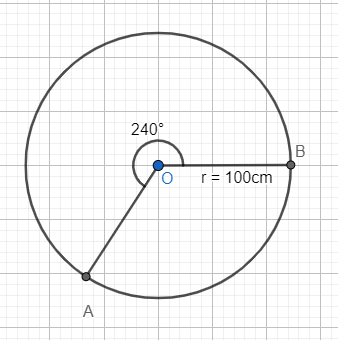
We can see that the centre of the circle is O and the radii are AO and BO. The length of the radius is 100 cm.
It is said that the major sector OAB is cut out from the circle.
The angle of the sector is 240°.
Now, we shall find the area of the sector.
We know that the area of the circle is given as ${{A}_{c}}=\pi {{r}^{2}}$, r is the radius of the circle.
We know that the angle of a circle is 360° or $2\pi $ radians.
So, for $2\pi $ radians, the area is $\pi {{r}^{2}}$.
Then, on comparing, area for $\theta $ will be given as $\dfrac{2\pi }{\theta }=\dfrac{\pi {{r}^{2}}}{{{A}_{s}}}$
Hence, area of the sector is given as ${{A}_{s}}=\dfrac{1}{2}{{r}^{2}}\theta $, where $\theta $ is the angle of sector in radians.
We know that the angle of sector in our question is 240°.
We shall convert this into radians. We know that 180° is equal to $\pi $. Hence, 240° will be given as $\dfrac{180}{240}=\dfrac{\pi }{\theta }$
Therefore, $\theta =\dfrac{4\pi }{3}$ radians.
We will substitute $\theta =\dfrac{4\pi }{3}$ and r = 100 in the formula for area of sector ${{A}_{s}}=\dfrac{1}{2}{{r}^{2}}\theta $.
$\begin{align}
& \Rightarrow {{A}_{s}}=\dfrac{1}{2}{{\left( 100 \right)}^{2}}\left( \dfrac{4}{3}\pi \right) \\
& \Rightarrow {{A}_{s}}=\dfrac{10000}{2}\left( \dfrac{4}{3}\pi \right) \\
\end{align}$
Now, it is given that a circle of the same area is formed. Let the radius of the circle be r.
We will equate the area of the circle with radius r and the area of sector and find the value of r.
$\begin{align}
& \Rightarrow \pi {{r}^{2}}=\dfrac{10000}{2}\left( \dfrac{4}{3}\pi \right) \\
& \Rightarrow {{r}^{2}}=10000\times \dfrac{4}{6} \\
& \Rightarrow r=100\times \dfrac{2}{\sqrt{6}} \\
& \Rightarrow r=100\times \dfrac{2}{2.4498} \\
& \Rightarrow r\approx 81.3 \\
\end{align}$
Therefore, the radius of the new circle is 81.3 cm.
So, the correct answer is “Option (b)”.
Note: To find the value of $\sqrt{6}$, we can multiply the value of $\sqrt{2}$ and $\sqrt{3}$, where $\sqrt{2}=1.41$ and $\sqrt{3}=1.73$. For problems from area and volumes, students must by heart values of $\sqrt{2}$ and $\sqrt{3}$, if not all the prime numbers.
Complete step-by-step answer:
The diagram of the conditions given in the question is as follows:
We can see that the centre of the circle is O and the radii are AO and BO. The length of the radius is 100 cm.
It is said that the major sector OAB is cut out from the circle.
The angle of the sector is 240°.
Now, we shall find the area of the sector.
We know that the area of the circle is given as ${{A}_{c}}=\pi {{r}^{2}}$, r is the radius of the circle.
We know that the angle of a circle is 360° or $2\pi $ radians.
So, for $2\pi $ radians, the area is $\pi {{r}^{2}}$.
Then, on comparing, area for $\theta $ will be given as $\dfrac{2\pi }{\theta }=\dfrac{\pi {{r}^{2}}}{{{A}_{s}}}$
Hence, area of the sector is given as ${{A}_{s}}=\dfrac{1}{2}{{r}^{2}}\theta $, where $\theta $ is the angle of sector in radians.
We know that the angle of sector in our question is 240°.
We shall convert this into radians. We know that 180° is equal to $\pi $. Hence, 240° will be given as $\dfrac{180}{240}=\dfrac{\pi }{\theta }$
Therefore, $\theta =\dfrac{4\pi }{3}$ radians.
We will substitute $\theta =\dfrac{4\pi }{3}$ and r = 100 in the formula for area of sector ${{A}_{s}}=\dfrac{1}{2}{{r}^{2}}\theta $.
$\begin{align}
& \Rightarrow {{A}_{s}}=\dfrac{1}{2}{{\left( 100 \right)}^{2}}\left( \dfrac{4}{3}\pi \right) \\
& \Rightarrow {{A}_{s}}=\dfrac{10000}{2}\left( \dfrac{4}{3}\pi \right) \\
\end{align}$
Now, it is given that a circle of the same area is formed. Let the radius of the circle be r.
We will equate the area of the circle with radius r and the area of sector and find the value of r.
$\begin{align}
& \Rightarrow \pi {{r}^{2}}=\dfrac{10000}{2}\left( \dfrac{4}{3}\pi \right) \\
& \Rightarrow {{r}^{2}}=10000\times \dfrac{4}{6} \\
& \Rightarrow r=100\times \dfrac{2}{\sqrt{6}} \\
& \Rightarrow r=100\times \dfrac{2}{2.4498} \\
& \Rightarrow r\approx 81.3 \\
\end{align}$
Therefore, the radius of the new circle is 81.3 cm.
So, the correct answer is “Option (b)”.
Note: To find the value of $\sqrt{6}$, we can multiply the value of $\sqrt{2}$ and $\sqrt{3}$, where $\sqrt{2}=1.41$ and $\sqrt{3}=1.73$. For problems from area and volumes, students must by heart values of $\sqrt{2}$ and $\sqrt{3}$, if not all the prime numbers.
Recently Updated Pages
Master Class 10 English: Engaging Questions & Answers for Success

Master Class 10 Social Science: Engaging Questions & Answers for Success
Master Class 10 Computer Science: Engaging Questions & Answers for Success
Class 10 Question and Answer - Your Ultimate Solutions Guide
Master Class 10 General Knowledge: Engaging Questions & Answers for Success
Master Class 10 Maths: Engaging Questions & Answers for Success
Trending doubts
What is the full form of NDA a National Democratic class 10 social science CBSE
Explain the Treaty of Vienna of 1815 class 10 social science CBSE
Who Won 36 Oscar Awards? Record Holder Revealed
Bharatiya Janata Party was founded in the year A 1979 class 10 social science CBSE
What is the median of the first 10 natural numbers class 10 maths CBSE
Why is it 530 pm in india when it is 1200 afternoon class 10 social science CBSE