




A second order lever:
A. reduces the effort required
B. increases the effort required
C. effort is equal to load
D. none of the above
Answer
 Verified
630.3k+ views
Hint: In this question we can apply the concept of lever mechanism. Lever mechanism is helpful for uplifting a heavy object with less effort. There are three things which are included in the lever system that are force, load and fulcrum.
Complete answer:
According to the position of load and the provided force with respect of the fulcrum, there are three types of lever presents in nature:
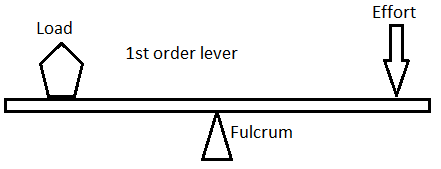
(I) first class lever
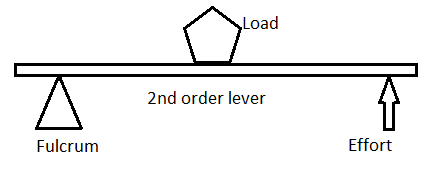
(II) second class lever
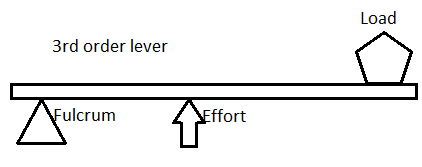
(III) third class lever
In the first order lever, the fulcrum is present between the input force and the output force. Its order is represented as input force, fulcrum and the output force. It is the most basic type of lever system. It increases the efficiency of the output force required. For example: seesaws, our hand , a wheel-axle and resting of our skull on the first and second vertebrae.
In the second order lever, the fulcrum is at one end and the input force is at the other end , the output force is situated in the middle of these two. The order is represented as fulcrum, output force and input force. For example: staplers, doors, nutcracker and nail clippers. So the second order lever reduces the effort required.
The third class lever is the lever in which the fulcrum is at one end, the input force is situated at the middle and the output force is on the other end. Its order is as follows: fulcrum, input force and output force. This lever requires more force to displace the load to a longer distance. Its examples are fishing rod, human jaw, a baseball and the bow- arrow.
So, the correct answer is “Option A”.
Note:
A lever is used to do some work with less effort that means a lever increases the input force to give the more output force. Once again, the further away the effort force is from the fulcrum and the output force or load the greater the advantage of the lever system.
Complete answer:
According to the position of load and the provided force with respect of the fulcrum, there are three types of lever presents in nature:
(I) first class lever
(II) second class lever
(III) third class lever
In the first order lever, the fulcrum is present between the input force and the output force. Its order is represented as input force, fulcrum and the output force. It is the most basic type of lever system. It increases the efficiency of the output force required. For example: seesaws, our hand , a wheel-axle and resting of our skull on the first and second vertebrae.
In the second order lever, the fulcrum is at one end and the input force is at the other end , the output force is situated in the middle of these two. The order is represented as fulcrum, output force and input force. For example: staplers, doors, nutcracker and nail clippers. So the second order lever reduces the effort required.
The third class lever is the lever in which the fulcrum is at one end, the input force is situated at the middle and the output force is on the other end. Its order is as follows: fulcrum, input force and output force. This lever requires more force to displace the load to a longer distance. Its examples are fishing rod, human jaw, a baseball and the bow- arrow.
So, the correct answer is “Option A”.
Note:
A lever is used to do some work with less effort that means a lever increases the input force to give the more output force. Once again, the further away the effort force is from the fulcrum and the output force or load the greater the advantage of the lever system.
Recently Updated Pages
The given figure shows two endocrine glands marked class 11 biology NEET_UG

Match columnI with columnII and select the correct class 11 biology NEET
Match column I with column II and select the correct class 11 biology NEET_UG
Which floral family has left 9 right + 1 arrangement class 11 biology NEET_UG
Which is not a variety of sheep A Lohi B Beetal C Nellore class 11 biology NEET_UG
Match column I with column II and select the correct class 11 biology NEET_UG
Trending doubts
One Metric ton is equal to kg A 10000 B 1000 C 100 class 11 physics CBSE
Draw a diagram of a plant cell and label at least eight class 11 biology CBSE
Difference Between Prokaryotic Cells and Eukaryotic Cells
Draw a well labelled diagram of reflex arc and explain class 11 biology CBSE
Two of the body parts which do not appear in MRI are class 11 biology CBSE
1 ton equals to A 100 kg B 1000 kg C 10 kg D 10000 class 11 physics CBSE