




A room is 6 meters 24 centimetres in length and 4 meters 32 centimetres in width. Find the least number of square tiles of equal size required to cover the entire floor of the room?
(a) 117
(b) 222
(c) 202
(d) 353
Answer
 Verified
629.7k+ views
Hint:Here, length and width of room is given in meter and centimetre. So, first convert it in one centimetre or meter. Further, we need to find a minimum number of tiles that covers the entire floor of the room. So, the concept of Highest common factor (HCF) will be applicable.
Complete step-by-step answer:
We are given a length of room as 6m 24cm which we will convert it to centimetre for easy calculation. So, we know 1m $=100$ cm. Therefore, for length 6m $=600$ cm which will be $=600+24=624cm$
Similarly, for width 4m $=400$ cm which will be $=400+32=432cm$
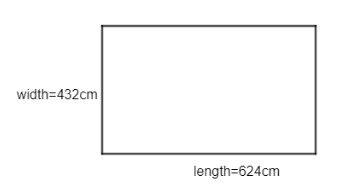
Now, we want the least number of tiles to cover the floor, so we need to find HCF for both length and width.
On finding H.C.F we will get:
H.C.F of 624
$\begin{align}
& \text{ }2\left| 624 \right. \\
& \text{ }2\left| 312 \right. \\
& \text{ }2\left| 156 \right. \\
& \text{ }2\left| 78 \right. \\
& \text{ }3\left| 39 \right. \\
& 13\left| 13 \right. \\
& \text{ 1} \\
\end{align}$
H.C.F of 432
$\begin{align}
& 2\left| 432 \right. \\
& 2\left| 216 \right. \\
& 2\left| 108 \right. \\
& 2\left| 54 \right. \\
& 3\left| 27 \right. \\
& 3\left| 9 \right. \\
& 3\left| 3 \right. \\
& \text{ 1} \\
\end{align}$
So, HCF of both 624 and 432 we have to find by taking all the common factors together which we will get as $=2\times 2\times 2\times 2\times 3=48$
Therefore, number of tiles will be equal to
$\dfrac{(length \times width)}{(\text{HCF of 624 and 432}) \times (\text{HCF of 624 and 432})}$
$=\dfrac{\left( 624\times 432 \right)}{\left( 48\times 48 \right)}=117$
Thus, 117 square tiles are required.
Hence, option (a) is correct.
Note: Students might get confused with least common multiple (LCM) and highest common factor (HCF). So, the concept of both these terms should be clear when and where to use them correctly. The HCF defines the greatest factor present in between given two or more numbers, whereas LCM defines the least number which is exactly divisible by two or more numbers. Now, instead of HCF if LCM is done then answer will be totally different i.e.
$\begin{align}
& 2\left| \!{\underline {\,
624,432 \,}} \right. \\
& 2\left| \!{\underline {\,
312,216 \,}} \right. \\
& 2\left| \!{\underline {\,
156,108 \,}} \right. \\
& 2\left| \!{\underline {\,
\text{ }78,\text{ }54 \,}} \right. \\
& 3\left| \!{\underline {\,
\text{ }39,\text{ }27 \,}} \right. \\
& 3\left| \!{\underline {\,
\text{ }13,\text{ }9 \,}} \right. \\
& 3\left| \!{\underline {\,
\text{ }13,\text{ }3 \,}} \right. \\
& 13\left| \!{\underline {\,
\text{ }13,\text{ }1 \,}} \right. \\
& \text{ 1, 1} \\
\end{align}$
So, LCM $=2\times 2\times 2\times 2\times 3\times 3\times 3\times 13=5616$
Complete step-by-step answer:
We are given a length of room as 6m 24cm which we will convert it to centimetre for easy calculation. So, we know 1m $=100$ cm. Therefore, for length 6m $=600$ cm which will be $=600+24=624cm$
Similarly, for width 4m $=400$ cm which will be $=400+32=432cm$
Now, we want the least number of tiles to cover the floor, so we need to find HCF for both length and width.
On finding H.C.F we will get:
H.C.F of 624
$\begin{align}
& \text{ }2\left| 624 \right. \\
& \text{ }2\left| 312 \right. \\
& \text{ }2\left| 156 \right. \\
& \text{ }2\left| 78 \right. \\
& \text{ }3\left| 39 \right. \\
& 13\left| 13 \right. \\
& \text{ 1} \\
\end{align}$
H.C.F of 432
$\begin{align}
& 2\left| 432 \right. \\
& 2\left| 216 \right. \\
& 2\left| 108 \right. \\
& 2\left| 54 \right. \\
& 3\left| 27 \right. \\
& 3\left| 9 \right. \\
& 3\left| 3 \right. \\
& \text{ 1} \\
\end{align}$
So, HCF of both 624 and 432 we have to find by taking all the common factors together which we will get as $=2\times 2\times 2\times 2\times 3=48$
Therefore, number of tiles will be equal to
$\dfrac{(length \times width)}{(\text{HCF of 624 and 432}) \times (\text{HCF of 624 and 432})}$
$=\dfrac{\left( 624\times 432 \right)}{\left( 48\times 48 \right)}=117$
Thus, 117 square tiles are required.
Hence, option (a) is correct.
Note: Students might get confused with least common multiple (LCM) and highest common factor (HCF). So, the concept of both these terms should be clear when and where to use them correctly. The HCF defines the greatest factor present in between given two or more numbers, whereas LCM defines the least number which is exactly divisible by two or more numbers. Now, instead of HCF if LCM is done then answer will be totally different i.e.
$\begin{align}
& 2\left| \!{\underline {\,
624,432 \,}} \right. \\
& 2\left| \!{\underline {\,
312,216 \,}} \right. \\
& 2\left| \!{\underline {\,
156,108 \,}} \right. \\
& 2\left| \!{\underline {\,
\text{ }78,\text{ }54 \,}} \right. \\
& 3\left| \!{\underline {\,
\text{ }39,\text{ }27 \,}} \right. \\
& 3\left| \!{\underline {\,
\text{ }13,\text{ }9 \,}} \right. \\
& 3\left| \!{\underline {\,
\text{ }13,\text{ }3 \,}} \right. \\
& 13\left| \!{\underline {\,
\text{ }13,\text{ }1 \,}} \right. \\
& \text{ 1, 1} \\
\end{align}$
So, LCM $=2\times 2\times 2\times 2\times 3\times 3\times 3\times 13=5616$
Recently Updated Pages
Master Class 11 English: Engaging Questions & Answers for Success

Master Class 11 Maths: Engaging Questions & Answers for Success
Class 11 Question and Answer - Your Ultimate Solutions Guide
Master Class 11 Biology: Engaging Questions & Answers for Success
Master Class 11 Physics: Engaging Questions & Answers for Success
Master Class 11 Accountancy: Engaging Questions & Answers for Success
Trending doubts
Differentiate between an exothermic and an endothermic class 11 chemistry CBSE
One Metric ton is equal to kg A 10000 B 1000 C 100 class 11 physics CBSE
Difference Between Prokaryotic Cells and Eukaryotic Cells
There are 720 permutations of the digits 1 2 3 4 5 class 11 maths CBSE
Draw a diagram of a plant cell and label at least eight class 11 biology CBSE
1 Quintal is equal to a 110 kg b 10 kg c 100kg d 1000 class 11 physics CBSE