




A rod is non uniform mass per unit length as μ varies linearly over distance x from one end of the rod as per relation \[\mu = ax\] (a is a constant). If its total mass is M and length l, the distance of centre of mass of rod from the end is given by
A. \[\dfrac{3}{4}l\]
B. \[\dfrac{2}{3}l\]
C. \[\dfrac{2}{5}l\]
D. \[\dfrac{l}{3}\]
Answer
 Verified
619.5k+ views
Hint:The centre of mass of a body can be defined as a point where the whole mass of the body appeared to be concentrated. To find the solution, you should first differentiate the relation given in the question and then substitute its value when Integrating.
Complete step by step answer:
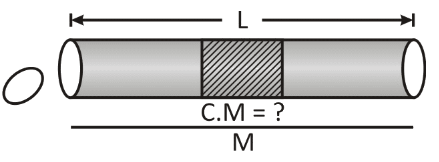
\[{X_{cm}} = \dfrac{{\int_0^L {xdm} }}{{\int_0^L {dm} }}\]
Here, Now Substituting $dm = axdx$ , we will get
\[{X_{cm}} = \dfrac{{\int_0^L {xaxdx} }}{{\int_0^L {axdx} }}\]
Therefore,
\[{X_{cm}} = a\times \dfrac{1}{a}\dfrac{{\int_0^L {{x^2}dx} }}{{\int_0^L {xdx} }}\]
\[\Rightarrow{X_{cm}} = {\left[ {\dfrac{{\dfrac{{{x^3}}}{3}}}{{\dfrac{{{x^2}}}{2}}}} \right]^L}_0\]
\[\Rightarrow{X_{cm}} = \dfrac{{\dfrac{{{L^3}}}{3}}}{{\dfrac{{{L^2}}}{2}}}\]
\[\therefore {X_{cm}}= \dfrac{2}{3}L\]
So, the Correct Answer is B.
Additional information:
Centre of mass of a body or system of a particle is defined as, a point at which the whole of the mass of the body or all the masses of a system of particles appears to be concentrated.
Motion of this unique point is identical to the motion of a single particle whose mass is equal to the sum of all individual particles of the system and the resultant of all the forces exerted on all the particles of the system by surrounding bodies (or) action of a field of force is exerted directly to that particle. This point is called the centre of mass of the system of particles. The concept of centre of mass (COM) is useful in analyzing the complicated motion of the system of objects, particularly When two and more objects collide or an object explodes into fragments.
Note:If the given object is not discrete and their distances are not specific, then center of mass can be found by considering an infinitesimal element of mass (dm) at a distance x, y and z from the origin of the chosen coordinate system.Mass is both a property of a physical body and a measure of its resistance to acceleration (a change in its state of motion) when a net force is applied. An object's mass also determines the strength of its gravitational attraction to other bodies.
Complete step by step answer:
\[{X_{cm}} = \dfrac{{\int_0^L {xdm} }}{{\int_0^L {dm} }}\]
Here, Now Substituting $dm = axdx$ , we will get
\[{X_{cm}} = \dfrac{{\int_0^L {xaxdx} }}{{\int_0^L {axdx} }}\]
Therefore,
\[{X_{cm}} = a\times \dfrac{1}{a}\dfrac{{\int_0^L {{x^2}dx} }}{{\int_0^L {xdx} }}\]
\[\Rightarrow{X_{cm}} = {\left[ {\dfrac{{\dfrac{{{x^3}}}{3}}}{{\dfrac{{{x^2}}}{2}}}} \right]^L}_0\]
\[\Rightarrow{X_{cm}} = \dfrac{{\dfrac{{{L^3}}}{3}}}{{\dfrac{{{L^2}}}{2}}}\]
\[\therefore {X_{cm}}= \dfrac{2}{3}L\]
So, the Correct Answer is B.
Additional information:
Centre of mass of a body or system of a particle is defined as, a point at which the whole of the mass of the body or all the masses of a system of particles appears to be concentrated.
Motion of this unique point is identical to the motion of a single particle whose mass is equal to the sum of all individual particles of the system and the resultant of all the forces exerted on all the particles of the system by surrounding bodies (or) action of a field of force is exerted directly to that particle. This point is called the centre of mass of the system of particles. The concept of centre of mass (COM) is useful in analyzing the complicated motion of the system of objects, particularly When two and more objects collide or an object explodes into fragments.
Note:If the given object is not discrete and their distances are not specific, then center of mass can be found by considering an infinitesimal element of mass (dm) at a distance x, y and z from the origin of the chosen coordinate system.Mass is both a property of a physical body and a measure of its resistance to acceleration (a change in its state of motion) when a net force is applied. An object's mass also determines the strength of its gravitational attraction to other bodies.
Recently Updated Pages
Basicity of sulphurous acid and sulphuric acid are

Master Class 11 English: Engaging Questions & Answers for Success
Master Class 11 Physics: Engaging Questions & Answers for Success
Master Class 11 Computer Science: Engaging Questions & Answers for Success
Master Class 11 Chemistry: Engaging Questions & Answers for Success
Master Class 11 Social Science: Engaging Questions & Answers for Success
Trending doubts
Difference Between Prokaryotic Cells and Eukaryotic Cells
Two of the body parts which do not appear in MRI are class 11 biology CBSE
One Metric ton is equal to kg A 10000 B 1000 C 100 class 11 physics CBSE
10 examples of friction in our daily life
Draw a diagram of nephron and explain its structur class 11 biology CBSE
What will happen if the mucus is not secreted by the class 11 biology CBSE